


You Booked the Flight. They Took the Card.
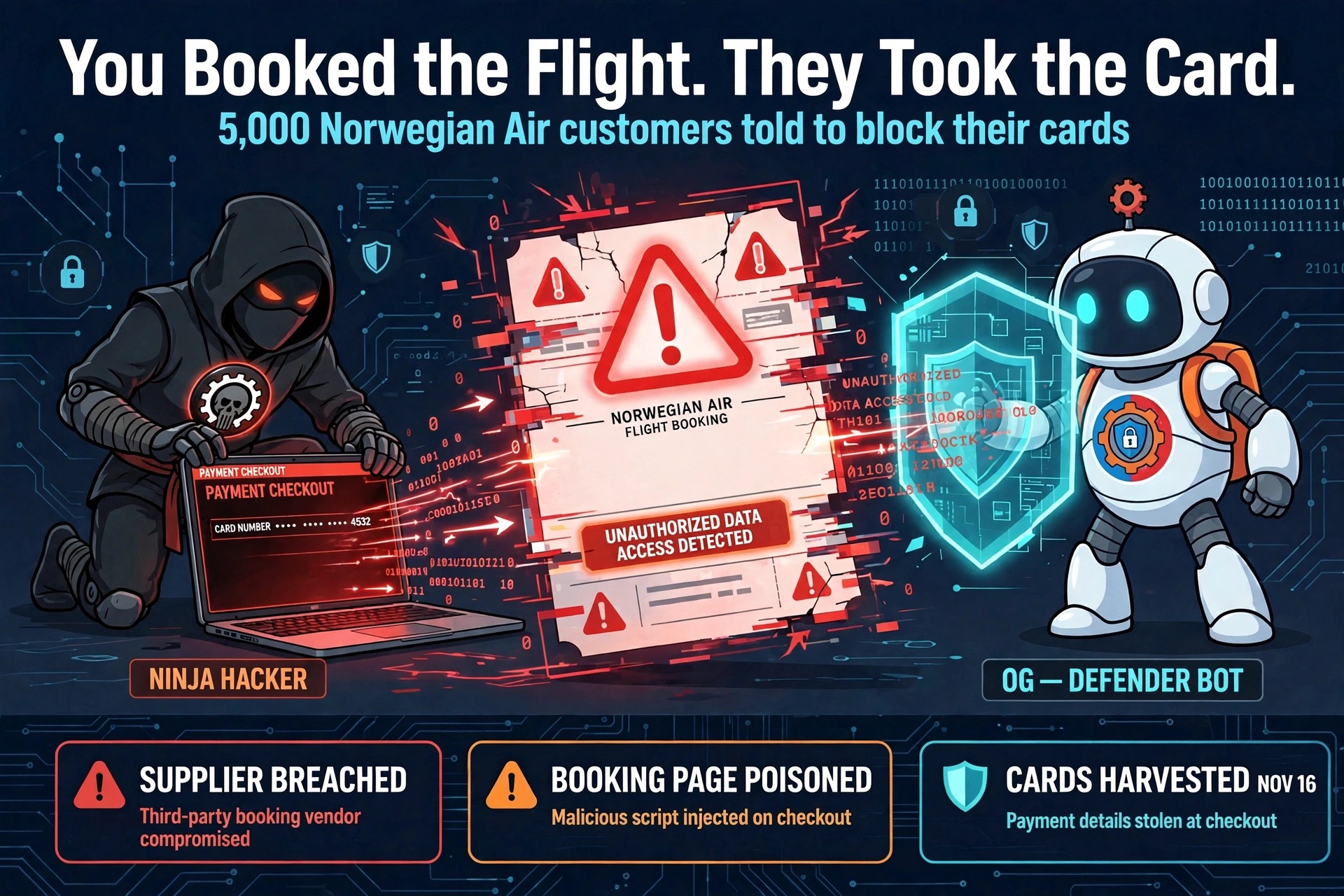
Norwegian Air has told around 5,000 customers in Norway and Sweden to block their bank cards after hackers stole payment details from the airline’s booking websites. The breach was not in Norwegian’s own systems. Attackers broke into an external IT supplier, injected malicious code into the booking pages, and harvested card numbers, expiry dates, and CVC security codes as travelers paid for flights.
The airline confirmed the incident on Thursday, November 19. The malicious code ran for a very short window — Monday morning and evening, November 16 — which limits how many travelers were exposed. Anyone who entered payment details during those hours may have had their card data stolen, and Norwegian says it has contacted the affected customers directly, urging them to block the cards they used for those bookings. “This is the only and most effective measure to prevent misuse of your card,” the notification reportedly states.
How the booking page became a skimmer
This is a supply-chain attack wearing a familiar disguise. The attackers never touched Norwegian’s internal systems, its servers, or its mobile app — the airline says all three were untouched, and online bookings are safe again now. Instead they compromised the outside supplier that powers part of the booking flow, then planted code on the pages where customers type their card details. It is the same playbook as a card skimmer on a payment terminal, moved onto the web: the page looks exactly like the airline’s own, the payment goes through, and a copy of the card goes to the attacker.
The difference here is the harvest. A skimmer on one terminal catches whoever walks past it. Poisoned booking code catches everyone who checks out while it is live — and because the window was two short bursts on a single Monday, Norwegian can draw a tight line around who is at risk. That precision is the one piece of good news in the story: the airline knows the dates, the hours, and the customers, and it is telling each of them to kill the card now, before the data is used. We have seen the same skimmer playbook before — a payment-card skimmer on Fandango’s checkout harvested cards the same way, silently, while every purchase looked normal.

What was taken
Card number, expiry date, and CVC — the three fields that together are enough to charge a card online. That is the full set a fraudster needs for card-not-present purchases, which is why Norwegian’s advice is to block, not to watch and wait. A blocked card cannot be charged, whatever the attacker holds. Monitoring statements helps, but it is a detection step after the fact; blocking is the prevention step.
What the attackers did not get matters too. Norwegian says its own systems were not compromised, so this is not a breach of the airline’s customer database. There is no indication of names, addresses, or account credentials in the haul — the code sat on the payment page and took what passed through it.
Two hundred companies may be next
The incident may not stop at Norwegian. The airline says around 200 companies worldwide may have been affected by the attack on the same external supplier, which it has not named. That is the part of the story to watch: one compromised supplier can quietly poison the booking or payment pages of many customers at once, and the other victims may not know yet that their pages were touched.
Norwegian’s press contact, Eline Hyggen Skari, told local media: “We find this very unfortunate, but we acted immediately and had the affected technology deactivated as quickly as possible.” The investigation is ongoing, and Norwegian authorities have been notified.
It is also the second airline-linked supplier incident in Norway in a month. Earlier in November, Norway’s National Security Authority warned businesses about a separate incident involving travel technology provider Amadeus IT Group, where a threat actor had maintained access to supplier booking systems for at least three years — exposing passport numbers, travel itineraries, contact details, and seat information. That breach lasted three years before it was found. The two incidents are separate, but the pattern is the same: the booking chain is only as strong as its weakest supplier.

What to do now
If you booked a Norwegian flight on Monday, November 16 — morning or evening — and paid by card on the website, block that card now and request a replacement. Do not wait for a fraudulent charge to appear. Check recent statements for anything you do not recognize, and if you see a charge you did not make, report it to your bank immediately.
And treat any follow-up message about the breach with suspicion. Attackers holding fresh card data often follow up with phishing calls and emails that reference the real incident to sound legitimate. Norwegian will not ask you to confirm card details by email or text to “secure” your account — if a message asks for them, it is not from the airline.
The lesson for everyone else is the supply-chain one: the page you trust can be poisoned upstream, by a vendor you have never heard of. Norwegian caught this one fast and drew the line tight. The 200 other companies sharing that supplier may not have yet.
Source: Cybernews.