






Two Months In. The Patch Just Landed.
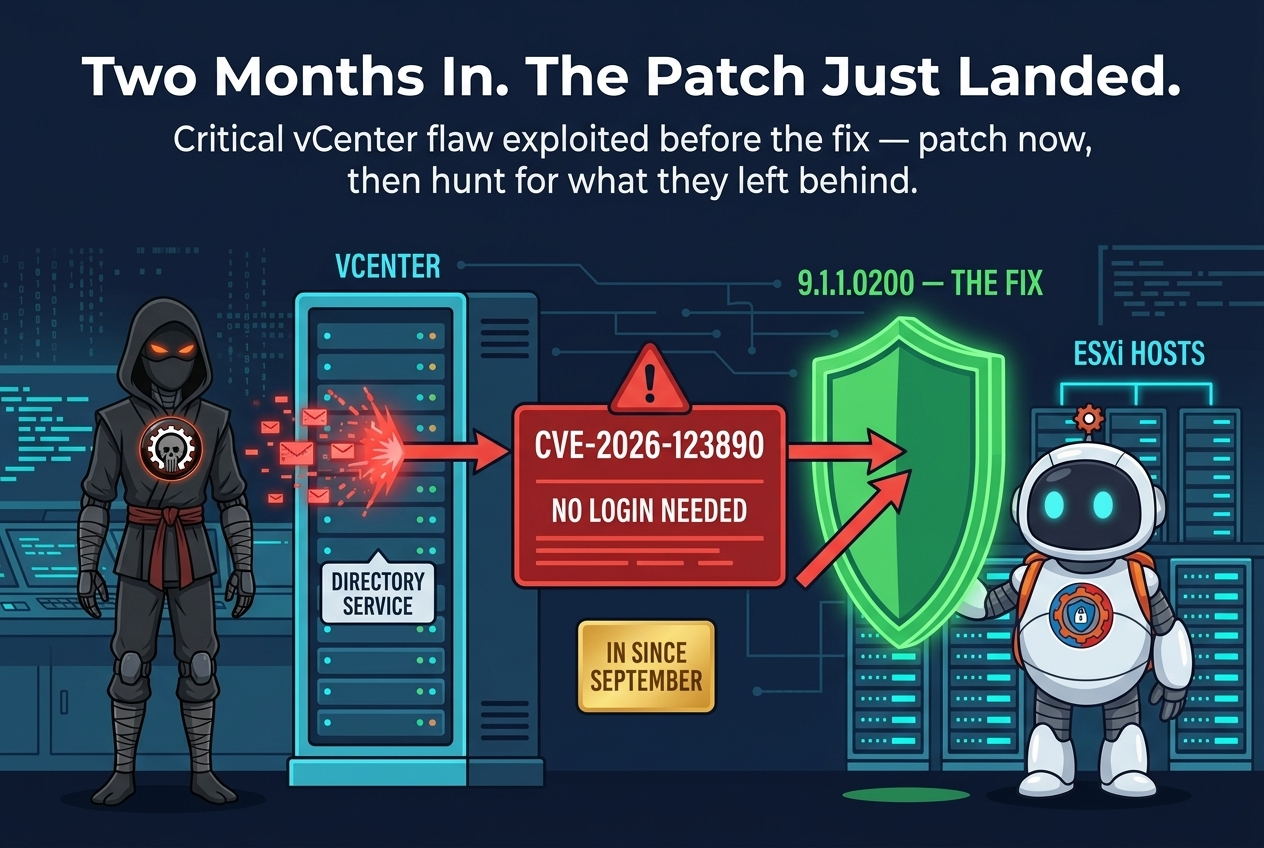
Broadcom patched a critical VMware vCenter flaw on Thursday — and the attackers were already inside. The flaw, CVE-2026-123890, scores 9.8 out of 10 and lets anyone with network access to vCenter bypass authentication and walk away with an administrator session. No workaround exists. Broadcom’s FAQ calls the fix an “emergency change” and urges customers to consult security staff immediately on timing.
The flaw sits in the VMware Directory Service, which handles identity inside vCenter. An attacker who can reach vCenter needs no username, password, or stolen token — they bypass the login and gain an administrator session, the keys to every VM, datastore, and host vCenter manages.
Who is affected
The fixed builds are vCenter 9.1.1.0200, 9.0.2.0200, and 8.0 U3m, released November 19 under advisory VMSA-2026-0009. All supported lines are affected: 8.0, 9.0, 9.1, plus vCenter inside VMware Cloud Foundation, vSphere Foundation, and the Telco Cloud products, including older Cloud Foundation 5.x. Enhanced Linked Mode makes no difference.
Older releases fare worse: 6.5 and 6.7 are presumed affected but no longer evaluated, and 7.0 left general support in October 2025, so its patch needs an extended support contract. Updates are cumulative, not via Quick Patch. VMs keep running during the update, management access drops briefly, and some Standard Key Provider encryption ops pause until vCenter is back.
The ordering trap: installing 8.0 U3m or 9.0.2.0200 blocks a later upgrade to VCF 9.1.1 — upgrade vCenter to 9.1.1 first and patch there, or wait for VCF 9.1.2.
They were in two months before the patch
Broadcom’s advisory says nothing about exploitation. That comes from Mandiant and Google’s Threat Intelligence Group, whose report “ARMORY CASTLE Exploits vSphere” says the group — formerly UNC5221, a suspected China-nexus actor also called Warp Panda — exploited the flaw in early September 2026, more than two months before the patch. They entered through the BeyondTrust Remote Support zero-day CVE-2026-102764, moved laterally to vCenter, and deployed a custom Go tool called BONESAW.
BONESAW did not just open a door. It stole the LMDB database, extracted the SAML signing material, and created a vSphere SSO administrator account — access that survives the patch. Mandiant has evidence the group knew of the flaw before the July 29 disclosure of CVE-2026-59309, and BONESAW hit a server already patched for that flaw. Mandiant CTO Charles Carmakal said the company investigated multiple incidents. BONESAW works against vCenter 7.x and 8.x, and the flaw is not in CISA’s Known Exploited Vulnerabilities catalog as of version 2026.11.18. Same group as the firewall-breach-and-wiper campaign we covered earlier this month — same playbook.

The second critical flaw this year
This is the second critical authentication flaw in the VMware Directory Service this year. The July 29 disclosure included CVE-2026-59309, another 9.8 bypass in the same component, plus CVE-2026-59310, a directory traversal flaw. Attacks on the traversal flaw began five days after disclosure; German firm QUIRSO linked them with moderate confidence to a suspected China-nexus actor, and roughly 361 IPs in 47 countries were hit, with Babuk-derived ransomware on ESXi hosts.
Four more flaws
VMSA-2026-0009 carries four others, all less severe. CVE-2026-123891 is SQL injection and CVE-2026-123892 command injection, both in SDDC Manager; CVE-2026-123893 escalates to root on the SDDC Manager appliance; CVE-2026-123894 is a SAML token signature bypass in VMware Tools for Windows, only where Guest Alias mapping is configured. Each needs a privileged actor already inside; the last stays in the guest VM. None lets code run on an ESX host from inside a VM, and ESX itself is not affected.
Why it matters
vCenter is the control plane for the whole virtual estate. An administrator session there is not one compromised server — it is every server, datastore, and virtual machine it manages, plus accounts and signing material that outlive the patch. BONESAW’s lesson: the attackers stole the identity material that lets them return through the front door. Patching stops the next attacker. It does nothing about the accounts and keys the last attacker already made — which is why the fix has two halves, and the second half is hunting.
What to do now
Patch, in the right order. Move to 9.1.1.0200, 9.0.2.0200, or 8.0 U3m now — Broadcom calls this an emergency change, not a routine update. Cloud Foundation shops: upgrade vCenter to 9.1.1 first and patch there, or wait for VCF 9.1.2. vSphere 7.0 needs an extended support contract.
Hunt for BONESAW’s footprints. Check the Mandiant/GTIG indicators, audit vSphere SSO for administrator accounts nobody recognizes, and review the SAML signing material — if it was stolen, rotate it. Stolen signing material is the same prize attackers chased in the Log4Shell signing-server compromise: whoever holds the keys can mint trust.

Check the way in, not just the target. The attackers entered through a BeyondTrust Remote Support zero-day — if that product is in your environment, treat it as part of the same incident and review its logs, sessions, and patch state alongside vCenter’s.
Assume compromise if vCenter was reachable. Any exposed vCenter on an affected build before November 19 is breached until the hunt proves otherwise — check ESXi hosts for the Babuk-derived ransomware from July, rotate credentials and signing material, and don’t close the incident when the patch finishes. The patch ends the vulnerability. Only the hunt ends the incident.
Two months in, the patch just landed. Patch fast — then look for what they left behind.