









No Login. No Click. Code Anyway.
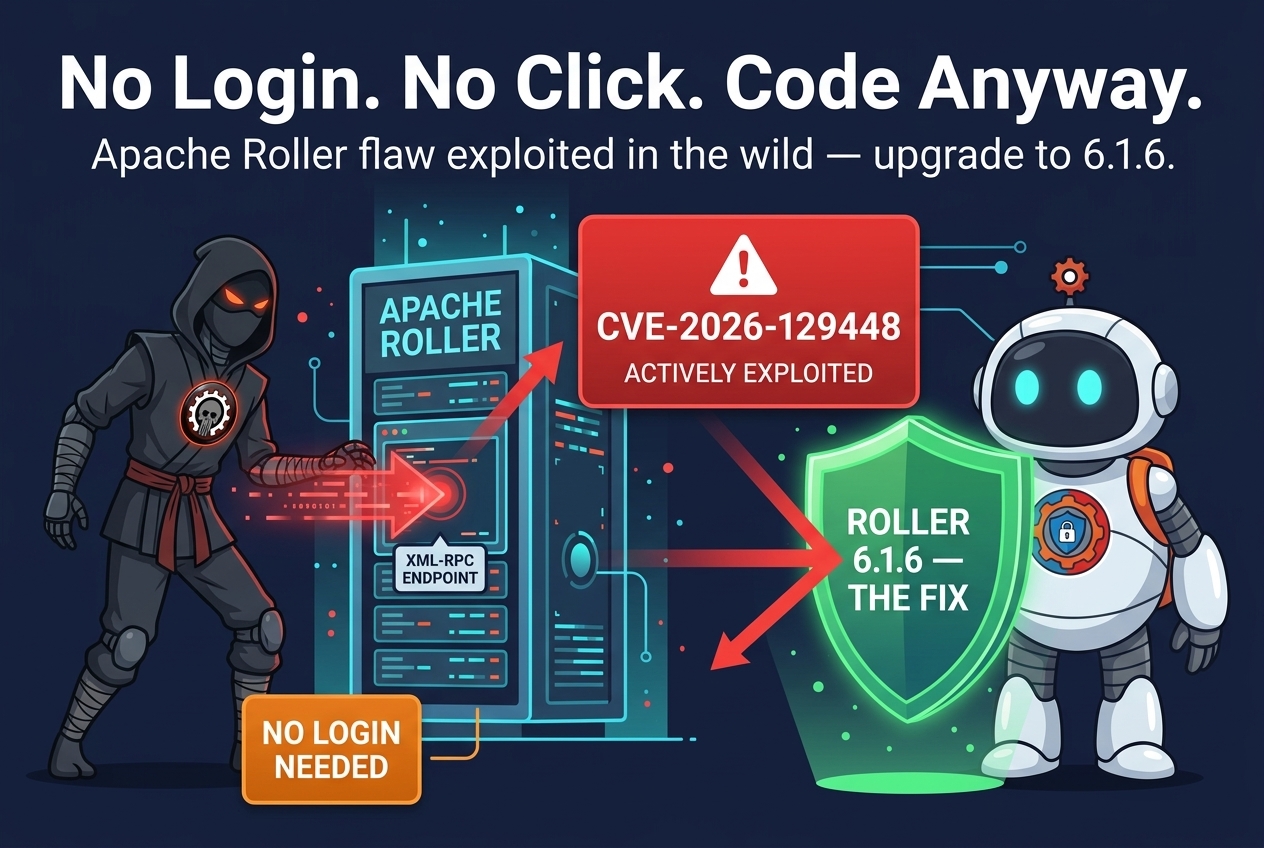
Apache has issued a warning that should make any admin still running old blogging software sit up straight. A critical flaw in Apache Roller, tracked as CVE-2026-129448, lets an attacker run their own code on a vulnerable server — no login, no click, no password needed. Apache says the flaw is already being exploited in the wild, and it has not said who is behind the attacks or how many servers are affected.
Roller is an open-source, Java-based group-blogging server. It holds a much smaller share of the web than modern content platforms, and that is exactly why this one is easy to miss: the servers still running it tend to be old, lightly watched, and forgotten about until something breaks. That is the worst kind of target for an unauthenticated remote code execution flaw — the kind of bug that turns a forgotten box into a foothold.
How the flaw works
The bug lives in Roller’s XML-RPC endpoint — the part of the server that accepts remote procedure calls, a way for other software to talk to the blog over the web. The endpoint accepts vendor extension types, a special kind of data it is built to handle, and it deserializes them — unpacks the incoming data into objects the server can use — before it ever checks whether the requester is authenticated. An attacker can send a crafted request and have the server run their code for them, all before any login check happens.
Apache says this is the same vulnerability as CVE-2026-82384, an earlier listing that named only Roller 6.1.5 as affected. The corrected picture is wider: every version from 4.0.0 through 6.1.4 is vulnerable. If your Roller install is anywhere in that range, assume it is exposed.

Why it matters
The bar for exploiting this flaw is about as low as it gets. There is no credential to steal first, no phishing email to send, no user to trick. Any server with the endpoint reachable from the internet is a candidate, and the only thing standing between an attacker and code execution is whether they have found it yet. Apache’s active-exploitation flag means somebody already has.
Once code runs on the server, the attacker is inside. From there they can plant a backdoor, read or alter the blog’s database, steal stored credentials, or use the server as a stepping stone into the rest of the network. A blogging server rarely holds the crown jewels itself — but it can hold the door open to the systems that do.
The timing fits a pattern. In April, CISA flagged a 13-year-old Apache ActiveMQ flaw, CVE-2026-34197, as exploited and ordered federal agencies to secure their systems within two weeks. Earlier this month, Apache patched a 9.8 flaw in its HTTP Server that also allowed unauthenticated code execution. Since November 2021, CISA has added 41 Apache flaws to its exploited-vulnerabilities catalog, and eight of those were also abused by ransomware gangs.
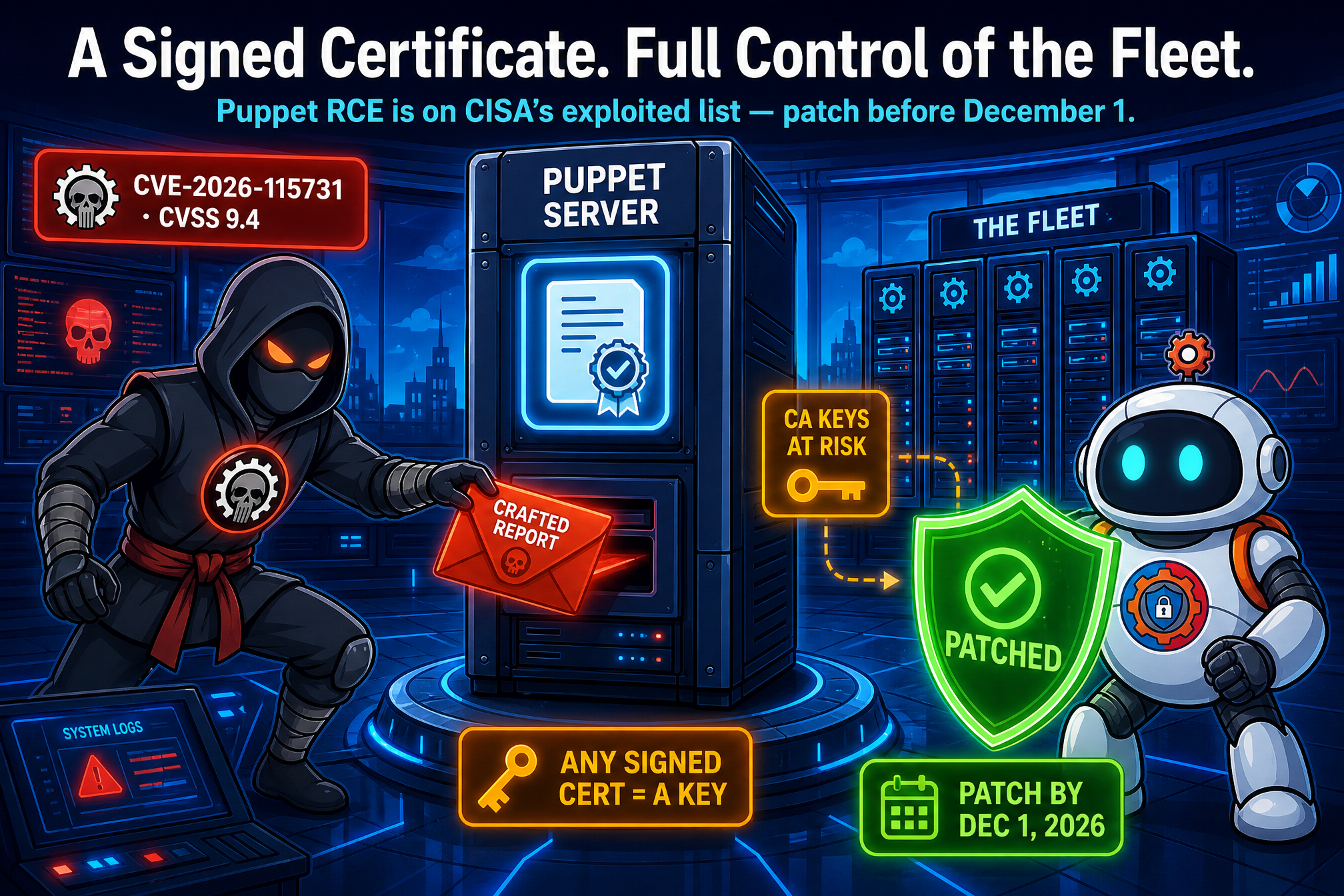
One detail worth stating plainly: CISA has NOT yet added CVE-2026-129448 to that catalog. The active-exploitation warning comes from Apache itself, not from CISA. That does not make it less urgent — it means the formal catalog entry, and the patch deadlines that come with it, may still be on their way. The same lesson played out when a signed-certificate flaw gave attackers full control of managed fleets: by the time a flaw lands on the official list, attackers have usually had a head start.
What to do now
1. Upgrade to Roller 6.1.6 or later. Version 6.1.6 disables the extension types and rejects malicious XML-RPC requests — and it turns the XML-RPC feature off. This is the fix. Everything else is a stopgap.
2. If you cannot upgrade yet, block the endpoint by hand. Set enabledForExtensions to false in WEB-INF/web.xml, remove the /roller-services/xmlrpc servlet mapping, and restart Roller. All three steps matter — skipping the restart leaves the old behavior running.
3. Do not trust the admin UI toggle. Disabling XML-RPC in the admin interface is not enough on older versions. The server deserializes the request before it checks whether that setting is on, so the toggle never gets a chance to stop the attack.
4. Check whether the endpoint is exposed. Find out whether the XML-RPC endpoint is reachable from the internet at all. If the service is only reachable inside your network, your exposure is far smaller — but check, do not assume. A firewall rule written years ago is not a guarantee.
5. Hunt for signs of compromise. On any Roller server, look for processes, files, or scheduled jobs you do not recognize, and check the logs for odd XML-RPC requests. Apache has not said how many servers are compromised, so assume nothing and look.

The bottom line
Roller is niche software, but that is not protection — it is the opposite. Niche, forgotten servers are the ones that stay unpatched the longest, and this flaw needs no credentials at all. Upgrade to 6.1.6, or shut the endpoint down properly today. The attackers are already moving, and the fix is already out.