











150 Million Photos. No Password Needed.
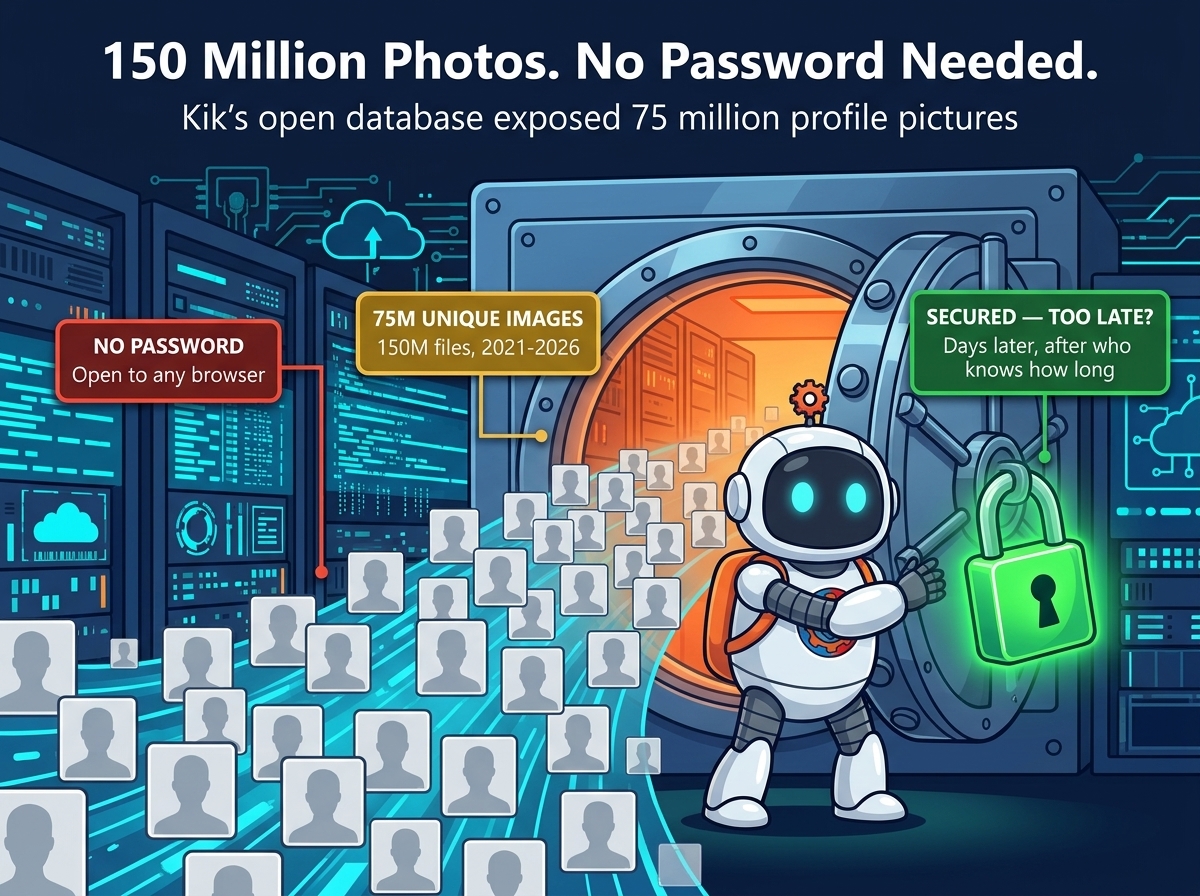
A messaging app used by millions of teenagers left more than 150 million profile pictures sitting in a cloud database with no password and no encryption. Anyone with the link could open it in a web browser and look through the photos. That is what security researcher Jeremiah Fowler found this week — one of the largest image exposures ever tied to a single app.
Fowler found the database while researching cloud storage exposures. The collection held a little more than 150 million image files — thumbnails and originals adding up to roughly 75 million unique pictures, spanning 2021 through 2026. The files appeared to be Kik profile pictures. What tied them to Kik was the hosting: the database name and a subfolder on a Kik-associated subdomain pointed straight at the app.
Most of the images appeared to show children or teenagers. The app has around 15 million active users and more than 120 million registered accounts, and more than one-third of American teens use it. Kik built its audience on anonymity. It has historically not required email or phone verification to sign up, and it relies on reactive reviews rather than tools that monitor for underage users.
In a sample of 2,000 images, Fowler found that 66 appeared to contain child sexual abuse material. He immediately reported the suspected material to the National Center for Missing & Exploited Children (NCMEC) and to the Connecticut Attorney General’s office. That is the finding, stated plainly.

How an open database stays open
There was no hack to pull off. The database was not password-protected and the files were not encrypted. The photos were viewable through the direct hosting URL in any browser, and the Kik subdomain subfolder made the collection easy to find for anyone poking around. Fowler found something left in the open and reported it.
The database was quietly secured several days after Fowler found it. Nobody can say yet how long it sat exposed, whether anyone else accessed it, or even who ran it — Kik, MediaLab AI, a contractor, or a third-party provider. A database nobody claims is a database nobody was watching.
The silence, and the investigation already underway
MediaLab AI, Kik’s parent company, did not respond to Fowler. His emails bounced, and a support ticket went unanswered. Connecticut’s Attorney General was already investigating the company. In September, the AG’s office announced an official state investigation into MediaLab AI, describing the platform, in the AG’s words, as a “predator’s paradise” and a “parent’s worst nightmare” over child safety and moderation concerns. The exposure lands on top of a company already under scrutiny for exactly this kind of failure.
The pattern is familiar. A leak of 125 million text messages showed the same failure: a database left open to the internet with no authentication at all. And breaches can sit undiscovered for years — a breach that ran for three years before anyone noticed at Finnair shows how long exposure can go uncounted. The difference here is who is in the pictures.
Why it matters even without names or passwords
The images contain no names, email addresses, or passwords. That does not make them harmless. A face is an identifier. Faces from this collection could be fed into facial-recognition systems for impersonation, stalking, or harassment, or used to train AI systems without the consent of the people pictured. For teenagers, a profile photo taken at 13 can follow them for years.
The scale is what turns a configuration mistake into a crisis. Seventy-five million unique images is not a leak of a few accounts. It is a population. And because it spans five years, it captures people as they grew up, changing photos as they went.

What to do now
1. Talk to your kids about the apps they actually use. Ask which messaging apps are on their phone, who they talk to there, and whether strangers can reach them. Kik’s appeal is anonymity — that is the feature to talk about. If your child uses Kik, ask what their profile picture is and who can see it.
2. Audit the photos. Go through your family’s apps and delete old profile pictures you no longer need. A photo that is not stored anywhere cannot leak. Review privacy settings together and remove contacts your child does not know in real life.
3. Check what your child shares, and with whom. Turn off anything that makes a profile public by default, and make sure location sharing is off in every messaging app, not just Kik.
4. Report suspected exploitation. If you come across material that appears to show the sexual exploitation of a child, report it to NCMEC’s CyberTipline at report.cybertip.org. Do not download it, share it, or investigate it yourself — report it and let the professionals handle it.
Kik’s parent company has not commented. The Connecticut investigation continues, and the questions Fowler raised — how long the database was open, who else saw it — still have no answers. Until they do, the practical lesson stands: assume any photo you upload can end up somewhere you did not intend. For parents of teenagers, that conversation cannot wait for a company’s reply.