



A Third of France. Their Mail Was Already Open.
Imagine learning that a company you have never heard of has been handling your mail for years — and that someone broke into it two months ago. That is the position roughly 22 million people in France woke up to this week.
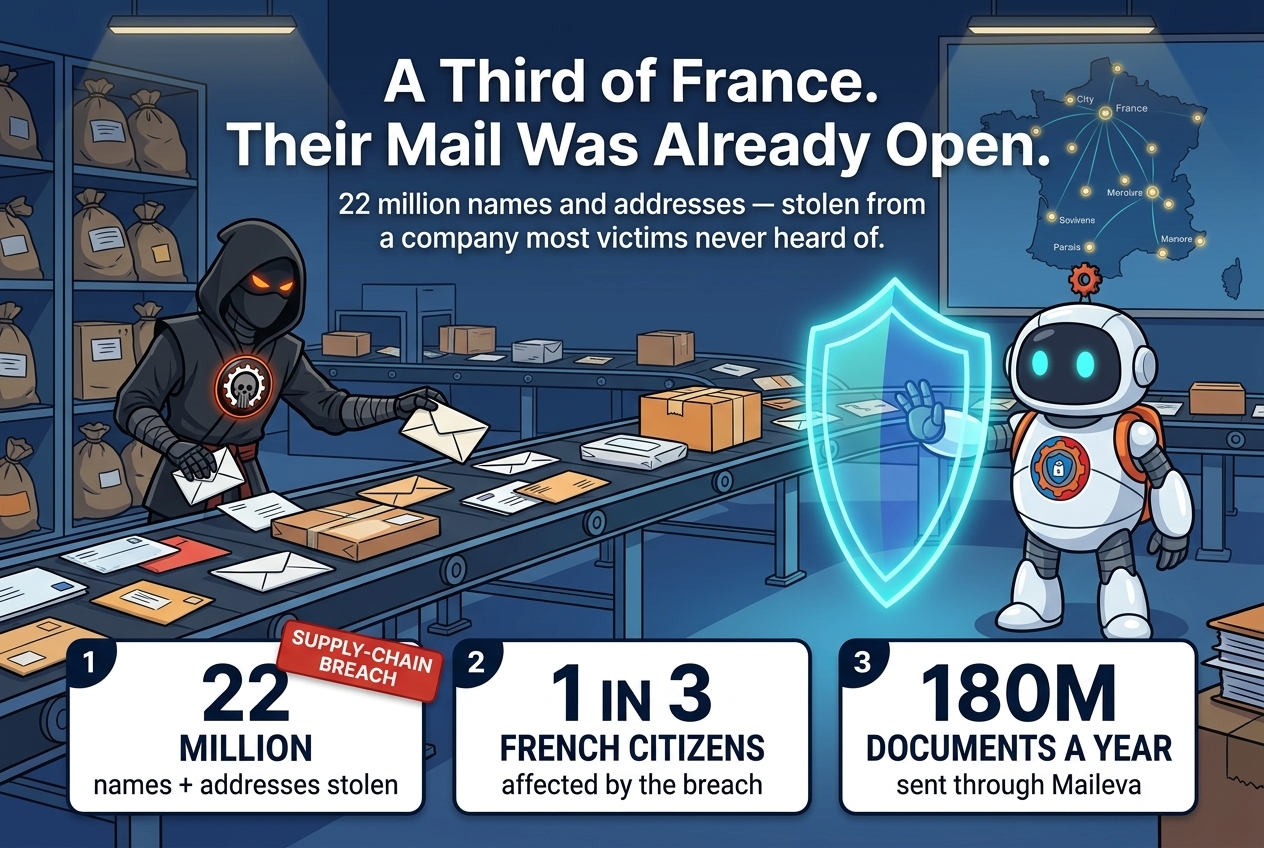
La Poste, France’s national postal service, confirmed on November 15, 2026 that its subsidiary Maileva suffered a cyberattack in mid-September. Attackers reportedly stole the names and postal addresses of 22 million people — about one in three people in the country. It is nearly three times the size of the Iris Ohyama breach that exposed 7.7 million shoppers — and most victims had no idea the company even existed.
What Happened
Maileva is part of Docaposte, the digital arm of the La Poste group. It delivers digital documents on behalf of businesses and public institutions, including hospitals and social housing providers, sending around 180 million documents a year. When a hospital or landlord needs a letter delivered, Maileva is often the company that sends it — even though the recipient’s relationship is with the hospital, not with Maileva.
That is what makes the stolen data so sensitive. Names and postal addresses look boring on their own — but the documents flowing through Maileva may include hospital bills, payment reminders, payslips, and social housing correspondence. A name plus a home address plus the knowledge that a person deals with a particular hospital or housing provider is exactly the raw material for a convincing scam.
Two clients have already warned the people affected. Foch Hospital in Hauts-de-Seine told patients that payment reminder letters sent between September 9 and 23 might have been read, stressing the letters revealed neither the nature of any medical treatment nor any bank account details. Social housing provider Flandre Opale Habitat told residents administrative and financial information, including invoice amounts, may have been accessed, and said the incident “may have resulted in unauthorized access to personal data contained in correspondence sent over the last ten years.”
There is some reassuring news. La Poste says direct bank details were not compromised, and no data alteration or destruction has been detected. It filed a complaint, a judicial investigation is underway, affected clients were notified within days, and France’s data protection authority, the CNIL, has been informed. For scale: La Poste handles around 2.6 billion packages a year and employs more than 200,000 people.

Why This One Hits Different
The uncomfortable core of this story is the supply chain. Millions of people were compromised by a third party they never interacted with directly — they trusted their hospital or housing provider, and the data was exposed two steps down the chain, at a vendor they never chose and probably never heard of. As Huntress senior manager Dray Agha put it, it is “a classic supply chain vulnerability where millions of people are compromised by a third party they have never interacted with directly.”
This pattern keeps working because the victim cannot defend against it. A breach at a Finnair supplier quietly exposed airline customers for three years before anyone noticed. The lesson is the same every time: your data is only as safe as the least secure company in the chain — and you never get a say in who those vendors are. And the risk here is not a dramatic bank-account drain. It is the slow follow-up: criminals holding 22 million verified names and addresses can craft fake invoices that look exactly like the real ones. The scam does not need your bank details. It needs you to trust a letter that already knows too much about you.
What To Do Now
If you live in France, assume the odds are against you: one in three residents is affected, and there is no public tool to check whether your information was exposed. Four checks will cover most of the risk:
- Verify every payment request through the official website. If a bill, invoice, or payment reminder arrives — by post, email, or text — do not use the phone number, link, or payment details printed on it. Check the organization’s official website yourself to see whether anything is actually owed.
- Never pay from a letter’s contact details. A letter that knows your name, your address, and your hospital or landlord is not proof it came from them. Attackers now hold exactly that information, and a letterhead is cheap to fake.
- Watch for fake invoices and payment reminders. Expect a wave of them in the coming weeks. Treat any unexpected demand for money with suspicion, especially one that pressures you to pay quickly.
- Contact the organization directly. If anything looks off, reach out to the hospital, housing provider, or employer through a channel you already trust — not through contact details in the suspicious message.

The Maileva breach is a reminder that the companies holding your data are not always the companies you chose. The failure happened further down the chain, at a vendor you never met — and the fix, for now, is the oldest one in security: slow down, verify through a channel you trust, and never let a letter, however official it looks, tell you where to send your money.