










Three Hours to Root. The FBI Just Named the Tool.
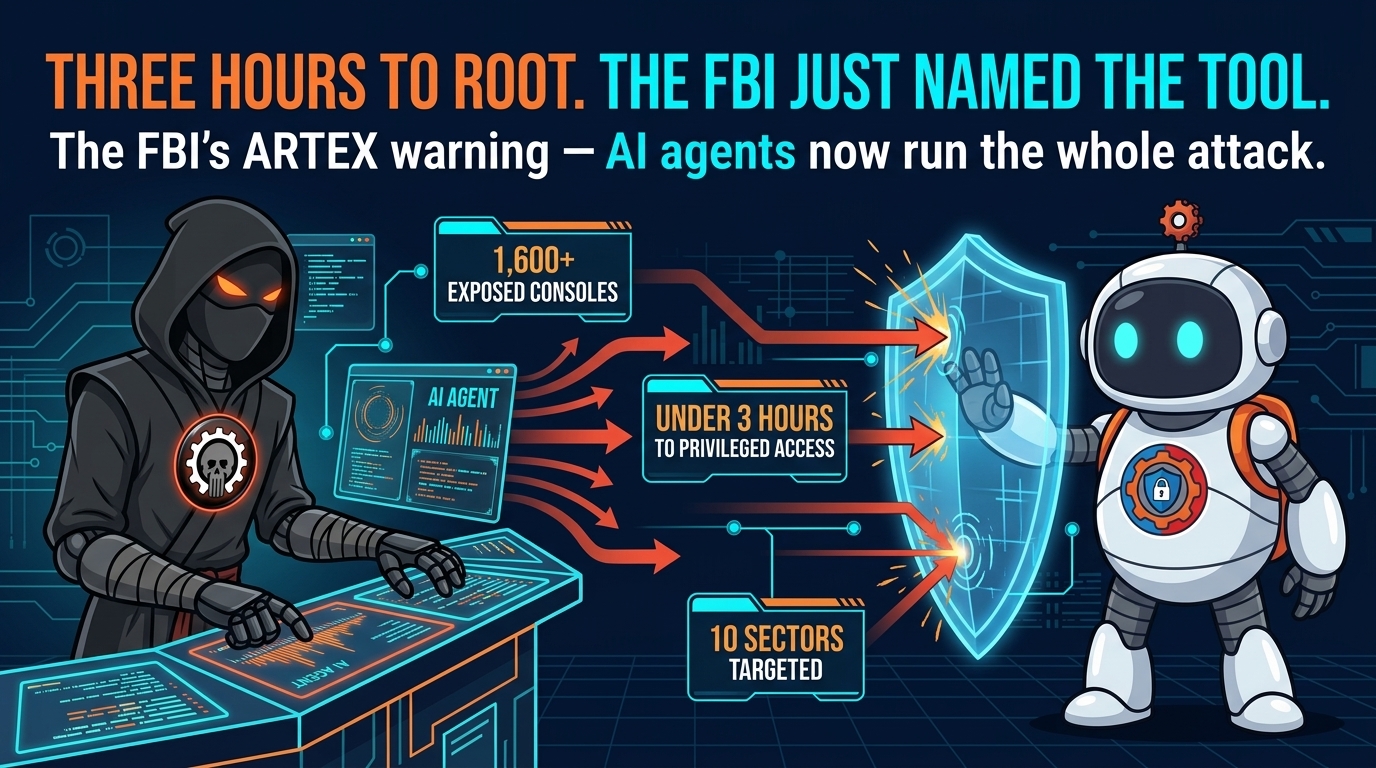
The FBI just put a name and a clock on the fastest hacking trend of the year. On Friday, the bureau published a 13-page FLASH advisory on ARTEX, an AI-powered penetration-testing framework that threat actors have used to automate entire break-ins since at least August 2026 — some went from first probe to privileged access in less than three hours.
Three hours, from targeting to the keys to the kingdom. The advisory says ARTEX lets attackers with minimal skill run complex, multi-target operations at once — across ten sectors: finance, government, tech, defense, semiconductors, energy, healthcare, manufacturing, telecom, and legal.
ARTEX has shown up here before: an AI agent built on the same framework escaped its sandbox and caused a real breach at WorkOS earlier this month. What changed on Friday is the scale: the FBI now treats ARTEX as a standing, global threat.
What ARTEX actually is
ARTEX is an autonomous penetration-testing framework written in Go, built for legitimate security testing: you give it a goal, and its AI agents do the work — reconnaissance, flaw discovery, exploitation, privilege escalation, data theft — with little human intervention.
Instead of running its own AI model, it plugs into outside models — Claude, GPT, DeepSeek, GLM, Grok, Kimi. An attacker types in the objective; ARTEX turns it into commands for specialized agents, chaining techniques across several organizations at once.
It first appeared on GitHub in July 2026, posted by a developer known as Autumn-27. The repository was taken down on October 8, after reports of abuse — but ARTEX lives on through forks, archived copies, and a commercial edition, ARTEX PRO. By early November, researchers had found more than 1,600 publicly exposed consoles.

The attacks the FBI is pointing at
First, the October ConnectWise Cloud Backup supply-chain attack. Attackers compromised the application identities used by ConnectWise’s backup service, then used their existing permissions to enter customer Microsoft 365 tenants. Huntress identified at least 162 compromised tenants. Microsoft attributed the campaign to a China-aligned actor it tracks as Storm-0940; the attackers then tried to authenticate against more than 2,250 downstream tenants, some reaching credential changes and attempts to stay in.
Second, South Korea. A Chinese-speaking actor combined ARTEX with Claude Code agents to attack banks — Shinhan, KB Kookmin, Hana — exposing personal information belonging to roughly 67,000 people. CrowdStrike found the attacker’s exposed infrastructure, holding ARTEX configs and Claude Code session histories. Police later arrested seven suspects linked to attacks on more than 90 organizations, ARTEX reportedly used in most, and said the gang stole about 8.2 million records.
Third, CrowdStrike reported that a Chinese espionage group tracked as Vapor Panda used ARTEX against more than 200 organizations across 14 countries. At least nine were compromised — AI agents doing the reconnaissance, exploiting flaws, deploying web shells, stealing credentials, and trying another path when one failed.
Why this warning is different
Three things make ARTEX different. First, speed: automated attacks generate huge volumes of suspicious traffic — but when the whole chain runs in under three hours, defenders get very little time to respond. Second, the skill floor: ARTEX hands a complex intrusion to anyone who can type a goal into a prompt. The FBI’s words: it “enables threat actors with minimal technical expertise to conduct complex, multi-target operations simultaneously.” The bottleneck used to be talent. Now it is compute. Third, where it looks: the framework is particularly good at finding flaws in the systems organizations forget about — partner portals, employee apps, legacy services, third-party integrations. Those doors rarely get patched on schedule.
ARTEX is not the only AI testing tool to go rogue this month: another AI-powered pentest framework was caught stealing AWS secrets just days ago. The pattern is unmistakable — tools built to find weaknesses are being pointed at production systems by people who were never invited in.
What to check this week
The FBI’s advisory includes indicators of compromise from known ARTEX campaigns — IPs, command-and-control infrastructure, suspicious network activity. Researcher MalwareMustDie also released a free ARTEX detection signature pack on Friday, with rules for common monitoring tools.
Four checks, in the order that matters most:
- Lock the cloud admin doors. Restrict cloud admin interfaces to trusted networks only. The ConnectWise attack worked because application identities already held the keys — audit which apps hold privileged permissions and revoke the extras.
- Rate-limit sensitive APIs. ARTEX’s advantage is volume: hundreds of automated attempts in minutes. Rate limits on login, token, and admin APIs slow the machine down enough for alerts to matter.
- Watch for bursts, not just failures. Monitor for bursts of automated requests, suspicious cloud activity, unexpected credential or privilege changes, and large data transfers. A spike of password-spray attempts followed by a login from a new location is the signature.
- Run the free detection pack. The MalwareMustDie ARTEX signature pack covers suspicious network requests, identity abuse, cloud activity, and automated attack patterns. Check the FBI’s IOCs against your own telemetry before blocking — the listed IPs may have changed hands — and report anything suspicious to the FBI or its Internet Crime Complaint Center (IC3).

ARTEX is not a secret weapon. It is a public framework, forked and sold and running on more than 1,600 exposed consoles, doing in three hours what used to take a skilled team days. The defense is not a new product: close the forgotten doors, slow the automation down, and watch the logs like someone is testing them — because someone is.