










The Update Was Poisoned. The Drones Stayed on the Ground.
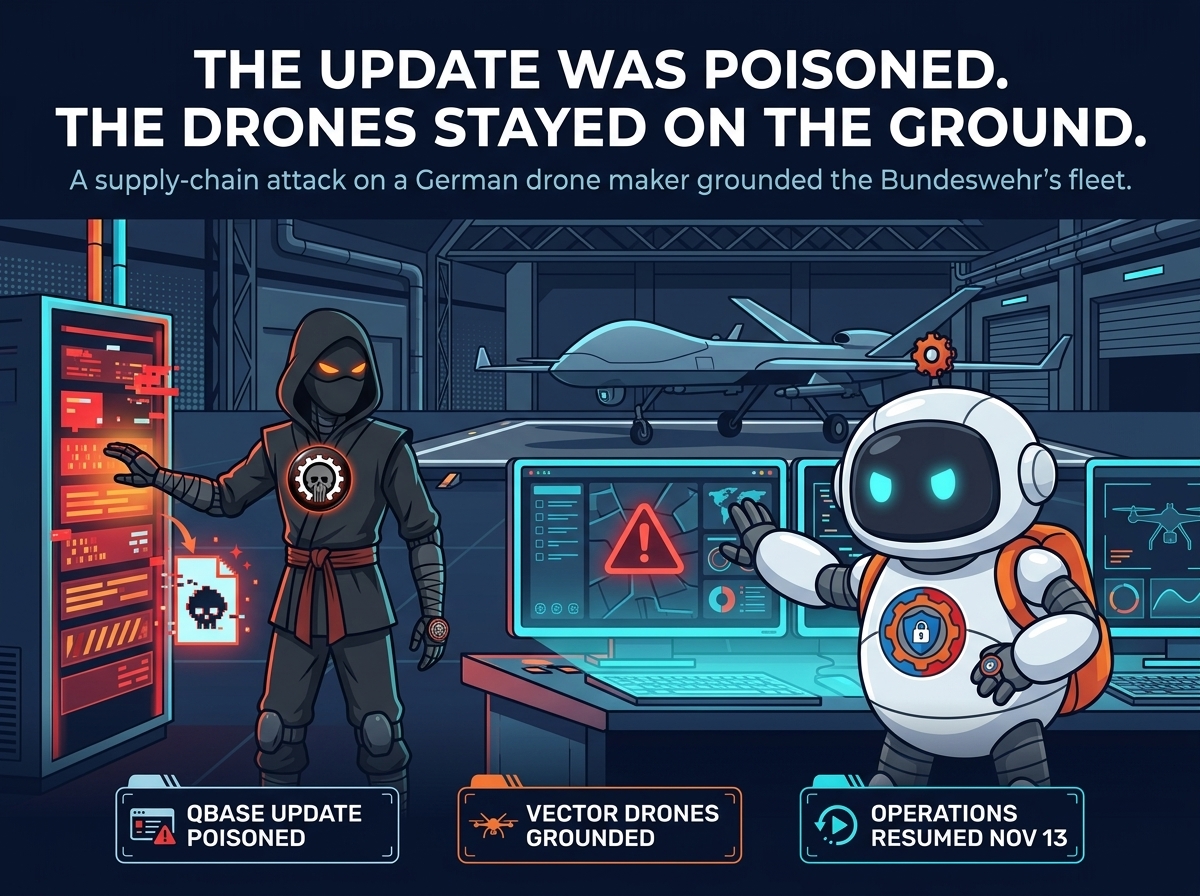
German defense company Quantum Systems confirmed on Friday that hostile actors hit it with a cyberattack in late October — and the German military grounded the company’s drones while it figured out what happened. The attack came through the one channel every customer is trained to trust: a software update.
What happened
Quantum Systems builds reconnaissance and interceptor drones, plus the software that controls them. On November 13, the company confirmed it had detected an incident in late October that was part of an “active cyberattack by hostile actors.” It responded with the relevant authorities, contained the attack, and says its unmanned systems have safely resumed operations.
According to reports from Der Spiegel and the Financial Times, citing internal sources, the attackers compromised the company’s update distribution server and slipped a malicious file into QBase — Quantum Systems’ ground-control and mission-planning software. QBase is the program that plans missions for the company’s Vector reconnaissance drone, known as Falke in German military service.
The unscheduled update raised alarms inside Quantum Systems. It is still unclear how many customers actually installed it. After being informed of the incident, the German armed forces grounded Quantum Systems drones as a precaution and excluded the company’s systems from a recent military exercise. The response reportedly involves Germany’s military counterintelligence, domestic intelligence, and federal cybersecurity agencies.
By November 12, the company said its teams had contained the attack in close cooperation with the authorities, and on November 13 it confirmed the drones had resumed normal operations worldwide — Germany was reportedly the only customer to temporarily ground its systems. Quantum Systems says the incident posed no risk to operators or end users.
How the attack worked
The compromise followed a familiar supply-chain pattern: instead of attacking the drones, the attackers went after the vendor that serves them. A poisoned update file on the distribution server turns the vendor’s own delivery channel into the weapon. Every customer who installs the update pulls the attack in themselves — which is why an unscheduled update is a red flag, not a routine event.
That pattern is exactly what hit Maersk days earlier, when attackers reached the shipping giant through a legacy system at a service provider — the vendor was the way in, and the ransom demand was $5 million. The lesson is the same here: your security is only as strong as the update channel you trust without checking.

Who is behind it
Quantum Systems has not named the attackers. The company says it believes it was targeted because of its recent announcement of support for Ukraine — in October, Germany announced funding to build tens of thousands of Quantum Systems interceptor drones in Ukraine for Ukrainian forces. “Companies at the forefront of supporting Ukraine are being targeted precisely because our work is critically relevant to customers’ security,” the company said.
A source close to the matter told AFP that initial indications suggested Russia was behind the attack, and that intelligence agencies were investigating. Russia consistently denies being behind such incidents. The pattern fits a wider campaign: when France blamed Iranian hackers for the supermarket refrigeration attacks, the attribution came weeks after the fires — state-backed attacks on civilian and defense targets alike are usually confirmed slowly, through intelligence work rather than a single smoking gun.
There is also a direct precedent. In July, the Australian drone maker CubePilot — which also openly supports Ukraine — was hit by a DNS hijacking attack that caused severe operational disruption. Attackers are increasingly targeting the European defense firms that supply Ukraine.
Why it matters
A drone is only as trustworthy as the software that plans its missions. QBase sits between the operator and the aircraft: it holds flight plans, sensor tasking, and the routes the drone follows. A compromised update to that software does not need to touch the aircraft at all to put operations at risk — and the precautionary grounding shows the military treated it that way, even before anyone could say how many customers installed the file.
The update channel is trusted by design, and that trust is exactly what attackers exploit. The attack is contained and operations have resumed — but the investigation, and the question of who installed the poisoned file, is still open.
What to check
If your organization runs software that arrives through a vendor update channel, these four checks apply now:
- Verify every update before you install it. Check the vendor’s published signature and hash against the file you received. An update with no signature, a mismatched hash, or a certificate you do not recognize is a stop, not a delay.
- Watch for unscheduled updates. If an update arrives outside the vendor’s published schedule, treat it as suspicious until the vendor confirms it through a second channel — that signal is what raised the alarm here.
- Segment ground-control and mission systems. The machines that plan missions or control hardware should not share a network with general office systems, and they should not pull updates from the open internet.
- Audit the vendor’s update channel, not just your own. Ask suppliers how updates are signed, who can publish them, and how a compromise would be detected — and make sure your incident response plan covers a poisoned vendor update.

The drones are flying again. The update channel that grounded them is the part worth fixing.