








The Key Was Stolen. The Extension Was Poisoned.
One key opened the door. A poisoned extension walked through it.
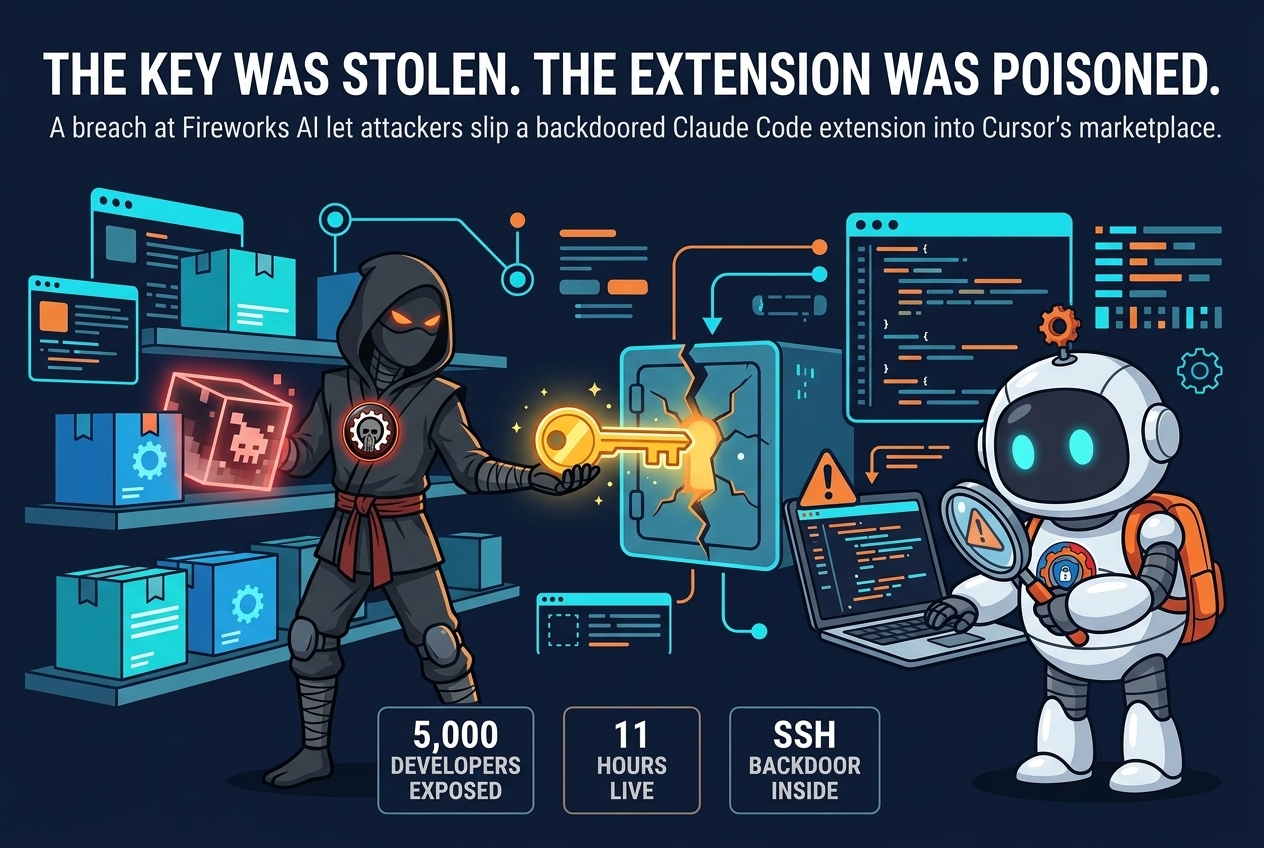
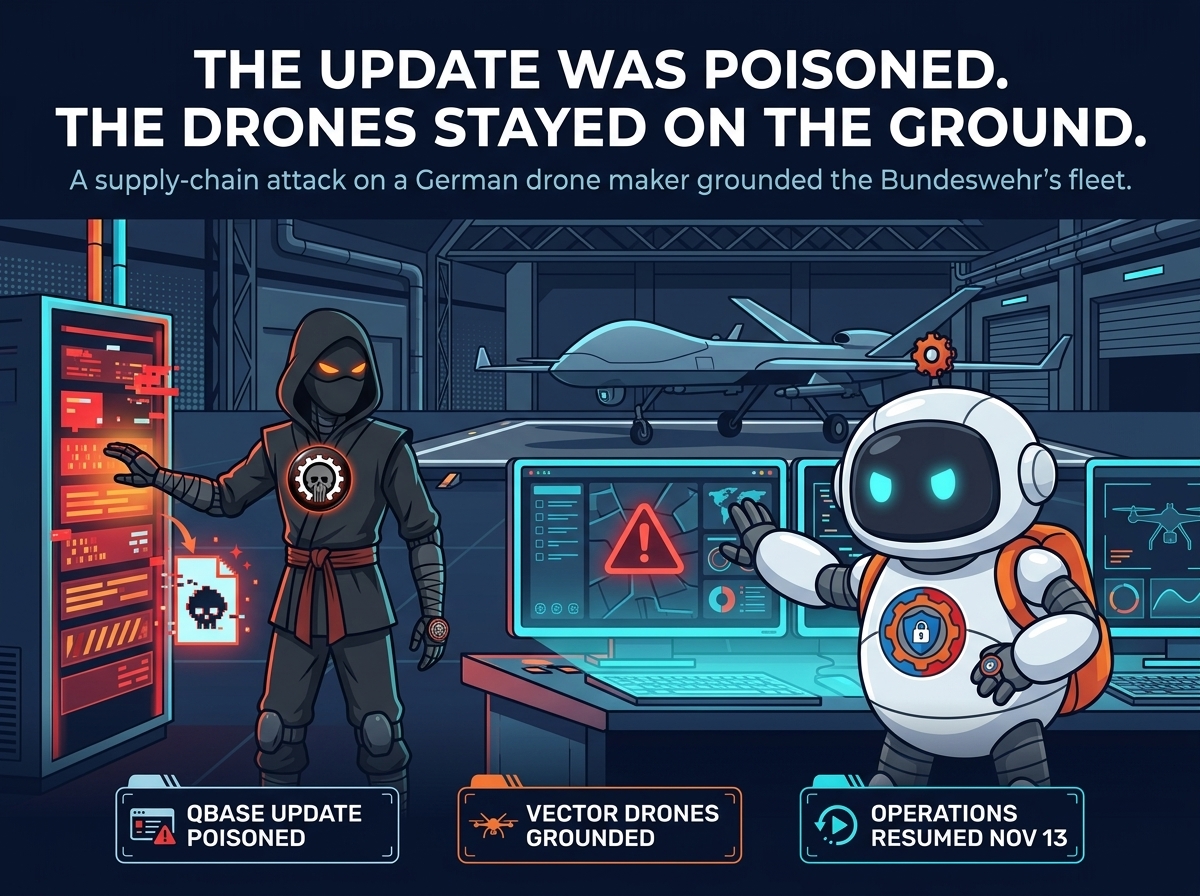
Cursor confirmed on Friday that it was breached — and the breach did not stop at Cursor. Attackers used a stolen access key from AI infrastructure provider Fireworks AI to slip backdoored copies of Anthropic’s Claude Code extension into Cursor’s own extension marketplace. The malicious versions, 2.1.312 and 2.1.313, were live for about 11 hours on October 29. Cursor estimates up to 5,000 developers may have received them.
The extension came from the official marketplace. That is the whole story: the place developers are told to trust was the delivery mechanism.
How one stolen key cascaded
The attack started at Fireworks AI, a third-party provider Cursor used for AI model training and inference. Attackers obtained an access key Cursor had issued to Fireworks, and used it to copy data from a read-only storage bucket Cursor shared with the provider.
That bucket held historical AI coding-agent traces, mostly from 2025, from users who had not enabled Privacy Mode. Some of those traces contained unredacted API credentials — keys and tokens pasted into coding sessions and never scrubbed. The attackers used those credentials to reach further into Cursor’s systems.
What they took, according to Cursor’s incident report, included archived non-production source code, limited customer support information and email conversations, product usage metrics and customer contact details, summaries of some AI coding-agent conversations, and credentials customers had previously shared with Cursor’s support team.
Cursor says its monitoring caught the activity, and the company revoked the Fireworks key and rotated exposed credentials. But the attackers had already obtained a credential that let them publish extensions through Cursor’s marketplace. On October 29, they placed malicious, unauthorized copies of Anthropic’s Claude Code extension directly on the cache that serves the Cursor VS Code extension marketplace.
Anthropic’s legitimate extension was not compromised. The poison was in Cursor’s own cache — which is exactly why it worked.

What the fake extension did
The attackers modified the legitimate Claude Code extension to run malicious JavaScript that tried to install a persistent SSH backdoor on developers’ machines. The malware collected system information, installed an attacker-controlled SSH key, tried to enable SSH access, and set up persistence to keep remote access after a reboot.
One piece of luck: researchers found coding errors in the malware that likely stopped the backdoor working on many Windows and macOS systems where SSH was not already enabled. The backdoor needed SSH to be running to be useful, and on most developer machines it was not.
The exposure was still real. Cursor says fewer than 0.05% of users had coding-agent traces exposed, and fewer than 0.01% of customers had API credentials compromised. Its production infrastructure, official application releases, customer code repositories, and the code and prompts of users with Privacy Mode enabled were not affected.
What Cursor has done since
Cursor has moved all inference traffic away from Fireworks, revoked and rotated the exposed credentials, rebuilt its extension marketplace, and redeployed its production infrastructure as a precaution. Customers who installed or updated the extension on October 29 should follow Cursor’s remediation guidance.
The bigger pattern: Black October
This was not an isolated incident. Cybersecurity company Wiz has dubbed the wave of attacks on AI developer platforms “Black October” — a run of breaches targeting development infrastructure to steal the credentials that unlock AI models. At Railway, attackers stole customer authentication secrets and generated about $740,000 in fraudulent AI charges. OpenCode reported exposed API keys and unauthorized AI usage. Fireworks AI itself disclosed multiple breaches in October, and those incidents also touched other customers: Notion disclosed that AI chat transcripts from a small number of workspaces were exposed.
We covered Fireworks AI’s own breaches when they surfaced.
What to do now
1. Check the extension version. Check the version of the Claude Code extension in Cursor. If you installed or updated to 2.1.312 or 2.1.313 on October 29, remove it and follow Cursor’s remediation guidance.
2. Check your SSH keys. Look at the authorized keys on any machine where the extension ran, and remove any key you do not recognize. If you do not use SSH on that machine, leave it off — an SSH service that is not running is not an open door.
3. Rotate keys that ever touched a coding session. API keys and tokens that appeared in coding-agent traces, or that were ever shared with a support team, should be treated as exposed and rotated. We have seen this failure before — Claude Code’s own “Don’t Ask Again” file put thousands of secrets on GitHub — and the lesson is the same: anything a coding agent sees can end up somewhere you did not intend.
4. Turn on Privacy Mode. In Cursor, Privacy Mode keeps your code and prompts out of the training data pool. The traces at the heart of this breach came from sessions that did not have it on.

Why this one matters
Supply-chain attacks work because they ride on trust that is already granted. Developers install extensions from the official marketplace without a second thought. One key, issued to one vendor, turned into a poisoned extension in the official store, a stolen bucket of session traces, and a backdoor aimed at 5,000 machines. The fix is not to stop trusting marketplaces — it is to assume the marketplace can be poisoned, and to check versions, keys, and SSH the way you would check a lock after a burglary.