








The AI Didn’t Ground the Flights. Nobody Can Prove That Yet.
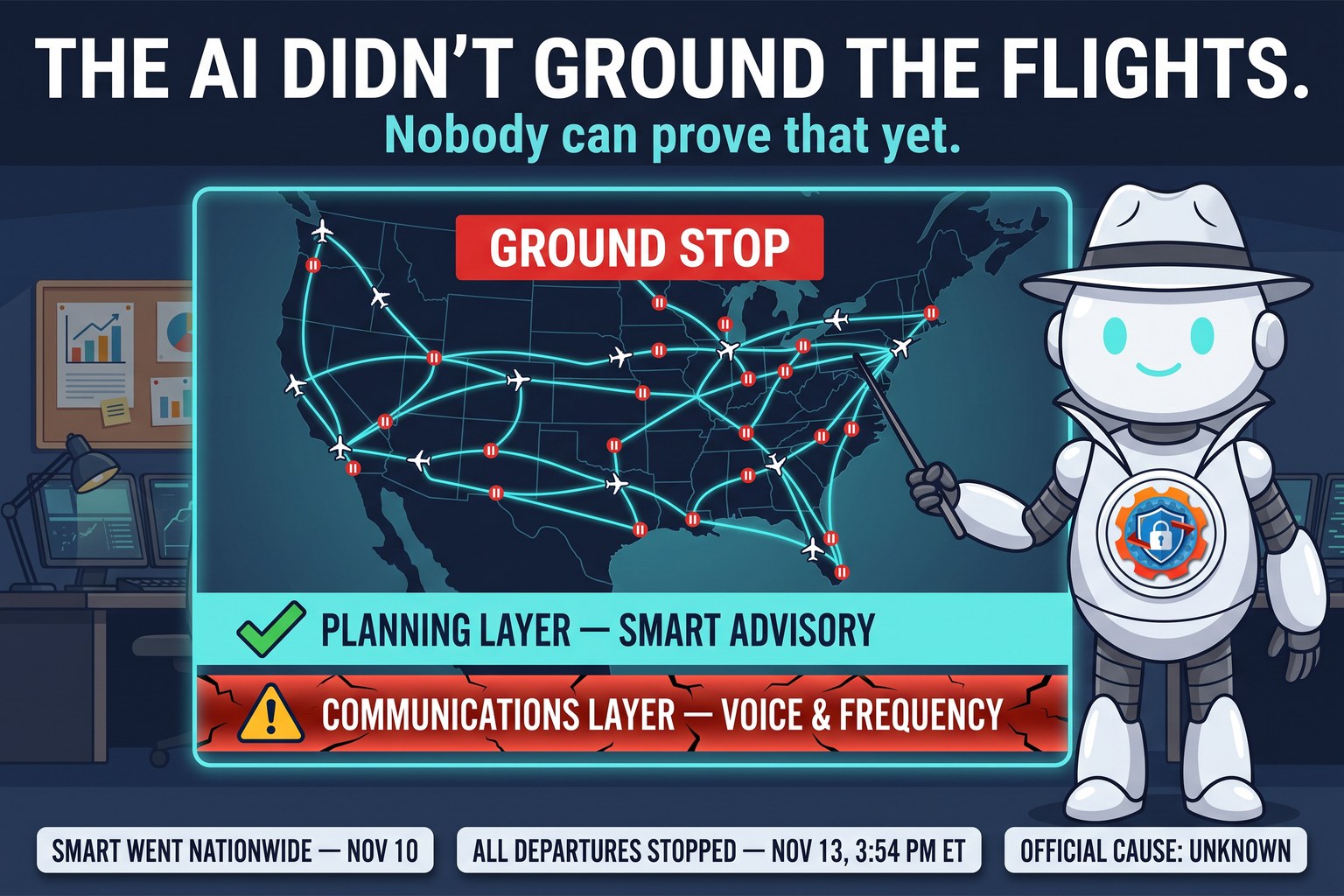
Three days. That is how long the FAA’s new AI traffic system had been running nationwide when, at 3:54 PM Eastern on Friday, the agency did something it almost never does: it ground-stopped every departing flight in the United States.
The official explanation is a telecommunications outage. The unofficial question hanging over the whole event — asked out loud by the Secretary of Homeland Security — is whether the AI had anything to do with it. Nobody has evidence that it did. Nobody in authority is willing to say it didn’t. And that gap, between a failure everyone can see and a cause nobody can yet prove, is the real story.

What actually failed
Start with what is confirmed. The FAA’s Air Traffic Control System Command Center issued Advisory 111 on Friday afternoon, ordering all airports to ground-stop departing traffic. Transportation Secretary Sean Duffy said technicians were investigating a communications issue affecting the nation’s air route traffic control centers. Reporting from the scene points at the voice layer — the frequencies and communication systems controllers use to talk to aircraft — and the FAA’s telecommunications infrastructure is managed by contractor L3Harris. One former controller and aerospace policy expert has speculated publicly about a software problem in the Voice Switching and Control System, which manages pilot-controller communications. That remains speculation, labelled as such.
What the failure was not, on current evidence: it was not the Microsoft 365 outage that had been running since Thursday. Homeland Security Secretary Markwayne Mullin said he saw no reason to connect the two, and Microsoft itself said it had no indication the ground stop was related to its disruption.
The AI in the room
Three days earlier, on November 10, the FAA had expanded SMART — the Strategic Management of Airspace, Routes and Trajectories system — from a Washington-area pilot to all 22 of its en route centers. SMART is built by Boston-based Air Space Intelligence under a contract worth roughly $875 million over 12 years.
Here is the part the social media version of this story keeps getting wrong: SMART is not an autopilot, and it does not fly, route or talk to a single airplane. It is a cloud-based planning tool. It ingests around 200 data streams — weather, flight paths, traffic volume, controller staffing — and recommends schedules and routes before flights depart. Human traffic managers review those recommendations, and local facilities can accept or decline them. The FAA’s own fact sheet is blunt: the system cannot take control of an aircraft and cannot replace controllers.
The early results were genuinely promising. In the Washington pilot that began September 21, SMART helped reroute 180 flights, saving an average of about 10 minutes and 80 gallons of fuel per flight, according to the FAA.
But notice the architecture, because it decides what SMART could and could not have done on Friday. SMART works in the planning layer. Friday’s failure was in the communications layer. The AI does not carry controller-pilot voice traffic, so the simplest theory — “the AI broke, so the planes stopped” — does not match the reported failure mode.

What officials are and are not saying
Asked directly whether the outage could be connected to the new AI system, Secretary Mullin did not close the door. DHS is examining it through the Cybersecurity and Infrastructure Security Agency, he said. “You just can’t rule out anything at this point.” He applied the same standard to a cyberattack: no evidence pointing that way, but not ruled out.
Air Space Intelligence, for its part, ruled its own product out completely, posting that the ground stop “is not based on or a result of the SMART system, any product of ASI or our integration with FAA and ATC.”
Both statements can be true at once. A vendor can be certain its software didn’t fail while investigators still check whether a brand-new integration changed load, timing or behaviour in the systems around it. That is not an accusation. It is how root-cause analysis works in any complex environment — and anyone who has troubleshot a production incident three days after a major rollout knows exactly why investigators start with “what changed.”
The questions that were already on the table
Friday’s ground stop landed in the middle of an oversight fight that started weeks ago. In October, more than two dozen lawmakers — including Representatives April Delaney, Don Beyer and Alexandria Ocasio-Cortez — asked the FAA to pause SMART’s Washington deployment, and 23 members of the House Transportation and Infrastructure Committee requested a GAO audit. Their letter listed specific gaps: no publicly available safety evaluation or testing reports, frontline staff notified of the rollout days in advance or not at all, unanswered questions about training, and the risk of an AI system producing incorrect, safety-critical information — the hallucination problem — inside a workflow run by already-overstretched controllers. The controllers’ union, NATCA, has raised its own reservations about how little controller input went into the deployment.
None of that proves SMART caused, contributed to, or even touched Friday’s outage. It does explain why “trust us, it wasn’t the AI” was never going to be a sufficient answer — the audit trail critics asked for in October is the same audit trail investigators need now.
The lesson for anyone who ships systems
Strip away the aviation specifics and this is a story every IT and security professional recognises. A powerful new system went from pilot to national scale in seven weeks. Three days after the full rollout, the surrounding infrastructure suffered its worst kind of day. The failure appears to sit in a different layer than the new system — and that may well be where the final report lands. But “different layer” is a finding you reach at the end of an investigation, not a press line you get to use at the start of one.
What to watch next: the FAA’s root-cause statement, which will either name the telecom fault in detail or open much bigger questions; whether CISA’s involvement produces a public statement of its own; and whether the GAO audit lawmakers requested becomes the vehicle that finally publishes SMART’s testing record. Until then, the honest headline is the uncomfortable one: America grounded its airplanes on Friday, the cause is officially unknown, and the AI question is open — not because there is evidence against the system, but because, three days after a rollout this size, there is no honest way to close it early.