

















Your Gallery Was Open. The Fine Is €805 Million.
Your photos were the product. The permission was the problem.
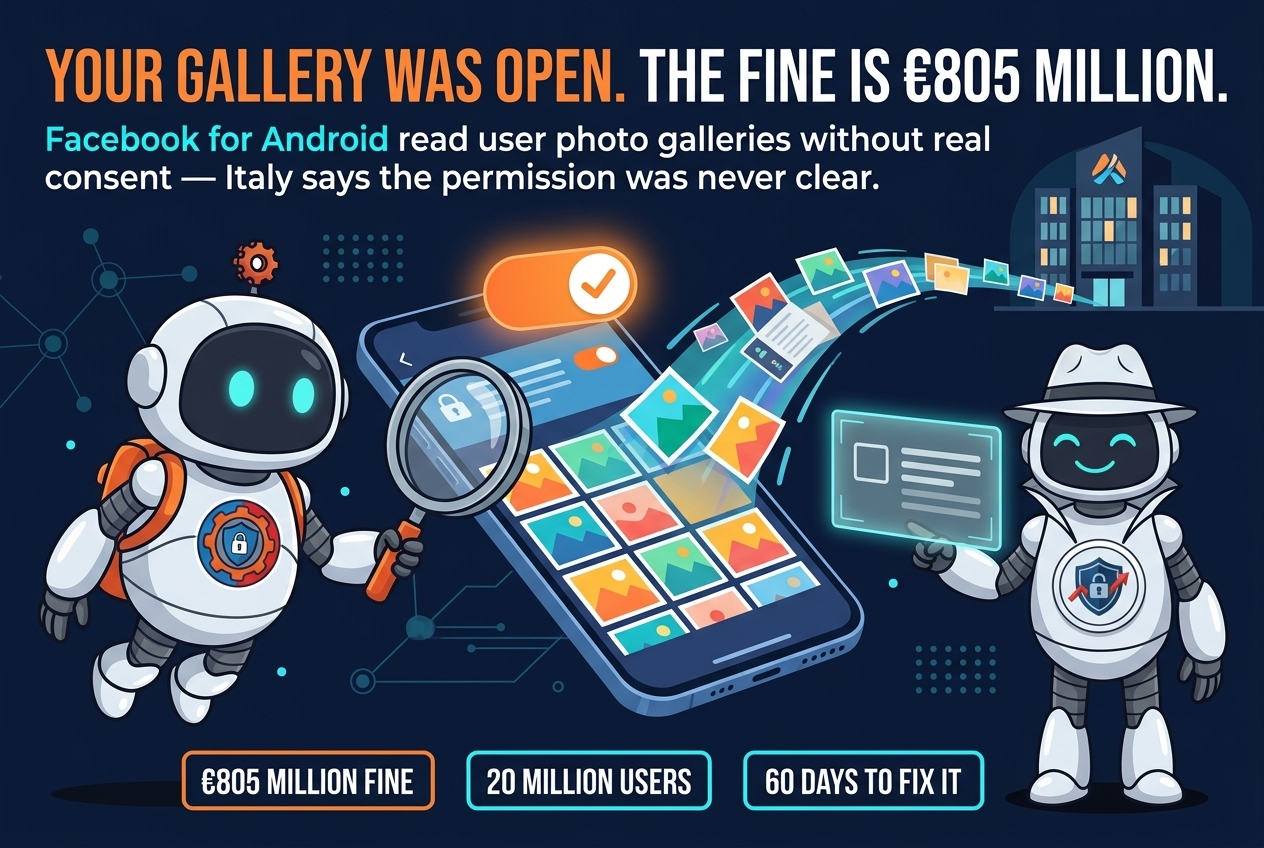
Italy has fined Meta €805 million over a Facebook for Android feature that suggests photos and videos from users’ phone galleries for them to post. The country’s data protection authority, the Garante, found the feature was switched on by default and reached into Italian users’ galleries — photos, videos, and related metadata — without their explicit consent. About 20 million Android users in Italy were affected. Meta plans to appeal and calls the fine “disproportionate”.
The feature has been available since 2023; the investigation began in July 2025 after a complaint from the Bolzano consumer group Centro Tutela Consumatori Utenti, and included the authority’s own technical analysis.
One permission, many purposes
The core of the case is how the permission worked. The Facebook app asks for gallery access through a single permission that covers the whole app and several functions with different purposes. A general notice about enabling other features appears first, but it does not make clear to users that they are also switching on gallery suggestions.
Once granted, it lets the app read the phone’s whole photo archive, usually on an ongoing basis — and neither the user nor the authority can check which information is actually used. Consent has to be free and informed, and a bundled permission with a vague notice is neither.
The authority found a breach of Article 122 of Italy’s Privacy Code, which puts the EU’s ePrivacy Directive into Italian law. That rule treats a phone as part of a person’s private life. Any access to what the phone stores therefore requires free and informed consent — whether or not data is sent anywhere or harm results.

What Meta has to do now
The Garante’s order requires the company to:
Within 60 days, ask for consent through a separate, specific request for this feature — and explain clearly what the feature is for, that it accesses the gallery, and how to turn it off. Within the same 60 days, the feature must be off by default, including for people who already granted the permission.
Within 30 days, report to the authority on the work it has started, and within 90 days, on the measures it has taken. If the company misses the 60-day deadline, the feature cannot be switched on for anyone who has not given valid consent.
Meta said the feature works only after users give permission on their device, and that they can change it at any time in settings. The Garante’s answer, in effect: a permission granted without understanding what it enables is not the consent the law requires.
How the fine was set
The €805 million equals about 0.47% of the group’s global revenue. The authority weighed the number of people involved — about 20 million Android users in Italy — and how long the breach has lasted. It is still ongoing for people who have not updated the app, and for those who already granted permission.
A 2019 decision against the company and limited cooperation during the investigation also counted against it. Changes made after the complaint counted in its favor, though the authority judged them late and limited to people who update the app.
The investigation did not examine whether gallery content was used to train AI models; the company denies any such use. The authority may separately examine a newer feature, launched this year, that processes gallery content in the cloud.
Why this one matters beyond Italy
Nothing was stolen, and no hacker was involved. It is a story about what a permission actually means — and the same pattern runs through the whole app economy: a single toggle, a vague notice, and an app that keeps reading after you have forgotten you said yes. Your gallery is not a public folder, and private messages leak at scale more often than people think — from 125 million exposed text messages to diverted texts carrying two-factor codes. The difference here is that nobody had to break in — the door was open by default.
Italy also rejected Meta’s argument that Ireland’s data protection authority should have handled the case: the ePrivacy rules provide no one-stop-shop mechanism, so the Garante could act directly. That matters beyond Italy — other national regulators can pursue the same kind of case on their own turf, without waiting for Dublin.
For anyone who has ever wondered why an app needs access to every photo on their phone to suggest one for a post — this fine is the answer in euros. The feature was convenient. The consent was not real. And in Italy, that is now worth €805 million.
What to do now
1. Check what your apps can see. On Android, open Settings → Privacy → Permission Manager → Photos and videos, and see which apps have full access to your gallery. Any app that does not need your whole archive should be set to “selected photos” or denied outright.
2. Switch off gallery suggestions in Facebook. In the Facebook app, find the gallery suggestion settings and turn them off — the Bolzano consumer group has been advising exactly this since July 2025. While you are there, check the app’s other permissions against what you actually use it for.
3. Treat a permission as a decision, not a formality. A single “allow” can cover several features at once, and the notice rarely says so. When an app asks for broad access, give it the one feature — not the whole phone.
