









TSMC Confirmed the Leak. The Deadline Is Today.
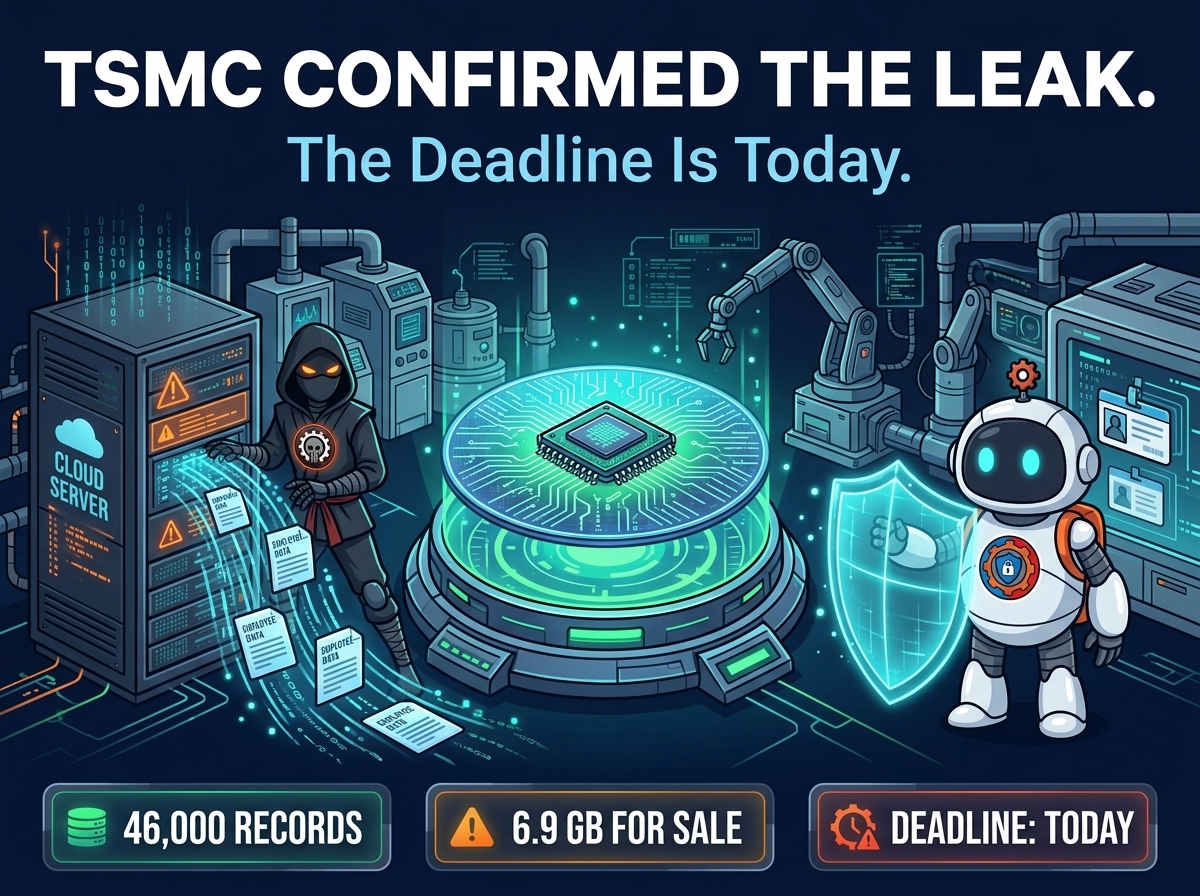
TSMC has confirmed it. The world’s largest chipmaker told regulators on Sunday that personal data belonging to current and former employees was leaked online — and the clock on the full release runs out today.
The confirmation came in a filing with the U.S. Securities and Exchange Commission, two days after the leak first surfaced on a hacker forum. TSMC verified the leaked sample and confirmed it matched data stored in the system services of a cloud provider it uses. In the company’s words, the breach sits outside its own infrastructure — and so far, it has found no evidence that TSMC’s own systems were compromised.
That distinction matters to the chipmaker. It does not matter much to the 46,000 people whose records are in the dataset.
What changed since Friday
We covered the original leak on Friday, when the forum post was still an unconfirmed claim: a 499-row sample, a 6.9 GB dataset, and an auction with a starting bid of 3 BTC. What changed this weekend is the source of the confirmation. TSMC itself has now verified the data, notified the people affected, and brought in a third-party cybersecurity firm to help manage the situation.
The company says the incident affected current and former employees but does not impact its operations or its customers. It is now notifying impacted staff and providing them with support — the standard first step, and the one that matters most to the people whose national ID numbers, addresses, contact details, and banking information are in the files.

The auction clock runs out today
The seller, posting under the alias SmithBianl, put the sample online on November 8 and offered the full dataset at auction, with bidding starting at 3 BTC — about $65,000. The warning attached to the listing was blunt: if nobody buys, the data goes public for free in one week. That deadline is today, November 15.
BleepingComputer has asked TSMC whether it has engaged with the threat actor and whether it plans to pay to stop the full release. A spokesperson declined to comment.
That leaves the people in the dataset in the worst position of all: their most sensitive identifiers may be published openly within hours, with no say in the matter and no payment that can reliably prevent it. Paying a ransom has never guaranteed that stolen data stays private — and when the data is already being shopped in public, the leverage is mostly gone.
Why it matters
TSMC is not a household name in the way Apple or Nvidia are, but it makes the chips inside their products. The company is the world’s largest contract chipmaker, manufacturing advanced processors and other semiconductors for Apple, Nvidia, and others. Last year it shipped roughly 15 million 12-inch-equivalent wafers and generated $122.4 billion in annual revenue.
An attacker who can walk away with employee records from a company of that scale does not need to touch a single wafer to cause real damage. National ID numbers plus home addresses plus banking information is the raw material for identity theft and for phishing messages that are almost impossible to spot — because the details in them are real. A message that knows your employee ID, your address, and the bank you use does not look like a scam. It looks like HR.
There is a second lesson here, and it is the same one that keeps showing up. The breach did not happen inside TSMC. It happened in a cloud provider’s systems, where TSMC employee data was stored. Your security is only as strong as the weakest vendor holding your data — a pattern we have seen before, when one vendor’s trusted access opened up its customers’ cloud accounts. TSMC’s own defenses held. The data still leaked.
What to do now
If you are a current or former TSMC employee, assume your details are exposed and act on that assumption rather than waiting for a notification letter:

- Watch your bank accounts daily for the next few weeks, and turn on transaction alerts for every account. Banking details in a leaked dataset are used quickly, while the data is fresh.
- Freeze your credit or place a fraud alert with the credit bureaus, so nobody can open accounts in your name with your national ID number and address.
- Expect phishing that knows you. Any message referencing your TSMC employment, your address, or your bank should be treated as suspect — even if every detail in it is correct. Verify through a channel you trust, never through a link in the message.
- Change passwords and enable MFA anywhere you reused credentials tied to a work email address, and check whether your details appear in breach-lookup services.
For everyone else, the takeaway is a vendor question, not a chip question: what employee data do your providers hold, where does it live, and how would you know if it leaked? TSMC found out from a forum post, not from its own monitoring — and confirmed it only after verifying the sample itself. The companies that avoid this story are the ones that can answer those questions before the auction starts, not after.