







Log4Shell Opened the Door. The Signing Server Was the Prize.
Some break-ins announce themselves with ransomware notes and stolen data dumped online. This one did neither. For months, a group Kaspersky tracks as BO Team — also known as Black Owl, Hoody Hyena and Lifting Zmiy — moved quietly through a Russian software developer, stealing source code and credentials on its way toward the one machine that mattered most: the code-signing server.
The victim, which Kaspersky does not name, builds software for a Russian customer base. It called in Kaspersky’s ICS CERT team in June 2025. Active since at least 2023 and assessed to be of Ukrainian origin, the group aims, according to Orange Cyberdefense, to degrade the Russian military-industrial complex. Kaspersky says a rapid response stopped the attack before it reached its intended conclusion.
The way in
The first door was an exposed SSH service on a Linux terminal server — a management port reachable from the internet. From there the attackers mapped the network the patient way: SMB, Kerberos, SSH, Telnet, FTP, HTTP and HTTPS, WinRM, LDAP.
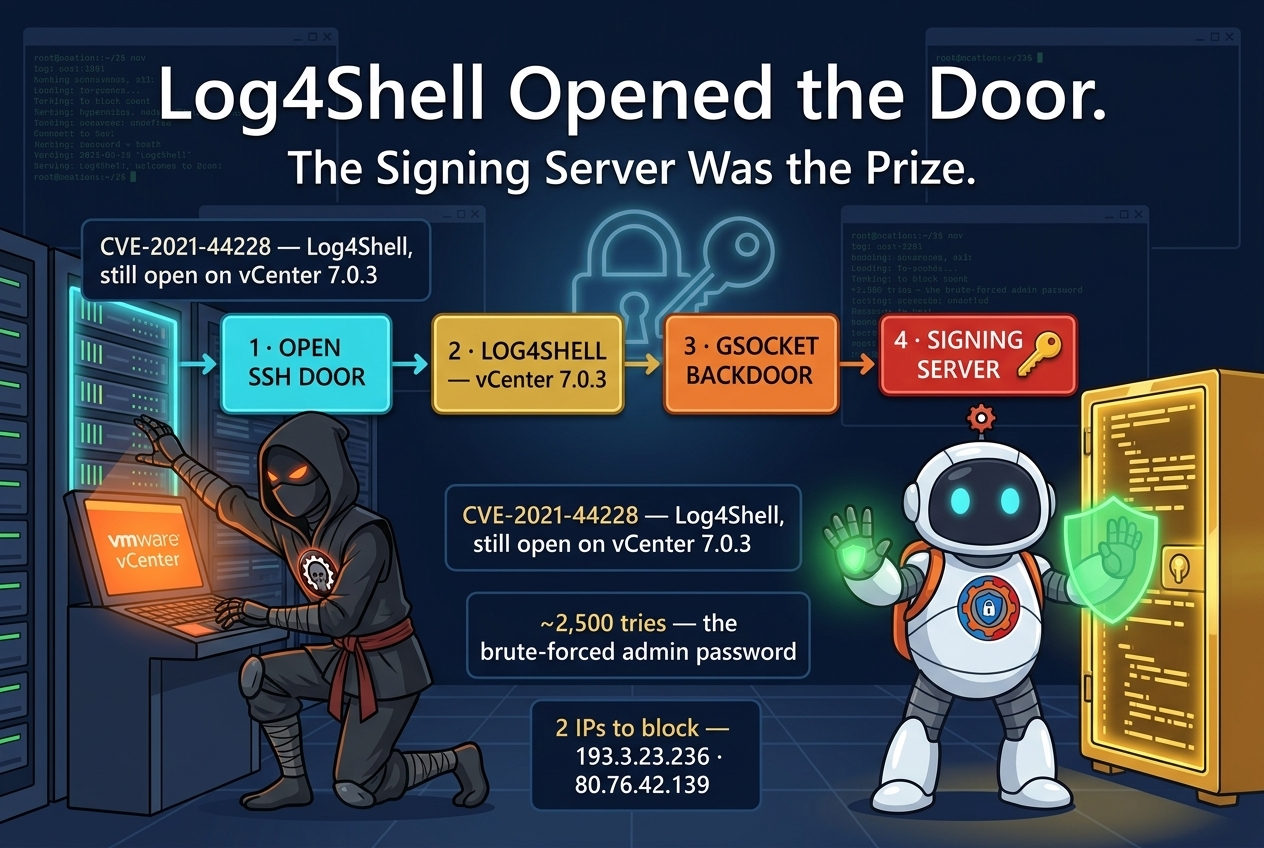
The break that mattered was a flaw defenders have known about since December 2021. The victim’s VMware vCenter server, version 7.0.3, was still vulnerable to Log4Shell (CVE-2021-44228), the Log4j remote-code-execution hole. BO Team exploited it for a root shell on vCenter, then used SSH to step onto the hypervisor.
Persistence was the clever part. A shell script called “pgcache” in /etc/cron.hourly/ re-ran itself every hour. It fetched a second script from a free subdomain on the nofrillsdns.com dynamic-DNS service, which downloaded GSocket — a legitimate remote-access utility used as the backdoor. When the command server was down, the DNS record pointed at 127.0.0.1; switching the backdoor on was a DNS-record change, not a new intrusion. GSocket has shown up in this lane before — the same tool hid behind a patched flaw in an earlier intrusion we covered.

From one cluster to the keys
From the hypervisor, the attackers abused its certificate to reach a second virtualization cluster and plant the same backdoor there. Virtualization keeps coming up as the weak seam: an earlier attack we covered crossed from a firewall straight into VMware ESXi. After reconnoitring VMs and firewalls, they breached the GitLab server — stealing source repositories and, more importantly, its private key. That key opened the Ansible orchestration system, which hands out access to everything it manages.
The domain controller fell through a sysadmin’s credentials. The group dumped LSASS memory with Nanodump and comsvcs.dll and decrypted the NTDS database to recover credentials for every domain user — helped by the same administrator password being reused across domains. Exfiltration went out over OpenSSH scp. They also modified /usr/bin/nxnode-login to siphon credentials into shared memory, and brute-forced the terminal server’s admin password after roughly 2,500 attempts. Timestomping and log deletion covered the tracks throughout.
Why the signing server
None of this was about ransom or destruction — no data wiping, no public claim. The prize, Kaspersky says, was the code-signing server, and the likely goal was a supply-chain attack. Hold the signing keys and you can slip malicious code into a build moments before signing, so it ships wearing the victim’s trusted signature — or steal the signature and sign your own malware with it.
The second act
Losing access did not end it. In July the group ran a phishing campaign warning recipients their “account disconnected from the mail server” — and the messages sailed past SPF and DKIM checks because they were signed with the victim’s own stolen mail-server private key. The lure pointed at a page built by a service that clones the victim’s official site. Stolen credentials do not just open doors — they let attackers wear the victim’s identity.
Why this matters now
Four years after Log4Shell, a known, patched CVE-2021 flaw still opens the door — because the vulnerable software was still running, still reachable, still unpatched. The rest of the chain was ordinary hygiene failures: an exposed management port, reused admin passwords, signing keys on a reachable build host, persistence in a directory few admins inspect. Kaspersky published indicators with the report, including two IP addresses on a Ukrainian provider: 193.3.23.236 and 80.76.42.139.
Four checks to run today
1. Patch the 2021 flaw. Inventory every Java application and vCenter instance, including the ones nobody owns anymore, and confirm none is still exposed to Log4Shell.
2. Hunt the persistence. Audit /etc/cron.hourly/ and scheduled tasks on Linux hosts and hypervisors for scripts you did not place, and watch for GSocket traffic and odd DNS lookups to free dynamic-DNS services.
3. Guard the signing keys. Move code-signing keys into a hardware security module or an offline vault, with signing done through a controlled pipeline — never from a build host an attacker can reach.
4. Segment the hypervisors. Keep virtualization management off the domain, on its own network segment, with unique admin passwords and multi-factor authentication. One compromised hypervisor should never hand over a second cluster, GitLab, and the domain controller in one move.

BO Team never got to finish what it started. But the most dangerous attacks are often the quiet, patient ones — riding in on flaws defenders already know about.