









The Worm Came Back. The Loader Got Smarter.
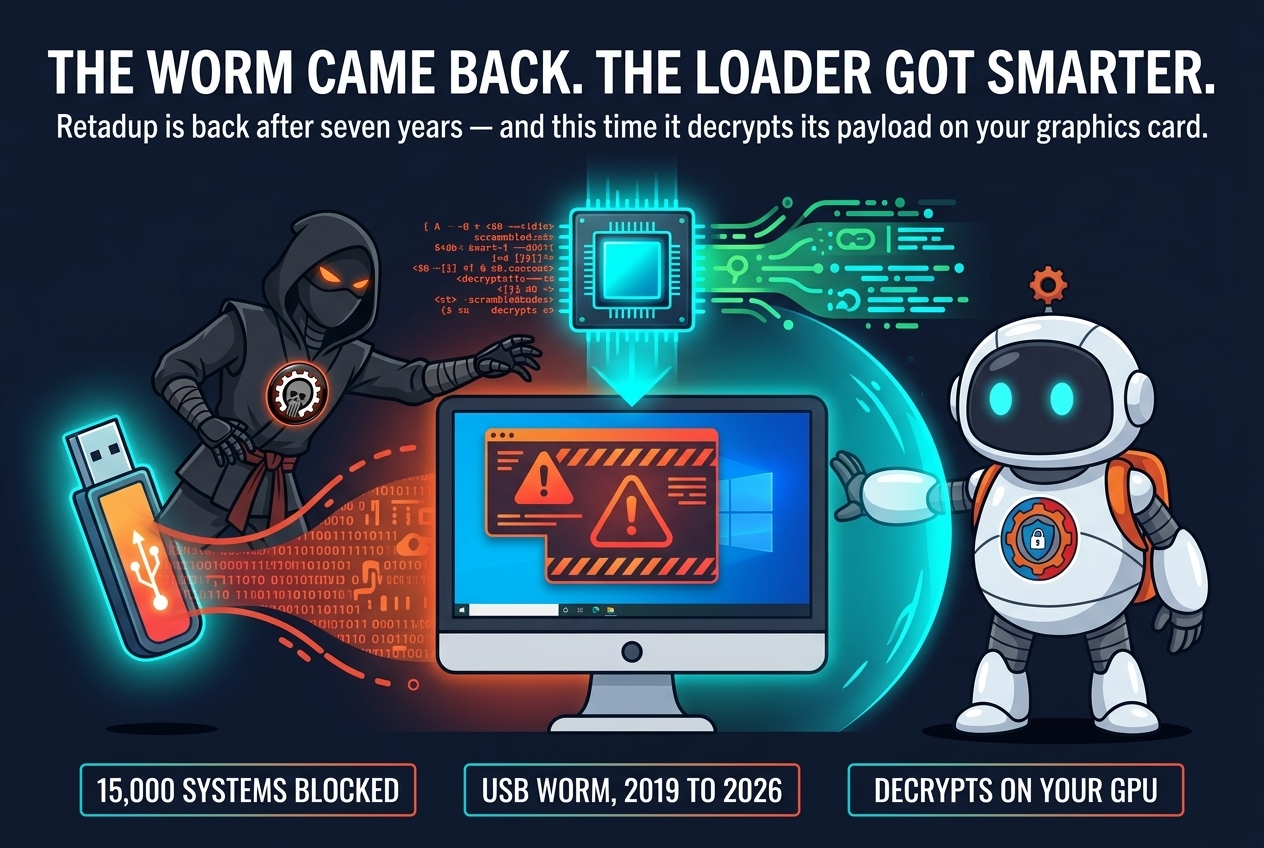
A worm most teams had filed away as history is back. Retadup — the USB-spreading worm French police disrupted in August 2019 — has resurfaced, now carrying a newer payload: CoffeeLoader, a malware loader first documented in March 2025. Kaspersky says it blocked around 15,000 systems from being infected, most in Peru, Angola, Russia and Bolivia. Those are blocked attempts, not confirmed infections — but the old worm still has reach, seven years after it was supposed to be dead.
Retadup was never sophisticated. It copied itself onto USB drives, and every infected drive plugged into a new machine gave it another chance to spread. In its first life it dropped crypto miners, the Stop ransomware family and the Arkei password stealer. The new version keeps the same delivery trick and swaps in a newer payload.
The infection chain: a fake installer and a hijacked graphics card
The worm arrives as an NSIS installer, a format countless legitimate Windows programs use. When it runs, it drops a patched copy of 7z.dll — a modified version of the well-known 7-Zip library — into a temporary directory and executes it through rundll32.exe, a trusted Windows tool for running library code. Nothing about that step looks alarming on its own. That is the point.
Inside the patched library, part of the original code is replaced with malicious self-decrypting shellcode — a new version of a packer called Armoury, first seen with CoffeeLoader earlier this year. The packer hijacks functionality belonging to Armoury Crate, the ASUS system utility, using files such as “ArmouryAIOSDK.dll” and “ArmouryA.dll” to hide its work. Then the unusual part: the shellcode decrypts itself on the graphics card — originally via OpenCL, now via OpenGL — keeping the code out of the places most security tools watch.
The new packer also changes what it delivers: intermediate shellcode — a small downloader — which fetches the main CoffeeLoader malware. CoffeeLoader is a loader, not a final payload: it takes orders from its command-and-control server and can inject the next-stage malware into a running process, save it to disk as an executable and run it, or save it as a DLL and run it through rundll32.exe. Researchers note it shares source-code similarities with SmokeLoader, a long-running loader family.

How it sticks around — and hides its own autorun
Once it lands, the malware works hard to survive a reboot. It copies the patched 7z.dll into subfolders of %PROGRAMDATA% or %LOCALAPPDATA% and creates a Run registry key so Windows launches it automatically at sign-in. The subfolder, the library file and the registry value are all named with eight hexadecimal digits generated from the system’s volume information, so the names differ on every machine, defeating filename-based detection. It also blocks the user from disabling autorun through Task Manager, closing off the obvious fix.
Once persistence is in place, the malware launches a legitimate process — dllhost.exe, WerFault.exe, svchost.exe, OpenWith.exe or AtBroker.exe — injects itself into it, then downloads shellcode from a hard-coded command-and-control server that decrypts and runs CoffeeLoader.

Why it matters: somebody rebuilt the worm’s old infrastructure
Strangest is the infrastructure behind it. About two years ago, someone began re-registering the domain names Retadup had used as command-and-control servers. At first those servers distributed SmokeLoader packed with the 32-bit Armoury packer; in early 2025, the same servers started serving CoffeeLoader. It is unclear whether the worm’s original author brought the servers back online or a different actor took them over.
Either way: dead malware is only dead until someone revives the plumbing. The USB mechanism was never patched out of existence — it relies on people plugging in drives — and the domains were cheap to re-register.
USB drives remain an old infection route — and worms riding trusted tools are nothing new: earlier this month, ScreenConnect itself was turned into a worm that hit 288 endpoints in 90 minutes.
Four checks for your environment
Control USB drives. Restrict removable media through policy or endpoint controls where you can, and keep USB autorun disabled. Treat any found or borrowed drive as untrusted — the worm’s distribution depends on a drive being plugged in.
Watch rundll32.exe abuse. Rundll32 is legitimate, but it should almost never launch a 7z.dll from a temporary folder or a %PROGRAMDATA% subfolder — alert when it loads libraries from unusual paths, or when its parent is an installer or a removable drive.
Monitor Run keys and autorun settings. Watch for new Run registry entries with eight-hex-digit names under %PROGRAMDATA% or %LOCALAPPDATA%, and for changes to the keys that let users disable startup items.
Loader malware keeps getting harder to spot — fake security tools were pushing backdoors the same way.
Lean on behavior, not just signatures. A worm that decrypts its payload on the GPU and hides inside dllhost.exe or WerFault.exe is built to slip past file-based detection — endpoint protection that watches process injection, unusual GPU activity from non-graphics software, and unexpected outbound connections is the best chance of catching it.
Retadup’s return is not a story about a brilliant new exploit. It is a story about recycling: an old worm, a re-registered domain, a repurposed hardware utility and a loader borrowed from an older family — assembled into a chain that still works because the defenses it bypasses are the ones organizations assume they already have. The cheapest link is still a USB drive in a pocket.