





Your Card Was Typed. The Skimmer Kept It.
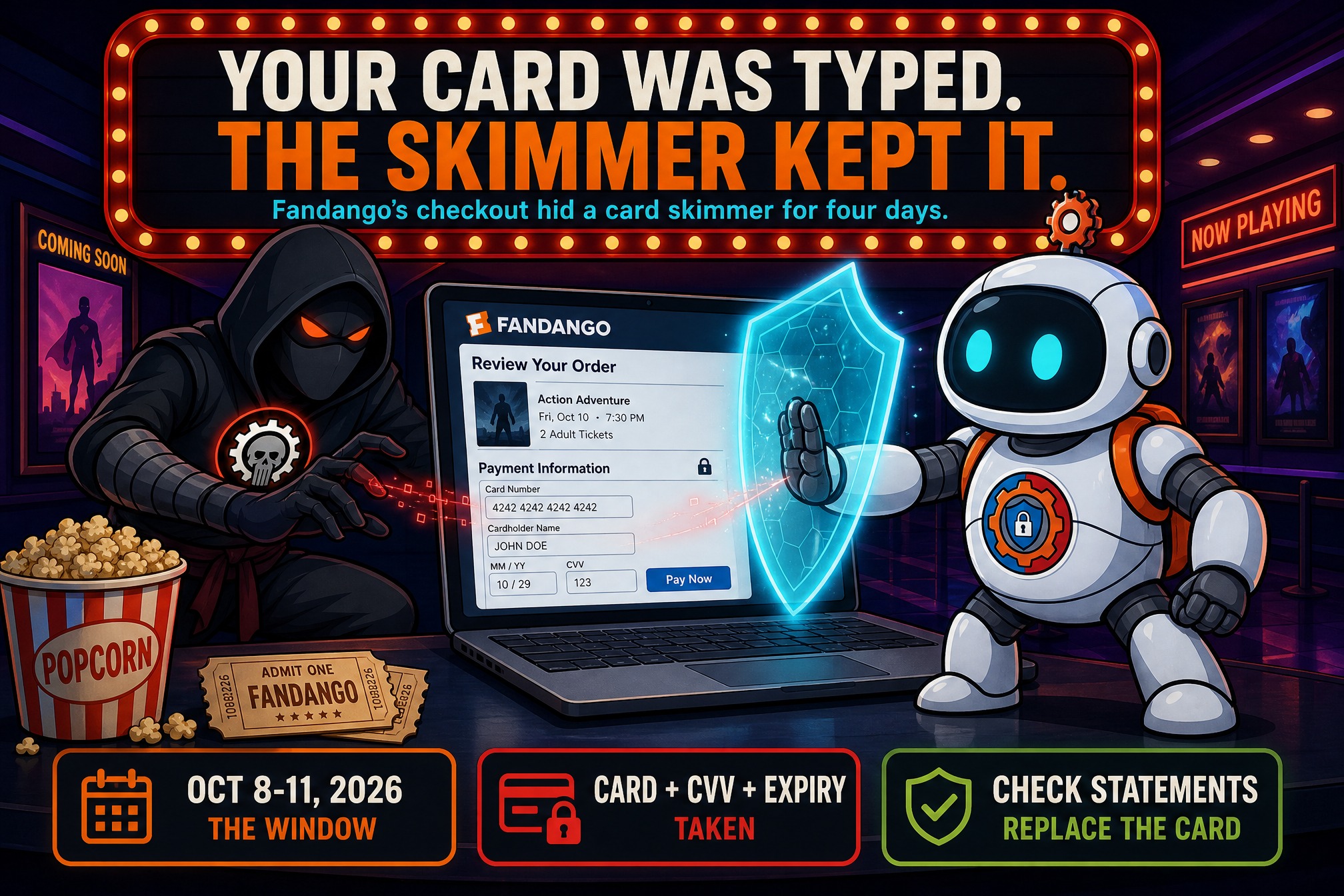
Fandango is notifying customers that hackers stole payment card details straight from its checkout pages — not from a database, but from the page itself, as customers typed. If you bought tickets on Fandango between October 8 and 11, 2026, your card number, security code, and expiration date may have gone to the attackers with your order.
Fandango Media is the biggest name in US online movie ticketing, selling tickets for 31,000 cinema screens, including AMC, Regal, and Cinemark. A four-day window on a platform that size is a lot of checkouts.
The mechanism is becoming the standard way to steal cards. Attackers injected card-skimmer code into Fandango’s checkout page. The page looked normal and the purchase worked — but the injected code copied the payment details as they were entered and sent them to the hackers. Nothing to spot: no error, no warning, no broken page.
Four days of checkouts, copied keystroke by keystroke
The skimmer was live on the checkout page from October 8 to 11, 2026. Fandango determined on October 30 that customer information may have been impacted; notifications began November 16. Fandango says it has fixed the issue and investigated with outside specialists.
Fandango has not said how many customers are affected, and it says it is not aware of any fraud using the stolen data so far. But a four-day skimmer on the country’s largest ticketing platform does not need a headline number to be serious.

What was taken — and what was not
The exposed data is the full set a thief needs to spend a card online: card number, CVV verification code, expiration date, billing ZIP code, and email address. With a card number alone, an attacker has a guess; with the CVV and the expiration date, they have a working card.
What was not exposed matters too. Fandango says the incident did not expose names, government-issued identity information, Social Security numbers, or any other account information. The stolen data is built for unauthorized purchases, not for opening accounts or stealing an identity outright. A suspicious file exposed 7.7 million shoppers at Iris Ohyama the other way around — names, addresses, and dates of birth, but no card data. Here the split is reversed: the cards are the prize.
Cold comfort if your card was in the window. Fandango is offering two years of free IDX credit and dark-web monitoring, plus identity theft recovery services, with enrollment open until February 13, 2027. The monitoring is free, but it only helps if you sign up — and the deadline is three months away.

Why the checkout page is the new front door
The checkout page itself has become a target. Attackers do not need to break into a company’s servers — they need a foothold in the code running in the customer’s browser, and the payment form does the rest.
Breach notifications also travel slowly: the skimmer ran October 8 to 11, the impact was confirmed October 30, and customers are hearing about it November 16 — more than a month after the last exposed purchase. The newsletter leaked at SEGA followed the same slow arc — a vendor’s first assurance, then a fuller picture days later. The lesson is the same in both cases: do not wait for the letter to check your statements.
What to do now
Check your statements from October 8 onward. Look at every card you might have used on Fandango during the window. Stolen card data is usually tested with small online purchases first, then used at full size. Report anything unauthorized to your card issuer right away — the issuer, not Fandango, can block and reverse the charges.
Replace the card, don’t wait for fraud. If you used a card on Fandango between October 8 and 11, ask your issuer for a new number. A card typed into a compromised checkout is a card whose details are already in someone else’s hands — waiting for a fraudulent charge to prove it is the expensive way to find out.
Enroll in the free monitoring before February 13, 2027. Fandango’s two years of IDX credit and dark-web monitoring cost nothing, and the monitoring is the piece that matters: it watches for your card details and email surfacing where stolen data gets traded. Set a reminder now — there is no reason to leave free coverage on the table.
Use a virtual card or a hosted checkout next time. One-time virtual card numbers — offered by most major banks — mean the number you type is useless the moment the purchase is done. Wallet payments such as Apple Pay and Google Pay go further: your real card number never reaches the merchant’s page at all. A skimmer can only copy what you type, so the strongest defense is typing nothing worth stealing.
The movie ticket is the smallest part of this story. The part that matters is the checkout page — where everyone types their most sensitive numbers into a form they have no way to inspect. Fandango fixed its page; the next skimmer is already running somewhere else. Check the card, replace it, enroll in the monitoring, and make the next checkout one where there is nothing to skim.