








One Vendor’s Script. 178 Famous Sites.
Monday morning, visitors to some of the most trusted sites on the internet loaded pages that had quietly turned against them. CNN, the BBC, Zoom, Salesforce — everything looked normal, and the scripts came from the vendor’s own servers. But inside one script, an attacker had hidden a second program, watching everything visitors typed and pasted.
What happened
The vendor was Optimizely, whose Web Experimentation tool tests different versions of a page. An attacker exploited a flaw in the account signup flow and injected malicious JavaScript into customers’ projects. Optimizely has confirmed the incident; its notice went up at 01:02 UTC on Tuesday, November 17. The campaign is tracked as OPTIMJACK.
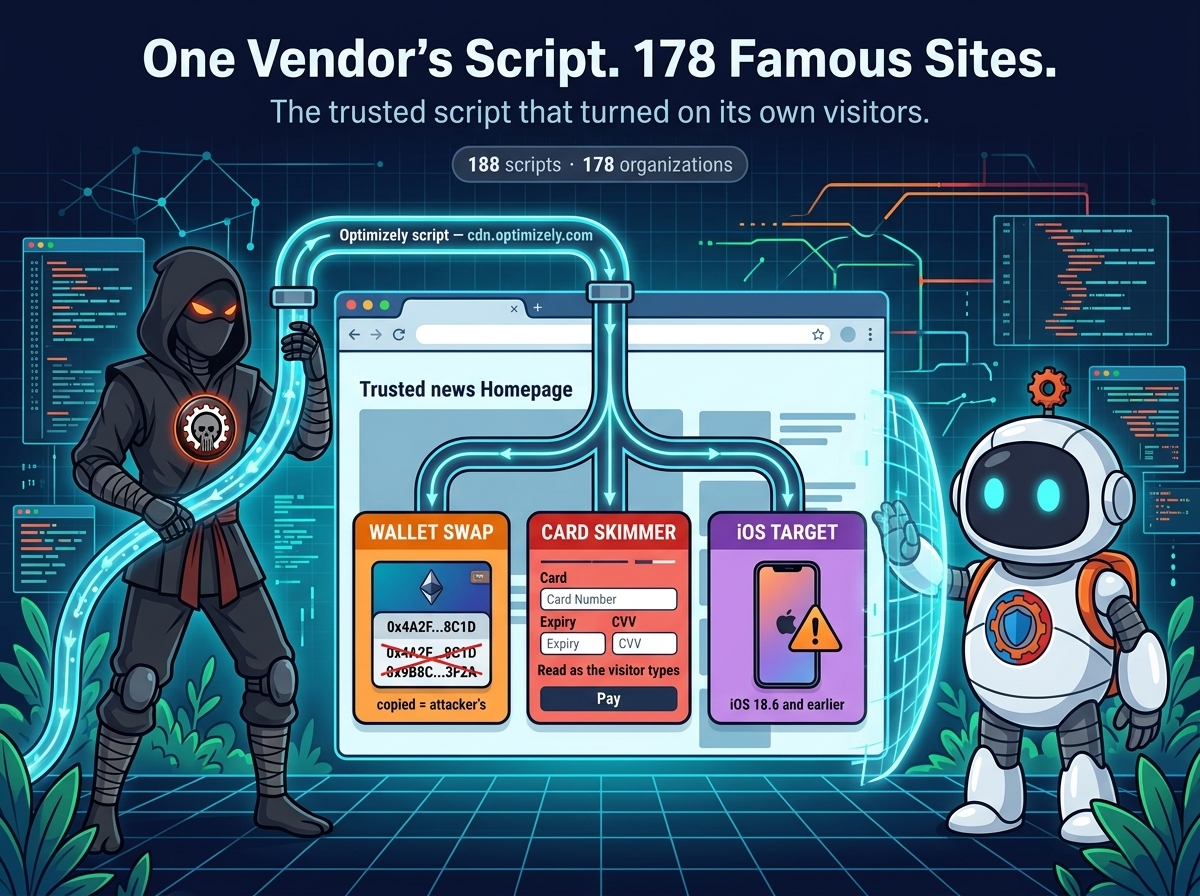
The scale is the story. Researcher Scott Helme, working with data from Report URI, checked 1,611 Optimizely snippets and found malicious code in 188 of them, belonging to 178 organizations — including CNN, the BBC, Zoom, Salesforce, IKEA, and HSBC. Optimizely’s own site and login page carried it too. The first injection was spotted at 04:21 UTC on Monday, November 16, in the BBC’s snippet.
The loader hides inside the project’s own JavaScript, and the snippets still load from cdn.optimizely.com — the vendor’s own delivery network — which is why nothing looked wrong. Researchers found three versions: one that pulls its payload straight from 1688360[.]cc/track.js, one that hides the address in base64, and one that carries a full copy of the payload in case the domain gets blocked.

What the payload does
The payload, track.js, is built for theft in plain sight. It scans a page’s text, forms, links, clipboard, and outgoing requests for crypto wallet addresses, swapping only ones that pass a checksum test and sit near words like wallet, deposit, or send. That selectivity is the point: the attacker’s address looks exactly like the real one, and by the time a victim pastes it into a wallet, the money is already gone. It also grabs the visitor’s cookies and screenshots the page, sending both to the attacker.
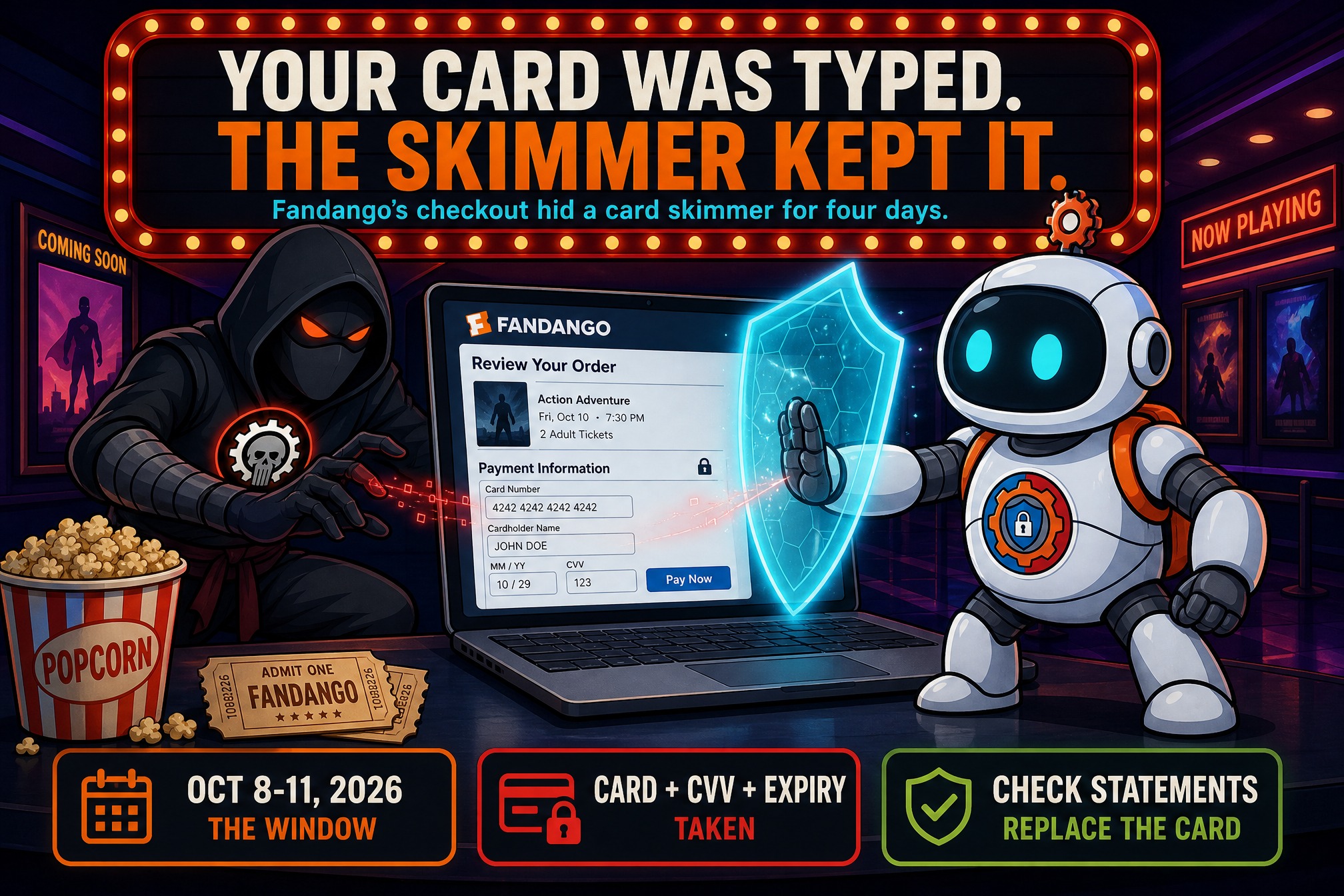
A card skimmer joined the campaign at 13:43 UTC on Monday. It reads card numbers, expiry dates, and security codes from form fields as visitors type. It cannot reach inside cross-origin payment frames such as Stripe or Adyen, but card details typed into a site’s own checkout form were exposed.
Then the iOS second stage. A script called boot.js pushes iPhone and iPad visitors toward two exploit kits: Coruna, aimed at iOS 13.0 through 17.2.1, and DarkSword, aimed at iOS 18.4 through 18.7. Between 17:13 and 17:57 UTC on Monday, the attacker added a Coruna iframe to every visit from iOS 18.6 or earlier. iOS 18.7.3 and 26.3 close those holes, and security firm Cynet, testing against an emulated iPhone, found the delivery conditional — “not a successful compromise of a physical iPhone or iPad.”
About $7,040 in cryptocurrency had been stolen by 19:25 UTC on Monday, per StepSecurity (~$6,600). Two attacker addresses predate the campaign, so not every transfer is a victim’s. Cleanup began around 20:40 UTC; by 21:52 UTC only TalkTalk’s snippet still carried the code. But Smartsheet’s script was cleaned once and then infected again — the attacker still had access. Optimizely’s notice still does not say how the flaw worked, when the fix went in, or whether the attacker still has access.
Why it matters
The lesson is the oldest one in supply-chain security: you do not choose all the code your site runs. One trusted script, loaded from a vendor you vetted, can turn every page it touches into a collection point. It is a familiar shape: a single vendor key opened every customer’s cloud in the Qubole breach, and a help-desk tool became the attacker’s foothold across 288 endpoints in the ScreenConnect attacks. The same injector, hosted at webshell[.]lol, was also planted through Kissmetrics, StorifyMe, and Minute Media scripts — not a one-vendor accident.

What to check
If you run a website: audit every third-party script your pages load — especially vendor-injected code — and check for changes in the last week. If you run Optimizely Web Experimentation, confirm your snippets are clean, and keep checking: Smartsheet’s re-infection proves one clean scan is not enough. Then block the attacker’s infrastructure — the domains and address below, plus webshell[.]lol — move card entry into hosted payment frames, and set the HttpOnly flag on every cookie that does not need JavaScript access.
If you visited one of these sites on Monday: if you sent cryptocurrency from an affected page, compare the destination address character by character with the one you intended — the attacker’s address is checksum-valid too. Money sent to the wrong address is almost certainly gone — report it to your exchange. If you typed card details into a site’s own checkout form, watch the account and consider replacing the card. And update your iPhone or iPad — iOS 18.7.3 and 26.3 close the holes the kits target.
Indicators to block
- 1688360[.]cc — /track.js, /card.php, /hit.php
- 136.113.106[.]136
- 5vobauua3ojpklx[.]icu and eil786npto9u5bq[.]icu — iOS boot.js
- webshell[.]lol — injector, also planted via Kissmetrics, StorifyMe, and Minute Media
- SHA-256 f7b84b9a94f749f8ced3f0112d0a66894e8bbc3b4aa5592021d1b8976a9bad40 (final track.js); 617df364120adc47fb4f55dcc0c69a9b6c9e108a92c60bc2b64a266254ab02f3 (earliest)
The victims did nothing wrong — they visited sites they trusted, and the trust itself was the weapon. Until vendors guard a signup flow like a login page, the next trusted script is already loading.