












A Signed Certificate. Full Control of the Fleet.
What happened
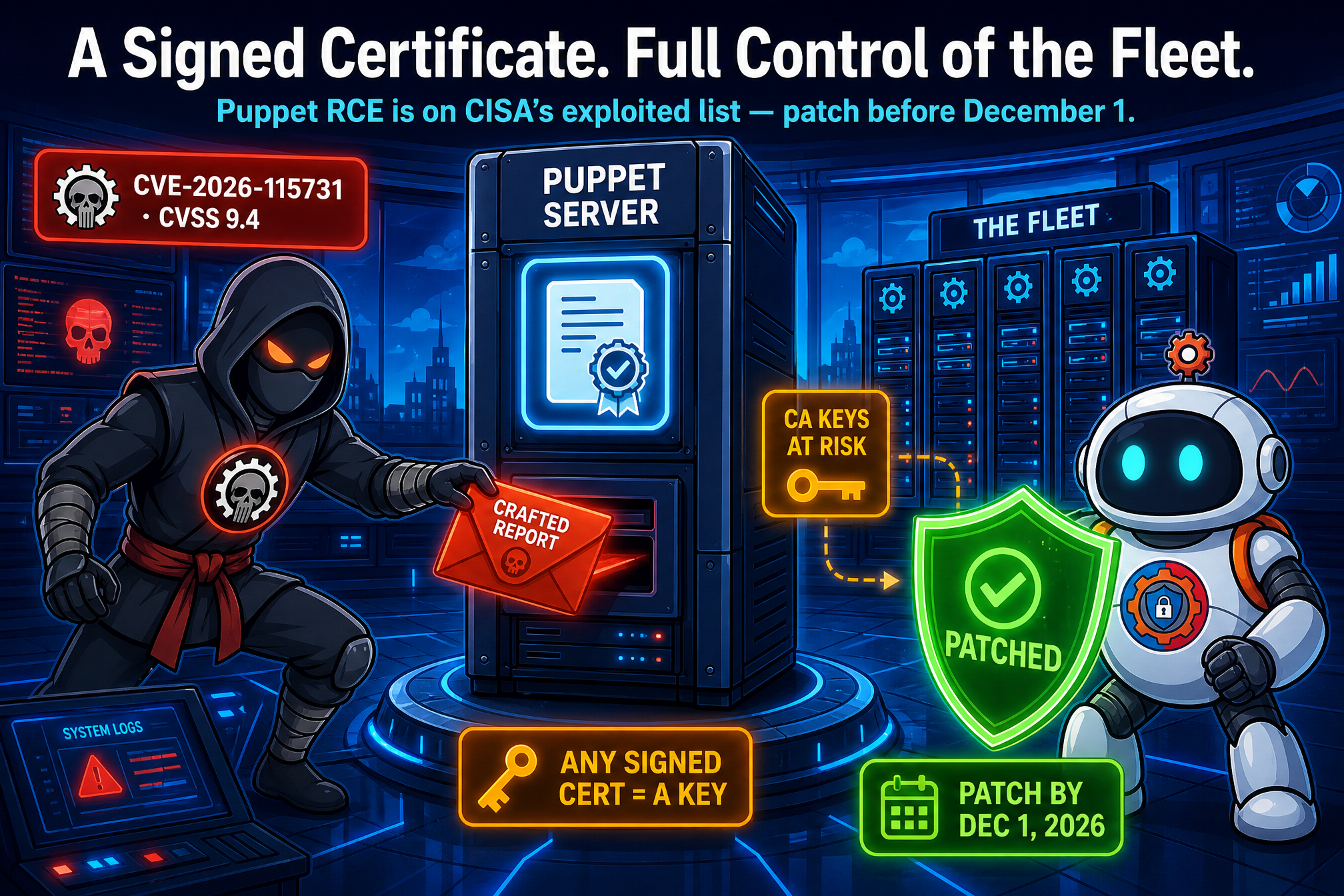
On Tuesday, November 17, CISA added a new name to the list of flaws attackers are already using in the wild. CVE-2026-115731 — a critical remote code execution bug in Puppet — joined the Known Exploited Vulnerabilities catalog, the patch-now list for federal agencies. It scores 9.4 out of 10, and it lives in the tool many enterprises trust to configure and control their entire server fleet. The fix has been out since November 3. The exploitation, apparently, did not wait for it.
Puppet works like a control tower for infrastructure. Instead of logging into hundreds of servers one by one, administrators write down how every machine should look, and Puppet’s agents check in with a central server and apply that desired state. That power is also the risk: the server that tells every machine what to do is trusted by every machine.
The bug sits in how the Puppet Server handles the reports agents send back after each run. There, the server unpacks incoming data without checking it properly — deserialization of untrusted data. An attacker holding any agent certificate signed by the organization’s certificate authority can send a report carrying a crafted rich-data type in a PUT request, and the server runs the attacker’s code as the Puppet service account. No stolen password, no phishing email.
The uncomfortable part is how ordinary the key is. CISA’s warning puts it plainly: when the certificate authority signs requests automatically, without strong verification, an attacker can simply obtain a valid certificate and walk in. If your setup auto-signs requests, the front door may already be open.

Who is affected — and what to install
Perforce, which maintains Puppet, shipped fixes on November 3 across every supported line. Puppet Enterprise needs 2026.0.1, 2025.12.1, or 2023.8.13. Puppet Core needs 9.1.3 or 8.22.2. OpenVox is affected too: Agent 9.3.0 / 8.32.0, Server 9.2.0 / 8.18.0.
For federal civilian agencies, this is now a deadline, not a suggestion: under binding operational directive BOD 26-04, fixes must be applied by December 1, 2026. Treat that date as the clock too — once a flaw lands on the KEV list, every attacker with a scanner knows it is real and unpatched in plenty of places. The list keeps growing: just last week, four more flaws landed on it with a November 12 deadline.
A second flaw from the same researcher
CVE-2026-115731 did not arrive alone. The same researcher, Alain Rödel of Neodyme AG, also reported CVE-2026-115732, a certificate-name authorization bypass scoring 9.0 that affects Puppet and OpenVox as well. The second weakens the checks on whose name a certificate belongs to — a different door into the same house. Neodyme says the issues were found with AI assistance and precise steering.
Why this one is different
Most critical flaws give an attacker one machine. This one hands them the machine that configures all the others. Puppet runs, in the researchers’ words, “often with full access to a fleet of systems in a corporate network.” Neodyme warns that, regardless of configuration, an attacker with code execution on the Puppet server can grab the certificate authority’s signing keys and impersonate other hosts. From there: ransomware deployed fleet-wide, mass data exfiltration, and lateral movement from a position of total trust.
The same pattern showed up in other critical flaws that arrived through trusted channels — the QNAP Plex2Shell chain showed how a single crafted request can open the whole door. The difference is the blast radius: a compromised Puppet server can push whatever it wants to every managed host.
Weaponization details are still thin, but the timeline is unsettling. A Reddit user posting on November 4 — one day after the fixes shipped — said the flaw had already been exploited shortly after disclosure, after finding a badly misconfigured certificate authority in their fleet and tracing an intrusion back to this flaw. A single report, not a confirmed campaign, but it fits the pattern: KEV listings rarely arrive before real-world abuse.
Four checks to run today
1. Patch to the fixed versions. Enterprise 2026.0.1, 2025.12.1, or 2023.8.13; Core 9.1.3 or 8.22.2; OpenVox Agent 9.3.0 / 8.32.0 and Server 9.2.0 / 8.18.0. Start with servers reachable from less-trusted networks, and treat December 1 as your deadline even outside federal agencies.
2. Audit autosign. Check whether your certificate authority signs requests automatically. If it does, tighten verification or turn autosigning off — every automatically signed certificate is a potential key to this flaw, and an attacker only needs one.
3. Review the certificate authority itself. Look for certificates you do not recognize, especially recent ones, or ones for hosts that never asked. Revoke anything suspicious and rotate the keys — and assume the signing keys may be exposed if the server was reachable while unpatched, a patched server with stolen CA keys is still compromised.
4. Hunt for signs of intrusion. Search your Puppet Server logs for unexpected report submissions and odd activity from the Puppet service account. If anything looks off, treat it as a full incident: one intrusion here can reach the whole fleet.

A signed certificate is supposed to mean “this machine is one of ours.” This week it meant the opposite: a valid credential, a crafted report, and suddenly the control tower answers to someone else. Patch it, check the keys — the fix alone does not close the door.