

















Eleven Flaws Patched Today. The 9.2 Is Still a Rumor.
Oracle is releasing security patches for Java today, Tuesday, November 17, 2026. Eleven vulnerabilities in Java SE, all of them exploitable remotely, and none of them requiring an attacker to log in first.
That combination is what makes this patch worth your attention even before the details arrive. Oracle has confirmed the count, the timing, and the worst severity score. It has not published the CVE identifiers, the affected components, or what each flaw actually lets an attacker do. The patches land first. The explanations come later.
The highest score among the eleven is 8.1 on the CVSS 3.1 scale, the 0-to-10 severity rating the industry uses to rank flaws. An 8.1 is firmly in the high range: serious enough to patch fast, not so catastrophic that it stops everything else. But the number alone understates the problem. Eleven flaws, all reachable over the network, all with no login required, is a wide attack surface — and the missing details mean defenders cannot yet tell which of their systems are exposed to the worst of them.
The affected versions span nearly every supported line. Oracle Java SE 8u511, 11.0.33, 17.0.21, 21.0.13, 25.0.5, and 27.0.1 are all affected, along with GraalVM for JDK 17.0.21 and 21.0.13, GraalVM Enterprise 21.3.20.0.3, and JavaFX 21.0.13, 25.0.5, and 27.0.1. The replacement builds are 8u513, 11.0.33.1, 17.0.21.1, 21.0.13.1, 25.0.5.1, and 27.0.1.1 — and Oracle advises customers to stop using the current builds once today’s update is out.

The 9.2 Is a Report, Not a Fact
Separate from Oracle’s announcement, a second story is circulating — and it needs to be handled with care. Security firm Calif says it found and reported a flaw it calls “Java4Shell,” tracked as CVE-2026-114938, with a reported CVSS 4.0 score of 9.2, affecting OpenJDK 17.0.6 and later. The firm says the flaw leaked, and that it will publish technical details by 1 p.m. Pacific today, after Oracle releases a patch.
Here is what is not known. The CVE record remains reserved, with no public description. There is no official advisory, no evidence of exploitation, and the flaw does not appear in CISA’s Known Exploited Vulnerabilities catalog. Researchers at watchTowr have publicly cautioned that the details are still unconfirmed. The OpenJDK Vulnerability Group had published nothing newer than October 24 at the time of this writing.
Most importantly, it is not established whether this reported flaw is one of the eleven Oracle is patching today. Oracle’s notice covers Oracle products only. It says nothing about the patch status of third-party OpenJDK distributions — the builds from other vendors that many organizations actually run. Treat the 9.2 as a report, not a fact, until a vendor or the CVE record confirms it.
Why It Matters
Java runs everywhere that matters: back-end services, enterprise applications, and the middleware that holds older systems together. A remote, no-login flaw in a runtime that widespread is the kind of thing attackers scan for within hours of a patch release — not because every flaw is easy to exploit, but because the payoff for finding one is enormous. We have seen the same shape recently: a 9.8 in Apache HTTP Server that needed no login at all.
The window between a patch release and the first exploit attempts is famously short. The patch is out, and the attacks are already here is not a prediction — it is the pattern. Fixes ship, and the race to exploit the unpatched begins the same day. With eleven flaws and no public details yet, the safest assumption is that attackers will be reading the patches themselves to work out what changed.
What to Do Today
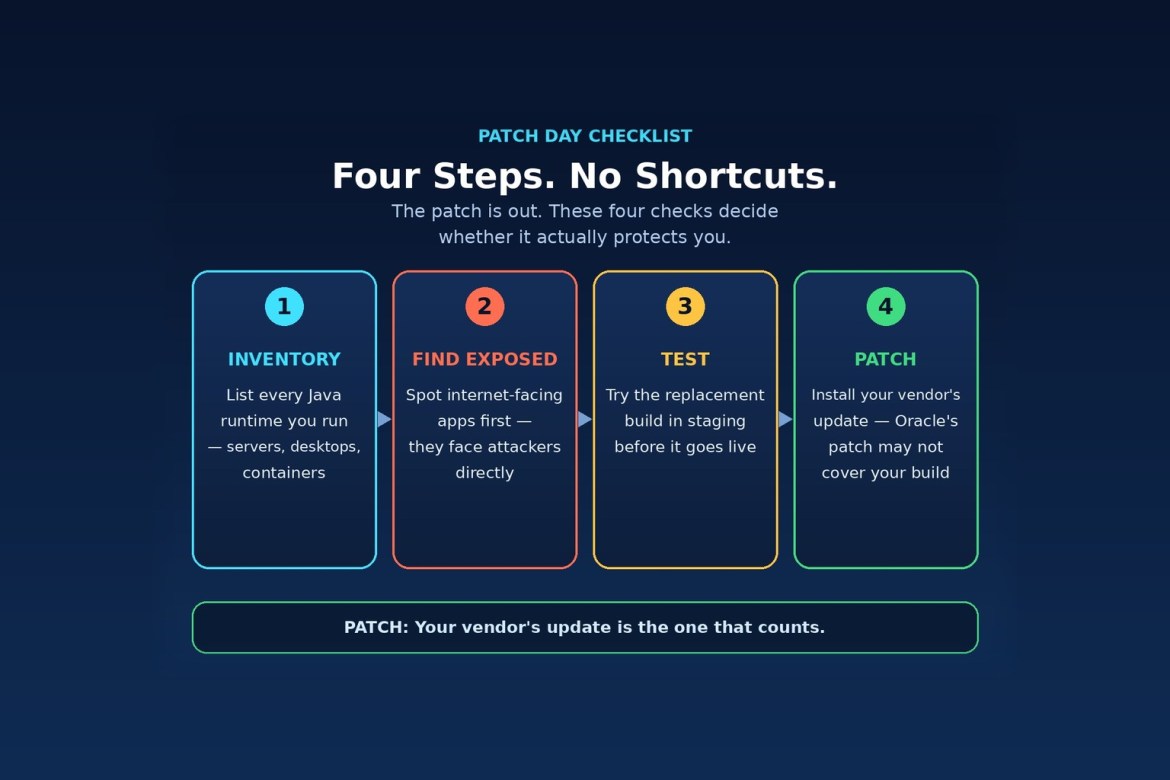
Four checks, in order. None of them is complicated. All of them matter more than waiting for the full advisory.
1. Inventory your Java runtimes. List every version running anywhere — servers, desktops, containers, build machines. You cannot patch what you have not found, and Java has a habit of hiding in places nobody remembers installing it.
2. Prioritize internet-facing applications. Anything reachable from the internet goes first. Internal systems matter too, but the exposed ones are where a remote, no-login flaw turns into an incident.
3. Test the replacement build, then install it. Move to the replacement builds Oracle listed. Test in staging first, but do not let testing become a delay — the window is short, and the flaws are already public knowledge in outline.
4. Check your vendor, not just Oracle. Oracle’s patch covers Oracle products. If you run another OpenJDK distribution, your vendor’s advisory is the one that matters, and it may arrive on a different schedule. Do not assume you are covered until your vendor says so.
The confirmed news today is straightforward: eleven flaws, a patch, and a clear instruction to move to the replacement builds. The 9.2 is a story still waiting for its confirmation. Patch for the first. Watch for the second. And do not confuse the two.