
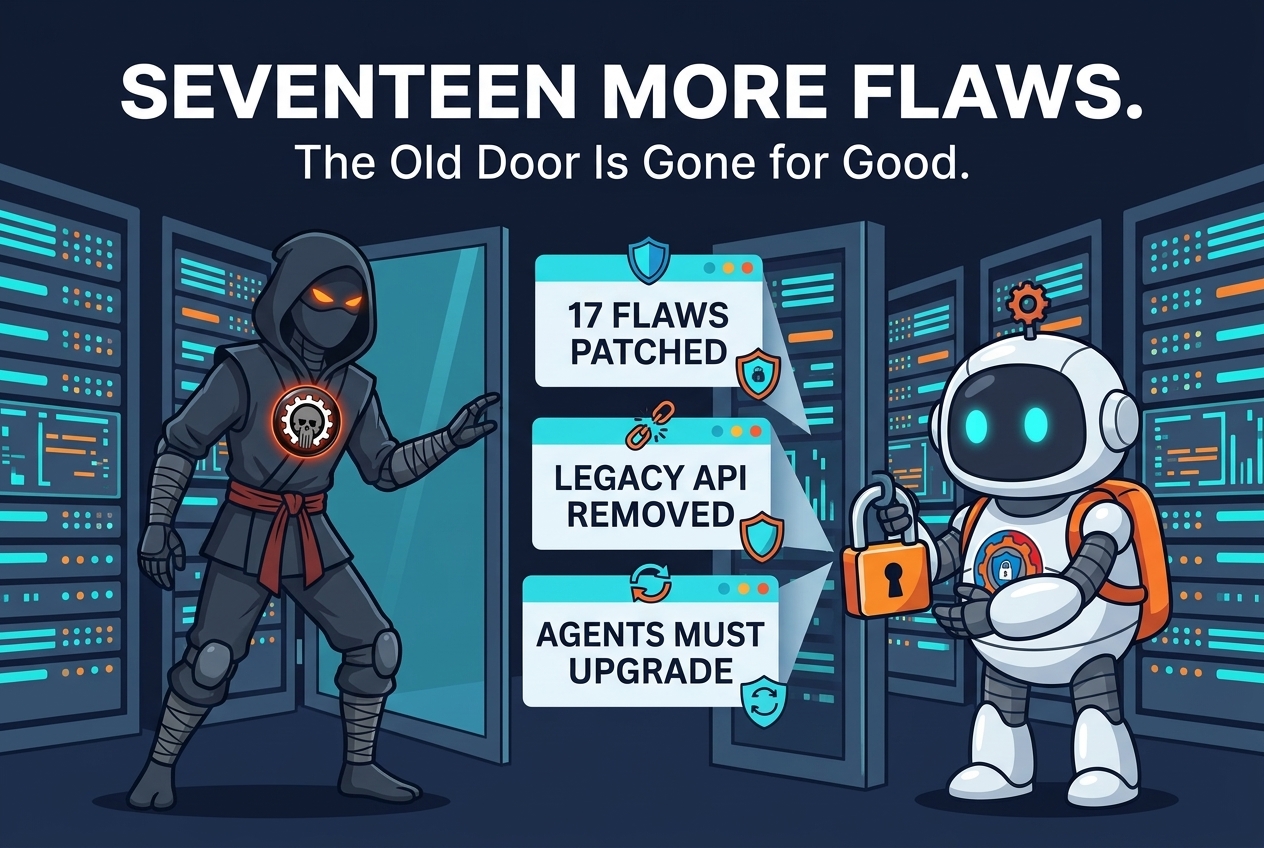












Seventeen More Flaws. The Old Door Is Gone for Good.
Five days after attackers were caught mining cryptocurrency on vulnerable N-central servers, N-able has shipped another patch — and this one does more than fix flaws. N-central 2026.4 Hotfix 3 closes seventeen more vulnerabilities, and it permanently removes the legacy API option that made the original attack possible. The door the attackers walked through is not just locked now. It is gone.
The company calls Hotfix 3 a critical security update, and the list backs that up. The seventeen flaws — CVE-2026-129271 through CVE-2026-129287 — span nearly every part of the platform: authentication and access controls, agent and probe communications, file handling, server components, and user management. Several of them let an attacker act without logging in at all.
Seventeen flaws, four weak spots
The worst of the batch reads like a catalog of missing locks. A predictable passcode let an attacker bypass authentication on the MMS3 appliance. Multiple ServerMMS2 calls — task result submission, asset data submission, maintenance actions — accepted requests with no authentication at all. A password-reset quirk leaked whether an account exists. View-only users could set device execution configuration they were never meant to touch.

The file-handling flaws are the sharpest. A path traversal bug in the SIS GenericFiles version handling leads to remote code execution. A syslog injection in the audit export feature allows root command execution — the attacker hides the crime and runs commands as root in the same move. Two separate XML external entity flaws sit in custom service imports and the SIS repository parser. A server-side request forgery flaw in the report manager and data export settings rounds out the set, alongside SOAP operations missing authorization checks and an XMPP validation error.
N-able has not said any of the seventeen are being exploited, and none of them appears in CISA’s Known Exploited Vulnerabilities catalog as of today. That is the good news. The context is the reason nobody should relax: the flaws this patch follows are being exploited, right now.
The old door is bricked up
Hotfix 3 builds on the protections delivered in Hotfix 2, but its most important change is not a patch — it is a removal. The configuration option for legacy APIs has been completely removed from N-central. The old API mode cannot be switched back on.
That matters because the original attack chain, dubbed 4EverAble2Shell and Agent2Shell by independent researcher Sean Bales, hinged on the legacy API mode being enabled. With the legacy APIs gone, that attack vector is closed at the root instead of patched around the edges. Bales, who disclosed the original flaws, has since published additional details for 24 CVEs and notes that they are patched vulnerabilities that “should not work on the latest patch.” The chain that let attackers run arbitrary code as root on the server and gain SYSTEM-level access on managed Windows machines no longer has its front door.
The exploitation was not theoretical. Attackers were caught deploying cryptocurrency miners on vulnerable servers — including servers that had already applied Hotfix 2 — within days of the disclosure. The miners were the payload, but the lesson was the platform: an RMM tool that manages thousands of endpoints is a prize target, and every unpatched gap is an invitation.
What admins must do now
The instructions from N-able are blunt, and the second half is the one teams usually miss. Customers running on-premise N-central deployments should upgrade their servers as soon as possible. For hosted N-central servers, no server-side action is required — the updates are being applied automatically.
But the server patch alone is not enough. “All customers, hosted and on-premise, must upgrade all of their Agents and Probes to the latest version to be fully protected,” N-able cautioned. “Agents and Probes that are not upgraded are susceptible to impersonation.” An upgraded server talking to an old agent still trusts something an attacker can pretend to be.

There is a cost to the fix, and N-able is upfront about it: as of writing, both remote control functionality and Intune integration are blocked. Teams that rely on N-central’s remote control or its Intune tie-in need a workaround until those return. That is inconvenient. Running an RMM platform with seventeen known holes — after miners already moved in once — is worse.
Four checks before the day is out
First, confirm the Hotfix 3 build is actually installed on every N-central server you own — hosted customers should verify the applied version rather than assuming the automatic rollout has reached them. Second, inventory every agent and probe and upgrade them all; a single forgotten endpoint agent is an impersonation target. Third, check the servers that were exposed during the mining campaign for persistence — the original disclosure showed how quickly exploitation followed, and a miner found now means the box was owned before the patch. Fourth, plan around the blocked remote control and Intune integration now, before a support ticket forces the issue.
N-able patched the flaws, removed the legacy door, and told customers exactly what to upgrade. The rest is execution — and in a week where miners already proved the exposure was real, execution is the whole job.