















The Rumor Was Real. The Fix Is Out.
Yesterday it was a rumor: a reported 9.2 flaw in Java, no confirmation, no patch. Today the story arrived — and it is real.
Calif has published its write-up, and Oracle and the OpenJDK project have released the fix. Java4Shell, tracked as CVE-2026-114938, lets an attacker with no account run their own code on Jira, Jenkins, Keycloak, Confluence, JFrog Artifactory, and PingFederate. Here is what it means, and what to do.
How the Attack Works
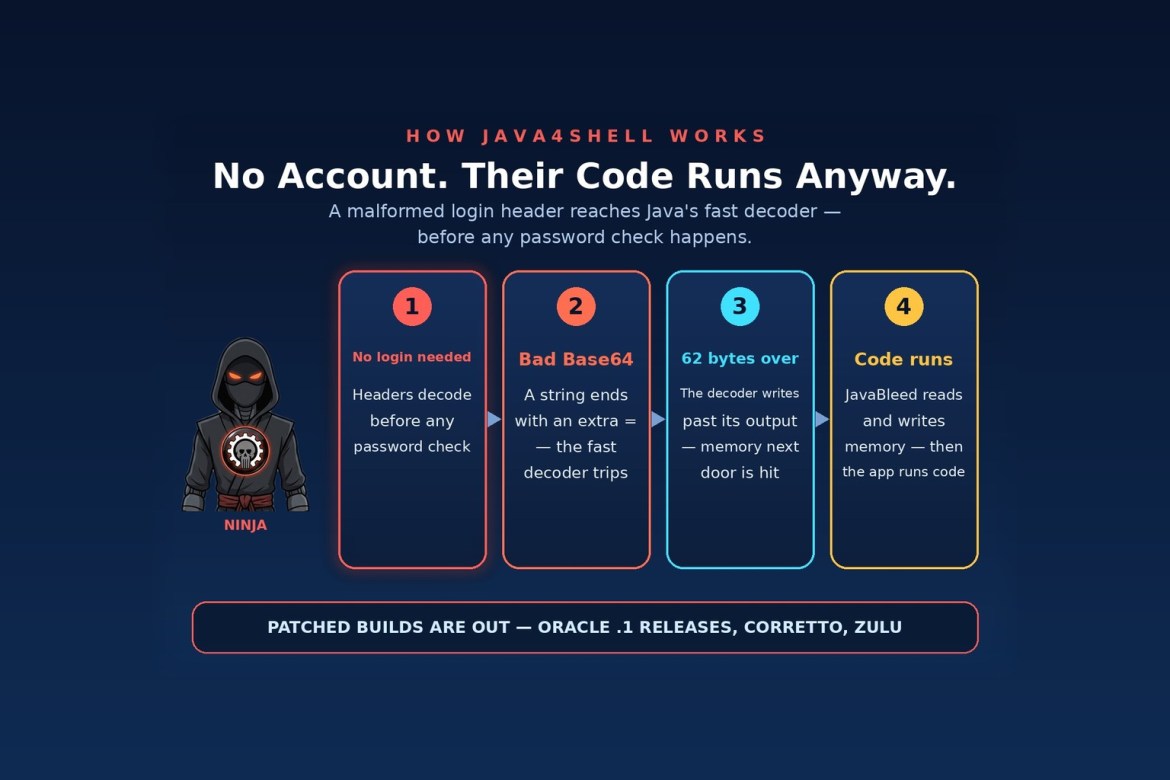
The flaw lives in a faster version of Java’s Base64 decoder, which turns encoded text back into plain data. Servers decode Base64 constantly — usually before checking whether anyone is logged in. That is the door. An attacker sends a malformed string, and the decoder does the rest before any password check.
The fast decoder runs only on x86-64 chips with AVX-512 VBMI, and Java switches to it automatically on busy servers. A malformed string ending with an extra equals sign makes the decoder write 62 or 63 bytes past the end of its output. Java rejects the string — but only after the write has happened.
The overflow alone looks small: the bytes are fixed, so an attacker controls where they land, not what they contain. Calif’s researchers got further by arranging the server’s memory so the overflow expands a neighboring array, then using that array to write bytes of their choosing and a second to read memory back — a step they call JavaBleed. From there, they say, the attack reaches the parts of Java that run code. Each target needs its own memory layout and timing, and a proxy that waits for complete requests — as nginx does by default — blocks some attacks but not all.
Who Is Exposed
Under the default settings of Keycloak, Jira, Confluence, JFrog Artifactory, Jenkins, and PingFederate, the attacks needed no login. Five more — Kafka Broker, Solr, Elasticsearch, Gerrit, and Spinnaker — were exploitable with a login. The researchers say their lists are incomplete, so treat them as a floor, not a ceiling.
The vulnerable code is in Java 17.0.6 and later, and in Java 21, 25, and 27. Standard Java 8 and 11 do not contain it, but the Java SE 8 Performance Pack build is affected, as are several GraalVM builds. On hardware, it runs only on newer Intel Xeon and AMD Zen 4 chips; ARM64 chips do not run it — so the same container image can be vulnerable on one server and safe on another.
Why It Matters — and What Is Still Unproven
The scores disagree: Calif 9.2, Oracle 8.1, Red Hat a preliminary 9.8, Amazon 8.8. The spread reflects how much the impact depends on which application sits on top of Java.
The nuance that matters most: the discloser has demonstrated remote code execution. Independent labs have not — yet. Upwind reproduced the memory corruption on an AWS server, where it crashed Java. Blackpoint Cyber crashed a test application with about 28,300 malformed login requests in 20 seconds, without ever logging in. Neither lab reproduced remote code execution. The researchers are holding back their attack code — for now.
There is no known exploitation in the wild. Canada’s Cyber Centre said it was not aware of any attacks, and the flaw was not in CISA’s Known Exploited Vulnerabilities catalog when checked today. But the trigger input was posted publicly on September 9, in a proposed fix submitted to OpenJDK’s code repository. Log4Shell taught the same lesson: when the flaw is in the platform, the blast radius is every application that trusts it.
What to Do Today
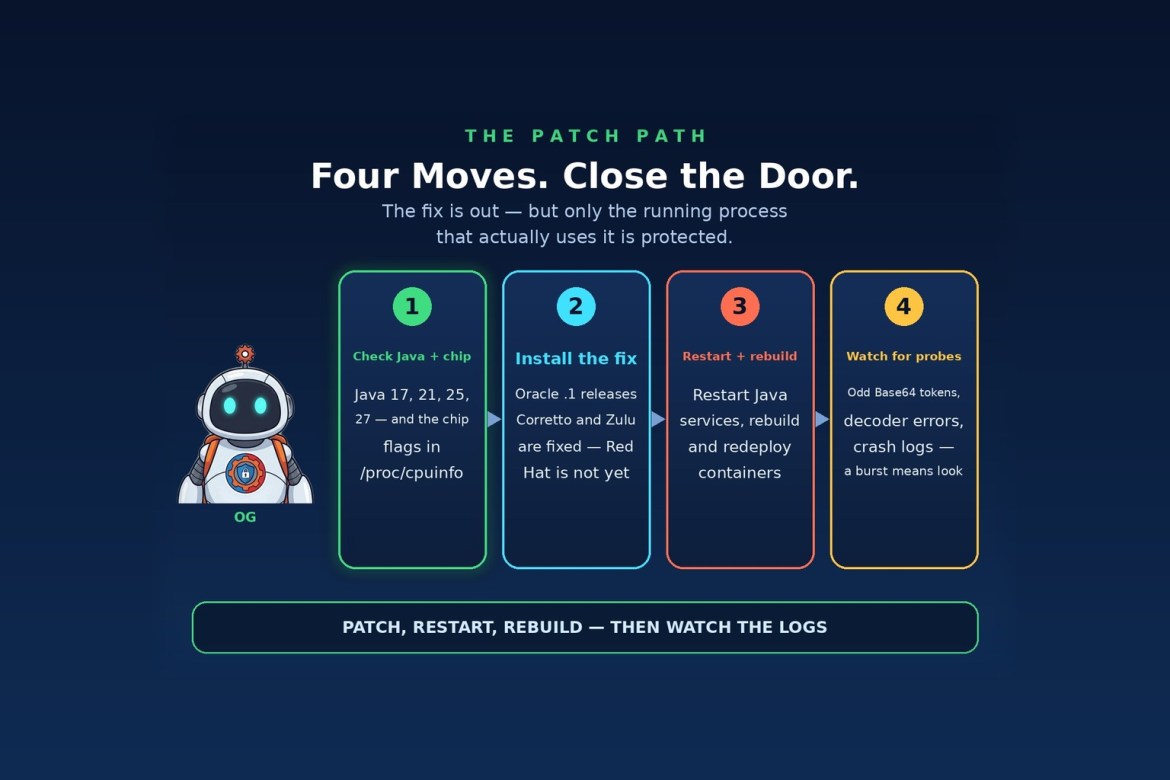
1. Check your Java version and your chip. Find every Java 17, 21, 25, and 27 runtime, and check whether it sits on a chip with AVX-512 VBMI — on Linux, /proc/cpuinfo must list avx512f, avx512bw, avx512vbmi, and bmi2.
2. Patch to the fixed builds — and check your vendor. For Oracle Java, the fixed builds are the new .1 releases: 17.0.21.1, 21.0.13.1, 25.0.5.1, and 27.0.1.1. Amazon has fixed Corretto, and Azul’s November Zulu update fixes the flaw too. Red Hat has not yet released fixes. Products that bundle their own Java runtime need an update from the product’s maker.
3. Inventory your exposed Jira, Jenkins, and Keycloak instances. Anything reachable from the internet goes first: a login page that decodes a header before authentication is the exact entry point. If you cannot patch yet, start the JVM with -XX:-UseBASE64Intrinsics, which turns off only the fast Base64 code. -XX:UseAVX=2 turns off AVX-512 entirely, but only on x86-64 servers — Java on ARM64 does not recognize it and will fail to start.
4. Restart, rebuild, and watch for attempts. After updating, restart Java services and rebuild and redeploy container images. Then watch for probing: Base64 tokens of 32 characters or more ending in = whose length is not a multiple of 4; bursts of IllegalArgumentException errors; unexplained crash logs or restarts. None of these proves a compromise — but a burst of them is a reason to look.
Yesterday the 9.2 was a rumor. Today it is a confirmed flaw with a fix, a named list of applications, and a demonstrated path to code execution without a login. The fix exists, most major vendors have shipped it, and no exploitation is known yet. But the researchers are holding their attack code back. Patch the runtimes, restart the services, rebuild the containers.