








The Repo Was the Command Center. Nobody Noticed.
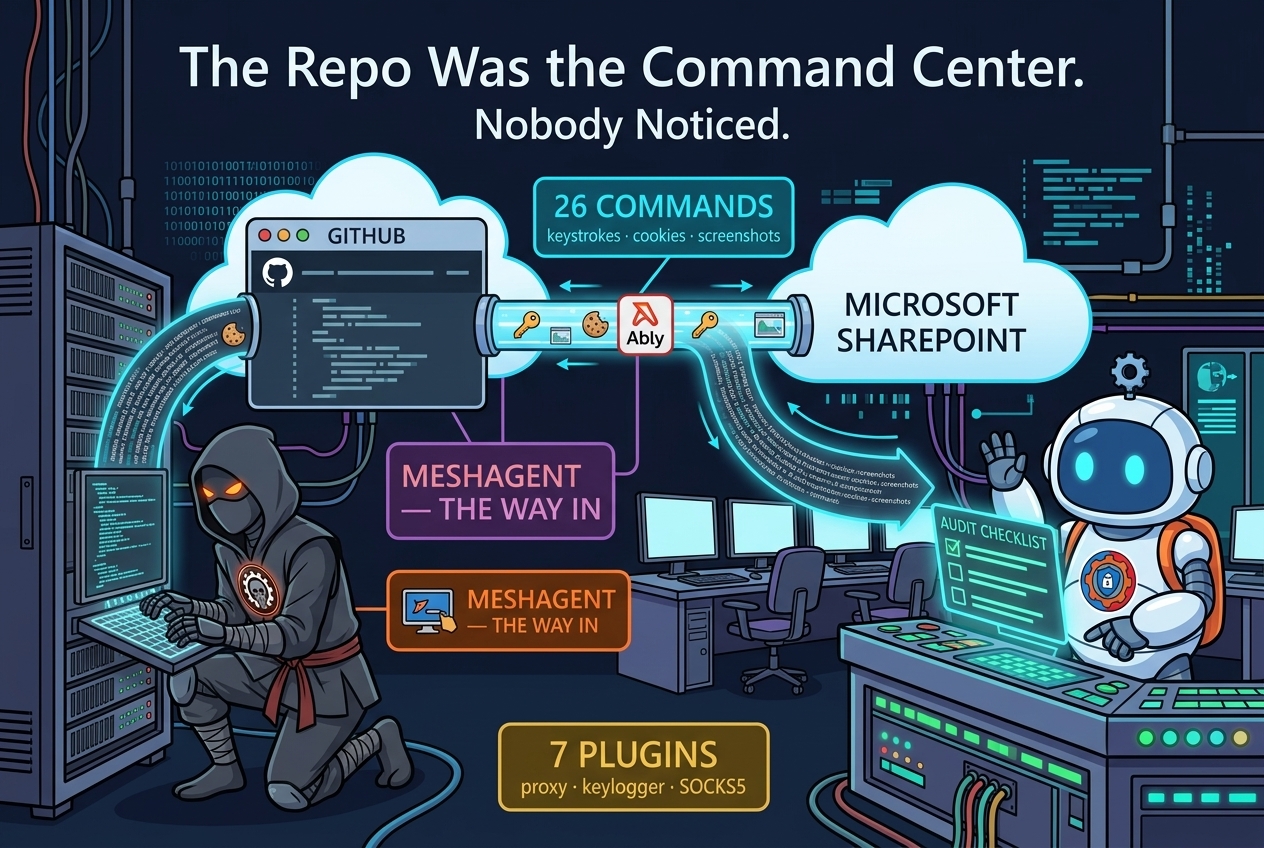
An active intrusion campaign targeting government offices across Asia and Africa hides its orders in the most ordinary places on the internet. Kaspersky calls it Operation ShadowCloud: two brand-new backdoors, GitDoor and GraphDoor, run their command-and-control traffic through GitHub, Microsoft SharePoint, and the Ably messaging service. To a firewall, the traffic looks like employees doing their jobs. That is the whole point.
The break-in starts with a tool IT teams would recognize. The attackers abuse MeshAgent, the agent component of MeshCentral, a legitimate remote-access utility. In the observed case, against a Taiwanese organization, the agent phoned home to a hard-coded server and fetched three payloads: a legitimate binary used for DLL sideloading, a rogue loader DLL, and an encrypted file holding the core backdoor. How it got there is unknown; the evidence points to a prior infection already on the network.
Two loader variants have been found. One runs the payload through an RC4 stream cipher and then an XOR mask; the other skips straight to XOR. Either way, the backdoor is injected into the memory of the running process, so nothing malicious lands on disk in recognizable form. Control-flow flattening and nested helper functions make the code deliberately hard to follow.
GitDoor: the orders live in a public repo
GitDoor uses GitHub as its command channel, talking to two repositories under the same account: a public one receives the command payloads, and a private one collects the results. The repositories’ creation dates suggest preparations began by the end of 2024.
GitDoor supports 26 commands — file management, keystroke logging, launching a proxy (including through Ably), and loading shellcode packaged as Base64-encoded COFF binaries. Shellcode modules add process injection, service management, file wiping, firewall changes, memory dumps, cmd.exe commands, scheduled tasks, Registry edits, and new user accounts.
The credential theft should worry defenders most. GitDoor logs keystrokes to a file tucked inside the user’s AppData folder, dumps cookies from Google Chrome and Microsoft Edge straight out of process memory, and uses Mimikatz to pull credentials from LSASS, the Windows process that holds login secrets. It can also capture screenshots, extract WhatsApp’s database decryption key, and trigger NTLM authentication to an attacker-controlled server to harvest hashes. GitHub has been abused as an attack platform before — a trusted service doing untrusted work.

GraphDoor: SharePoint as the drop box
GraphDoor takes the same idea to Microsoft’s cloud. It opens a named pipe, creates a folder called “Intel_Log” in Application Data, and gathers system information to send back. It authenticates with a malicious app through Microsoft’s login service, then uses the access token and the Microsoft Graph API to stage stolen data on a SharePoint drive.
It then fetches three plugin modules — screenshots, process listing, keylogging — launches them in parallel, and re-contacts SharePoint for its next commands. Seven plugins in total, including two Ably channels — one a covert SOCKS5 proxy tunneling TCP traffic through Ably’s WebSocket service. Its shellcode support goes beyond GitDoor, adding cmd.exe commands and MZ-format binaries.
Why this one matters
The cleverness is in the plumbing, not any single capability. Because the implants talk to GitHub, Microsoft Graph, and Ably, their traffic is indistinguishable from legitimate enterprise usage, and most network defenses wave it through. And because plugins and shellcode are fetched on demand from the cloud, the operators can add functions without touching the files on the host.
Attribution is still open: Kaspersky notes overlap with China-nexus activity Sophos tracks as Bronze Sandcastle, and tactical similarities with FamousSparrow and CopperTurtle. On several victim systems, those groups shared GitDoor’s staging directories, their implants landing within a day of GitDoor’s. That does not prove a direct link, Kaspersky cautions, but it suggests a Chinese-speaking group may be developing or using these backdoors. What is certain is the shelf life — the repositories date to the end of 2024, and these backdoors are built to outlive the patch that was supposed to kill them.
Three checks that expose it

1. Hunt for MeshAgent where it does not belong. MeshCentral is legitimate, which is exactly why it works as a dropper. Inventory every host for the agent and treat any installation you cannot tie to an approved deployment as an incident, not an anomaly. Same for the campaign’s sideloading binaries — start.exe, pythonw.exe, and zoomit.exe paired with an unfamiliar loader DLL.
2. Audit your cloud, not just your network. Review the GitHub repositories your users can reach, and audit Microsoft Graph app authorizations and SharePoint access in Entra ID. Look for unknown apps, tokens granted to apps nobody recognizes, and SharePoint sites receiving data from hosts with no business writing there. If your detection only watches the firewall, this campaign walks straight past it.
3. Watch for credential dumping, then rotate. Monitor for LSASS access, unexpected memory dumps, new local user accounts, and keystroke logs under AppData. If you find any of it, assume credentials are gone: force password resets, rotate service-account secrets, and review sessions and tokens for the affected accounts.
Operation ShadowCloud is a reminder that the cloud services your organization trusts are also the ones an attacker trusts most. The commands did not arrive from a shady server on a blocklist — they arrived through GitHub and SharePoint, the same services on every allow list. The defense is not to block the cloud. It is to watch what your cloud accounts are actually doing.