







Fifty Terabytes of Health Records. One Extradition.
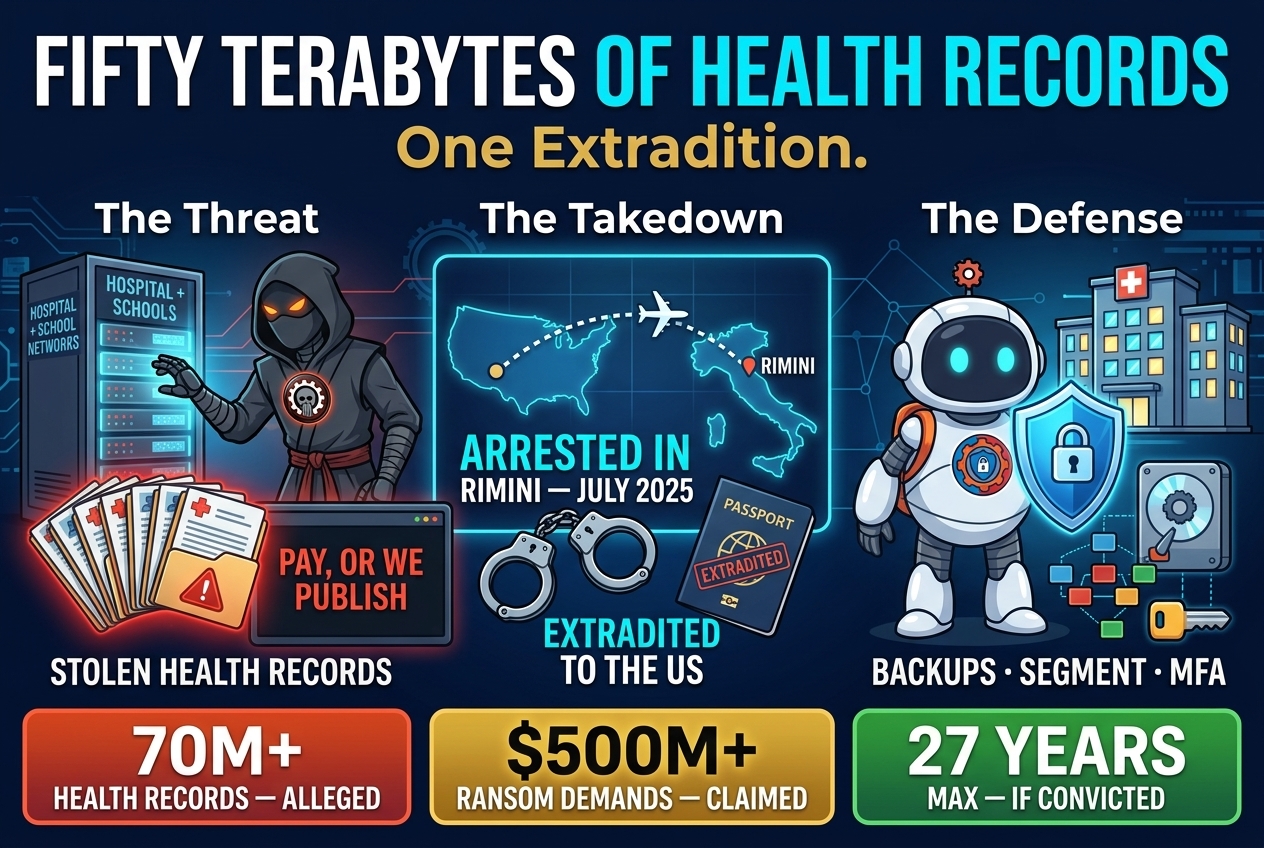
A family vacation in Rimini, Italy, ended in handcuffs. In July 2025, Italian police arrested 43-year-old Kazakh national Roman Khlynovskiy while he was on holiday with his family. This week, he was extradited to the United States to face charges alleging he helped run ransomware attacks against American schools, hospitals, and healthcare organizations in at least six states.
Khlynovskiy is believed to be a member of the “8-Digits Team,” a ransomware group affiliated with the INC and Lynx ransomware operations. If convicted, he faces up to 27 years in prison on counts including conspiracy to commit computer fraud, identity theft, wire fraud, extortion, money laundering, and threats to disclose non-consensual intimate images. He is accused of being an affiliate — an operator who carried out attacks with ransomware built by someone else — not the malware’s author.
Break in, steal it, threaten to publish it
The alleged playbook was double extortion, the model that defines modern ransomware. Breach the network, copy out the data that hurts most to lose, then threaten to release it publicly unless the victim pays — with encryption of the victim’s own systems as the second lever. A hospital that cannot open patient records, and cannot stop them appearing online, faces pressure from two directions at once.

Schools and hospitals make especially attractive targets. Both hold data people cannot afford to see leaked, and both run on tight budgets, with systems that cannot simply be switched off during an incident. That urgency is the product being sold.
The numbers prosecutors are claiming
The scale alleged here is enormous — and it needs to be read carefully. The Department of Justice says “the conspirators boasted that they possessed over 50 terabytes of data consisting of more than 70 million confidential health records,” and that the group’s actions “resulted in over $500 million in ransom demands.”
Those figures are prosecutor claims and alleged boasts, not established outcomes. A ransom demand is not a ransom paid, and a boast about stolen data is not a verified inventory. What is not in doubt is the intent: the threat to publish highly sensitive medical information was itself the pressure tactic.
INC Ransom, Lynx, and a rebrand
The two operations behind the charges are, in researchers’ view, effectively one group wearing two names. INC Ransom emerged in July 2023 as a ransomware-as-a-service operation — the authors supply the tools, and affiliates like the accused carry out the attacks. Its leak site lists more than 1,000 victims, including NHS Scotland, Ahold Delhaize, and Xerox Business Solutions in the US.
Lynx surfaced in July 2024 and is believed to be a rebrand of INC rather than a new group — a fresh name to operate under with less scrutiny, with 400-plus victims on its own leak site. Its encryptor was likely based on INC source code allegedly offered for sale for $300,000 on hacking forums in May 2024, and BleepingComputer found in August 2024 that the two encryptors were mostly the same.
The rebrand pattern explains why taking down one ransomware name rarely ends the problem: the people, the code, and the affiliate network survive the name change.
Why this extradition matters
Arrests of ransomware affiliates are still rare enough to matter. These groups work across borders on purpose, so no single police force can reach all of them. An extradition from Italy shows the arrangement is not as safe as it looks: a vacation or a single cooperating jurisdiction can end it.
It is also part of a wider enforcement momentum. Law enforcement keeps unmasking ransomware operators — the administrator behind the Qilin operation was unmasked earlier this year — and large takedowns keep dismantling the infrastructure these groups depend on, as Operation Endgame seized 257 servers and identified 6.4 million victims. No single arrest ends ransomware, but each one raises the cost of participating.
What hospitals and schools should check now

The defenses here are unglamorous, and they work. Four checks for any hospital, school, or healthcare organization:
- Tested, offline backups. Backups only help if they restore — and only if attackers cannot reach them. Keep copies offline or immutable, and rehearse a full restore twice a year. A backup you have never tested is a hope, not a plan.
- Segment the network. Patient records, student systems, and admin networks should not be one flat space where one breached workstation leads everywhere.
- Phishing-resistant MFA everywhere. Multi-factor authentication — the extra check at sign-in — is the cheapest barrier to the break-in, but only phishing-resistant kinds, such as security keys or passkeys, stop attackers who steal passwords and session cookies.
- A practiced incident response plan. Decide in advance who involves law enforcement, who talks to patients or parents, and how care or classes continue while systems are down. Rehearse it as a tabletop exercise — not during a ransom deadline.
One extradition will not stop the next rebrand or the next demand. But it puts a name and a face to a business that depends on staying anonymous. For the hospitals and schools on the other side, the lesson is simpler: make the break-in hard, make the data hard to steal, and make the backup real.