







Four Flaws Hit the Exploited List. Patch by November 21.
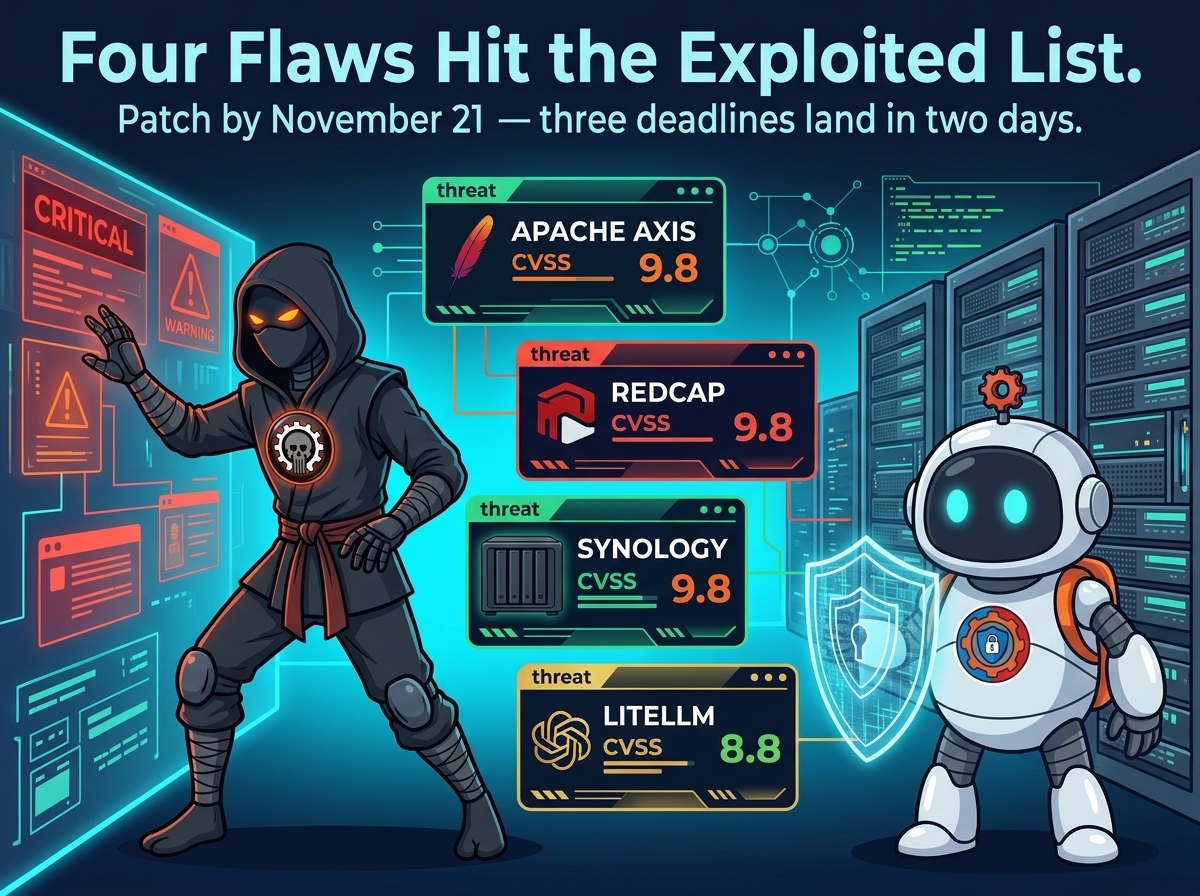
CISA added four vulnerabilities to its Known Exploited Vulnerabilities catalog on Wednesday, and every one of them is already being exploited in the wild. Three carry a patch deadline of November 21 — two days from now. The fourth, a flaw in the AI gateway LiteLLM, gives federal agencies until December 2.
The four flaws read like a tour of the modern attack surface: a twenty-year-old Java library that refuses to die, a university research tool, an AI gateway, and the network storage box in the corner holding your backups.
The four flaws
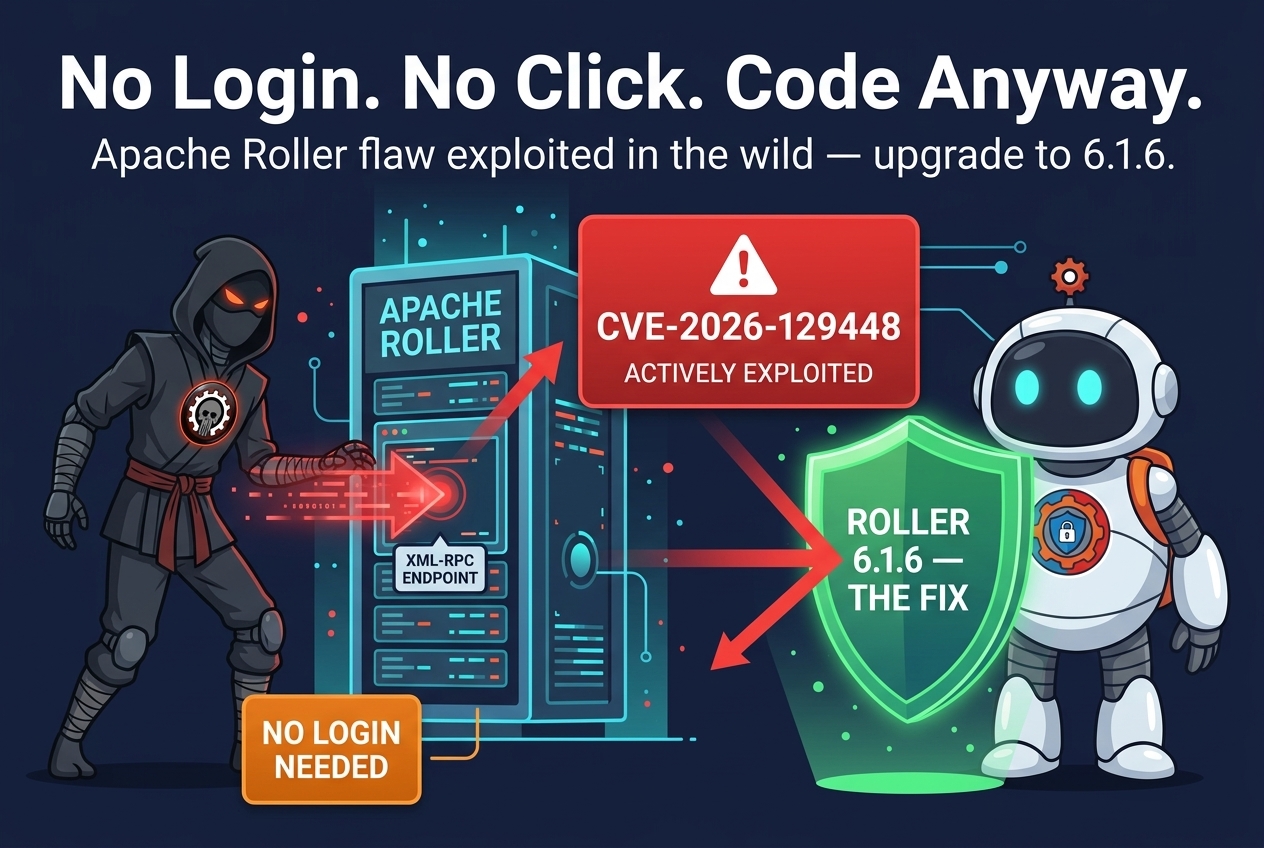
CVE-2026-90436 (9.8) — Apache Axis. An unsafe reflection flaw in Apache Axis 1.x that lets an unauthenticated attacker run arbitrary code remotely. It is being exploited alongside the 4EverAble2Shell flaws in N-able N-central to plant cryptocurrency miners on vulnerable servers.
CVE-2026-90817 (9.8) — REDCap. A code injection flaw in Vanderbilt University’s Research Electronic Data Capture platform. An unauthenticated attacker can run code on the server through crafted requests aimed at a public survey, as long as they know a valid survey hash.
CVE-2026-40217 (8.8) — LiteLLM. An unprotected alternate channel in BerriAI’s LiteLLM that lets a remote attacker run code through bytecode rewriting at the /guardrails/test_custom_code endpoint. It is the engine behind a wave of LLMjacking attacks.
CVE-2024-10441 (9.8) — Synology DSM. An improper output-encoding flaw in Synology DiskStation Manager that allows remote code execution. Synology disclosed earlier this month that it is being exploited in ransomware attacks on NAS devices, deploying the C3RB3R ransomware.
The Axis attack: three minutes to your database
The Apache Axis story is the most detailed of the four, and the most alarming. Rapid7 detected the flaw being exploited against Atlassian Confluence Data Center, which uses the Axis library in its XML-RPC and SOAP APIs. The attack only works when Confluence’s “Remote API” setting is enabled — off by default for new installations since Confluence 3.0 and fully removed in Confluence 10.0, so the exposed population is older deployments that never turned it off.
Once in, the attackers moved fast. Just over three minutes after the first observed execution, they were authenticating to MySQL with Confluence’s own database credentials, querying page bodies, application links, and attachments with names tied to credentials, tokens, VPN configurations, and private keys. Their scripts — likely AI-generated, per Rapid7 — parsed Office documents, hunted payment card numbers with Luhn checks, and mapped internal services. They also tried a Kerberos credential-harvesting technique called AS-REP Roasting.
The roasting attempt failed. But the attackers still took a service account credential, queried a production cloud data warehouse, and about twelve hours after the first exploit request signed in to Microsoft 365 as an integration service account using legacy authentication.
There is no patch coming for Axis 1.x — the library has reached end of life. The fix is to migrate to Apache Axis 2 or Java, or use a build carrying the patch from a July 12, 2026 commit. The same flaw is also the entry point in the N-able miner campaign, where it chains with the N-central flaws to deploy cryptominers.

The other three: a miner, a key thief, and ransomware
The REDCap exploitation, observed by Safe Security late last month, follows a familiar miner playbook with a few neat touches: a transient web shell, then an in-memory loader that pulls down XMRig disguised as image files, masquerades the miner as syslog-ng, and establishes persistence through cron and an added SSH key.
The LiteLLM flaw powers the LLMjacking wave Google’s Threat Intelligence Group reported this week: attackers use it to elevate limited-access inference keys into full administrative credentials and establish persistence, targeting financial services, retail, transportation, and tech firms across the Americas and Asia-Pacific. The victim pays the AI bill; the attacker keeps the keys.
And Synology’s flaw is the bluntest of the four: ransomware operators are exploiting it against NAS devices — the boxes people buy to keep their data safe — and deploying C3RB3R ransomware on them.
What to do now
Check whether any of the four live in your environment. Axis 1.x hides inside other products — Confluence is the known case, but any Java app still shipping the old library is exposed. REDCap instances with public surveys, LiteLLM gateways with the guardrails test endpoint reachable, and Synology NAS devices all need a look today, not next week.
Meet the deadlines. Federal agencies must fix or mitigate the Synology, REDCap, and Axis flaws by November 21, and the LiteLLM flaw by December 2. Everyone else should treat those dates as the point after which exploitation gets louder — KEV deadlines are public, and attackers read the same catalog.

Look for the miner’s fingerprints. If you run REDCap, check for unexpected cron entries, new SSH keys, and processes masquerading as syslog-ng. If you run Confluence, confirm the Remote API setting is off, review MySQL and Microsoft 365 sign-ins from unfamiliar addresses, and retire any legacy authentication still enabled for service accounts.
Protect the AI keys like production credentials. LiteLLM deployments should lock down the guardrails endpoint, rotate any inference keys that may have been exposed, and watch for usage spikes — an LLMjacking bill is often the first sign the keys are gone.
Four flaws, four products, one deadline two days away. The catalog exists so nobody has to discover these the hard way.