









CISA Says Patch Now. One Command Tells You If You’re Exposed.
Yesterday the story was the confirmation and the fix. Today the federal government weighed in — and the vendor whose product sits on the front line told everyone exactly how to check whether they are exposed.
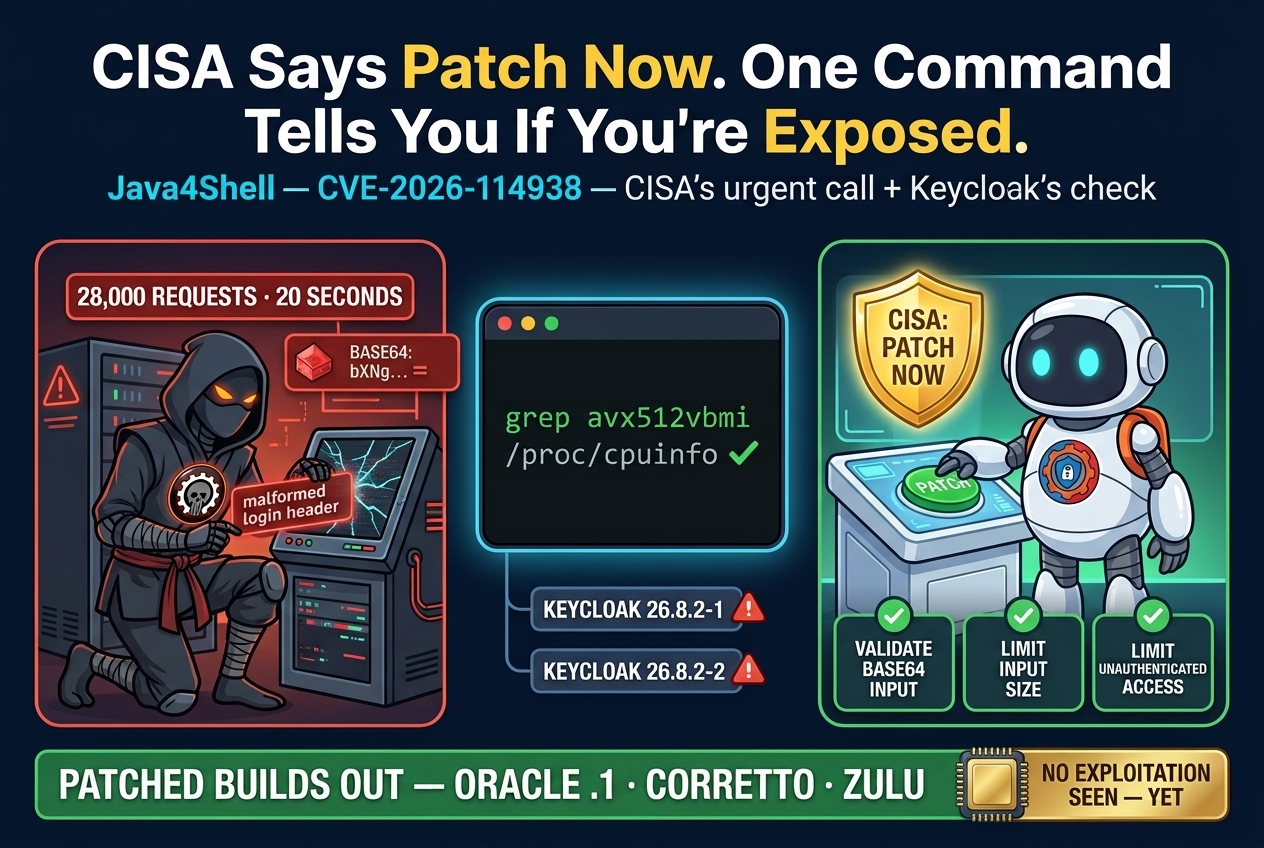
CISA has urged organizations to patch Java4Shell immediately. The flaw, CVE-2026-114938, is a memory-corruption bug in the fast Base64 decoder of the x86-64 HotSpot Java Virtual Machine: a specially crafted Base64 string can crash the JVM — or, under the right conditions, let an attacker with no account run their own code. Oracle and OpenJDK have released patches. There is still no evidence the flaw has been exploited in the wild. CISA’s message is to patch before that changes.
Are You Exposed? Three Conditions
Not every Java install is at risk, and the Keycloak team published the clearest test yet in an update shared today. An instance is at risk when all three of these are true:
1. It runs an unpatched OpenJDK build from 17.0.6 onward — including unpatched OpenJDK 21 and 25 builds. Fixed builds are out from Oracle and OpenJDK; the earlier post has the full list of fixed versions.
2. Its x86-64 host or virtual machine exposes the avx512vbmi CPU feature to Java. The fast decoder only switches on where the chip offers it. Keycloak recommends one command to check:
grep -m1 '^flags' /proc/cpuinfo | grep -qw avx512vbmi && echo 'AVX-512 VBMI available'
If the command returns nothing, the CPU does not expose the feature and is not known to be affected.
3. The running JVM has Base64 intrinsics enabled and has not been limited to AVX2 with -XX:UseAVX=2. That flag is itself a mitigation — it tells the JVM to stop at AVX2, below the level the fast decoder needs.
Keycloak also named the containers to check: its x86-64 images tagged 26.8.2-1 and 26.8.2-2 bundle an affected OpenJDK 21.0.13 build. But the tags alone do not settle it — check the CPU feature and the effective JVM flags, because the same image can be vulnerable on one host and safe on another. A ZIP or TAR.GZ distribution started directly on a host can be affected too; it depends on its Java runtime and CPU, not on whether it runs in a container. The team has released temporary mitigations to apply until patched Keycloak and Keycloak Operator images are available.

The Crash Takes 20 Seconds
The urgency is not abstract. Blackpoint Cyber researchers showed the flaw can be reached through a local Spring Boot application using Spring Security, and that roughly 28,000 unauthenticated HTTP requests carrying a malformed Base64 authentication value caused the JVM to terminate after about 20 seconds of sustained requests. Further testing confirmed something quieter and worse: corruption of nearby Java objects and changes to live application data without necessarily causing an immediate crash. A server that stays up is not proof nothing happened.
The same researchers note the flaw’s reach is wide because the vulnerable code sits in the platform, not in one application. Under default settings, attackers need no account on Keycloak, Atlassian Jira, Atlassian Confluence, JFrog Artifactory, Jenkins, and PingFederate; with a login, the list grows to Apache Kafka Broker, Apache Solr, Elasticsearch, Gerrit, and Spinnaker. And the advisory wave shows how seriously the industry is taking it: advisories have now been released by Aikido, Amazon Linux, Blackpoint Cyber, Chainguard, Cisco Talos, Cycode, Datadog, Dynatrace, Endor Labs, Field Effect, Hadrian, Horizon3.ai, Miggo, Orca Security, Qualys, Rapid7, Red Hat, SentinelOne, Sophos, Tanium, Tenable, Upwind, VulnCheck, watchTowr, and Wiz — more than two dozen vendors in a single day.
If You Cannot Patch Yet
CISA’s guidance is blunt: identify affected Java installations, review your software inventory for JDKs and Java runtimes — including those bundled with third-party applications or inside container images and appliances — and apply the relevant patches as soon as they are available.
For teams that cannot patch immediately, CISA recommends temporary compensating controls: restrict and validate Base64 input at the application boundary, enforce input-size limits, and limit unauthenticated access. Those three moves do not fix the decoder, but they shrink the window an attacker needs — fewer malformed strings reaching the decoder, and fewer unauthenticated callers able to send them.

That is the honest shape of this story. The fix exists, the patch is out, and no exploitation has been seen. But the flaw was first reported as an unconfirmed 9.2, confirmed within a day, and now carries a federal patch-now call plus a demonstrated 20-second crash. The window between “confirmed” and “exploited” is exactly when patching is cheapest. Run the check, patch the runtimes, and if you cannot patch today, put the three controls in place.