










The Patch Was Two Years Old. A Million Cards Walked Out.
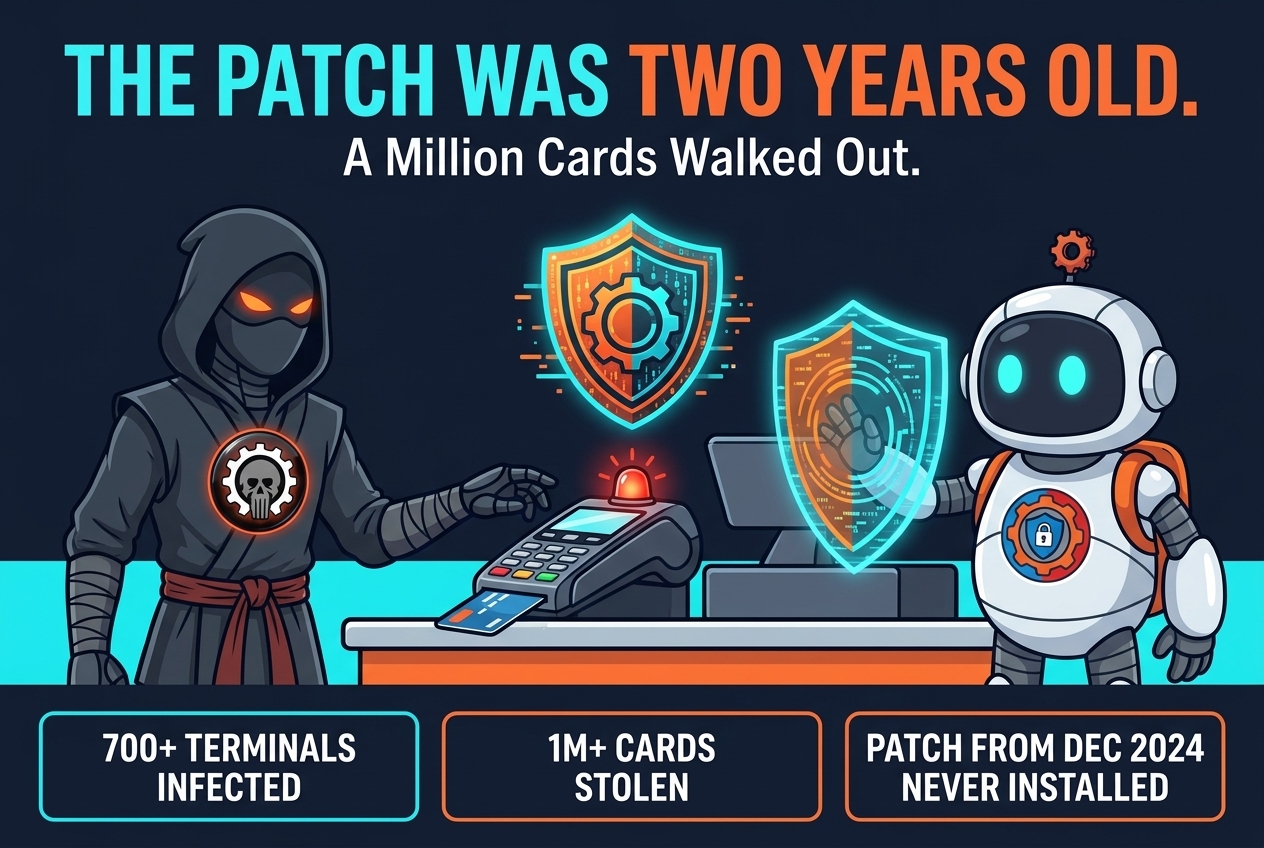
More than a million payment cards were stolen from checkout counters in over 20 countries, and the door the attackers walked through had been locked — on paper — for almost two years. The patch was ready in December 2024. The terminals never got it.
Cybernews researchers found the campaign while examining a server the attackers left exposed. On it sat the whole operation: malware source code, the exploit tools, and a carding panel holding the stolen card records. The terminals were running Windows software that had not been updated in at least a year and nine months. Every swipe at those counters fed the panel.
The flaw was fixed. The fix was never installed.
The attack ran on CVE-2024-49138, a privilege-escalation flaw in the Windows Common Log File System (CLFS) driver. It lets a low-privilege local user run code with system-level rights — exactly the step up a piece of card-stealing malware needs to sit quietly on a terminal and watch every transaction.
Microsoft patched the flaw in December 2024. That makes this a story about patch debt, not a zero-day. The compromised terminals were still running the vulnerable version nearly two years later. Point-of-sale systems are notorious for this: they run legacy software, updates get deferred for compatibility testing or operational worries, and nobody checks again until something breaks.
Something broke. Attackers did not need to invent anything new. The exploit was adapted from publicly available proof-of-concept code for CVE-2024-49138, with the original author credited in the files the researchers recovered. A known bug, a public exploit, and a fleet of machines that never took the fix — that was enough.

Every swipe fed the panel
Once the malware gained system-level access, it installed a remote access trojan that harvested payment card data continuously as transactions were processed. The carding panel — named “VINY JUNIOR TRILHAS” — held at least one million unique card records, including primary account numbers, validity periods, bank identification numbers, issuing countries and banks, exfiltration dates, and card types and brands.
The panel also listed 782 compromised point-of-sale systems, with their operating system versions and locations. Because the targets were live terminals processing daily transactions, the stolen dataset almost certainly kept growing for as long as the campaign ran. Each infected terminal was an ongoing collection point, turning every customer’s payment into fresh data for the attackers.
The majority of the infected terminals were in Brazil, and the researchers believe the threat actor is Brazilian, based on the language used in the attack reports and documentation.
Found in August. Reported in September.
Cybernews researchers discovered the exposed server in August 2026 and reported their findings to Brazil’s Computer Emergency Response Team (CTIR) on September 8, 2026. The server was observed closed on August 31, 2026. At least a million cardholders now face potential financial fraud — unauthorized purchases and account takeovers — with the damage depending on how fast each bank’s fraud detection catches the misuse.

Why this one matters
This is not a story about a clever new attack. It is a story about the gap between a patch existing and a patch being installed. The vulnerability was public, the fix was shipped, the exploit code was public, and the targets were machines whose entire job is handling other people’s money. The attackers simply walked the open path.
It is also a reminder that the same Windows component keeps showing up. The CLFS driver has been a repeated source of privilege-escalation flaws — the same driver family was behind an earlier flaw we covered — and point-of-sale fleets are exactly the kind of slow-moving, rarely-patched systems where a known bug stays dangerous for years.
And the theft itself was quiet. There was no ransomware note, no outage, no visible incident at the counter. Customers tapped or swiped, the terminal took the payment, and a copy of the card went to a panel on an exposed server. Skimmers work the same way — the difference here is that the skimmer was software, installed through a two-year-old hole.
What to do now
Patch the December 2024 update. If you run Windows-based point-of-sale terminals, confirm CVE-2024-49138 is actually closed on every machine — not scheduled, not planned, installed and verified. The patch has existed since December 2024; any terminal still missing it is exposed to public exploit code.
Audit the whole fleet, not a sample. The campaign hit more than 700 terminals because patch status drifted machine by machine. Pull the update level of every terminal, including the ones in back rooms and seasonal locations, and treat any machine more than a few months behind as compromised until proven otherwise.
Segment the payment network. Terminals should not be able to reach the open internet or the rest of the business network. A terminal that can only talk to its payment processor gives stolen-card malware nowhere to send its haul.
Watch the statements. If you paid by card at a small retailer in Brazil or elsewhere in the affected region over the past year, check for unfamiliar charges and report them fast — banks can only stop fraud they know about, and a stolen card number stays useful until it is cancelled.
The patch was two years old. The terminals never got it. A million cards walked out through the gap in between.