







Six Flaws. No Login. No Workaround.
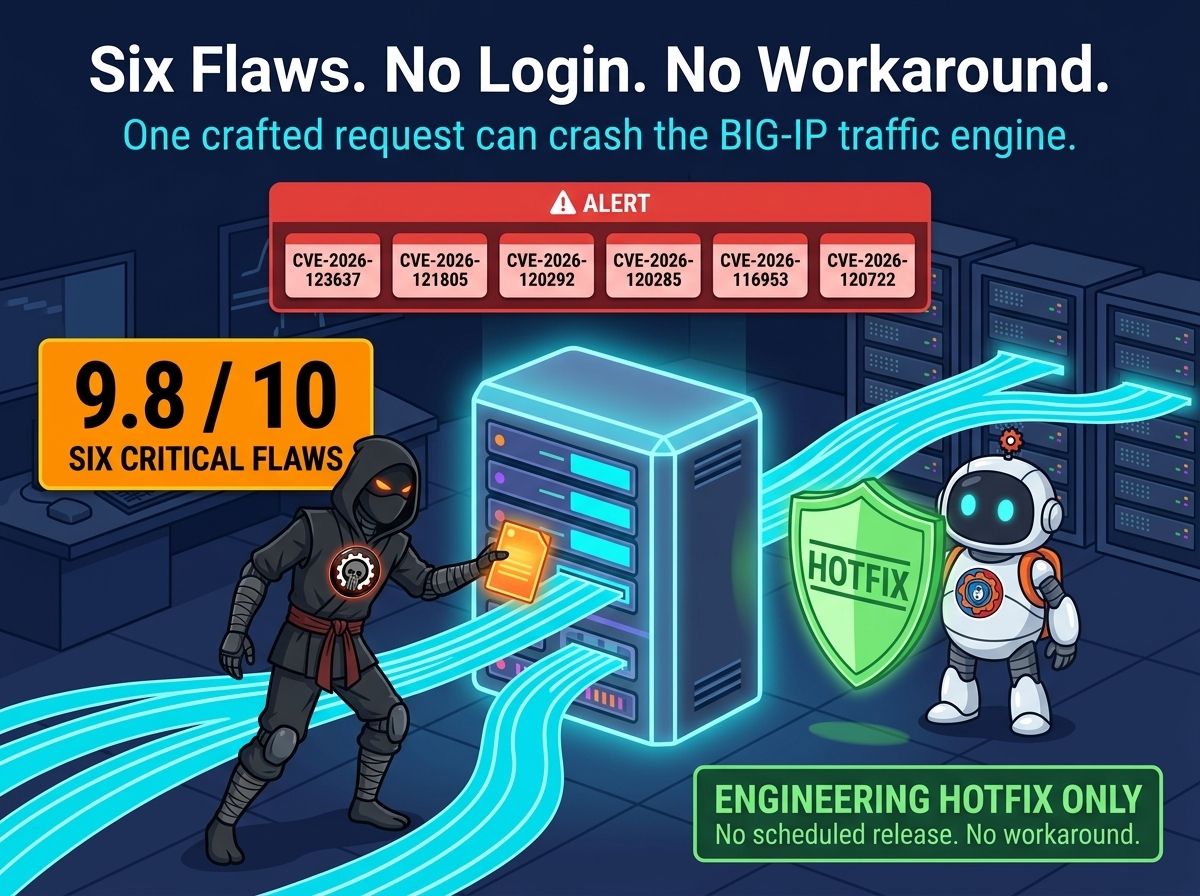
F5 has a bad-news day, and it comes in a bundle. The company disclosed six critical flaws in its BIG-IP traffic platform on November 18, every one rated 9.8 out of 10. Each is a stack-based buffer overflow in the data plane, the box’s traffic-moving part. An attacker needs no login, no account, no password. Send the right request to the right setup, and the traffic engine crashes. F5 says the same flaws may also allow remote code execution.
A crash is an outage: traffic stops until the engine restarts. Code execution is a takeover. No exploitation has been reported — but the gap between “crash” and “code runs” is the gap attackers close once they start poking at a public disclosure.
Six flaws, six specific setups
None fires on a default box. Each needs a particular virtual-server configuration — run the setup and you are exposed; unsure whether you run it, and you have homework. Five live in iRules — small scripts that steer traffic; one in an access policy:
- CVE-2026-123637 — APM per-request policy with the Client Information and Endpoint Security agents. APM only.
- CVE-2026-121805 — iRule using PEM::subscriber on client traffic. BIG-IP PEM, Kubernetes, and CNF.
- CVE-2026-120292 — iRule using MR::message route, HTTP profile. All modules, plus Kubernetes.
- CVE-2026-120285 — iRule using PSC::ip_address, HTTP profile. All modules, plus Kubernetes and CNF.
- CVE-2026-116953 — iRule using GENERICMESSAGE::route on client traffic. All modules, plus Kubernetes.
- CVE-2026-120722 — iRule using DNS::scrape on client traffic. BIG-IP DNS and Kubernetes.
All six score 9.8 (CVSS v3.1) and 9.3 (CVSS v4.0). The management side is not exposed — the attack comes through the traffic-facing side. Four were reported by WatchTowr researcher Sina Kheirkhah; F5 found the other two.

Why this one matters
A BIG-IP box sits in front of applications, deciding where traffic goes and enforcing access policy. When its traffic engine — the Traffic Management Microkernel, or TMM — crashes, the traffic it carried stops with it. That is an outage delivered by a single unauthenticated request.
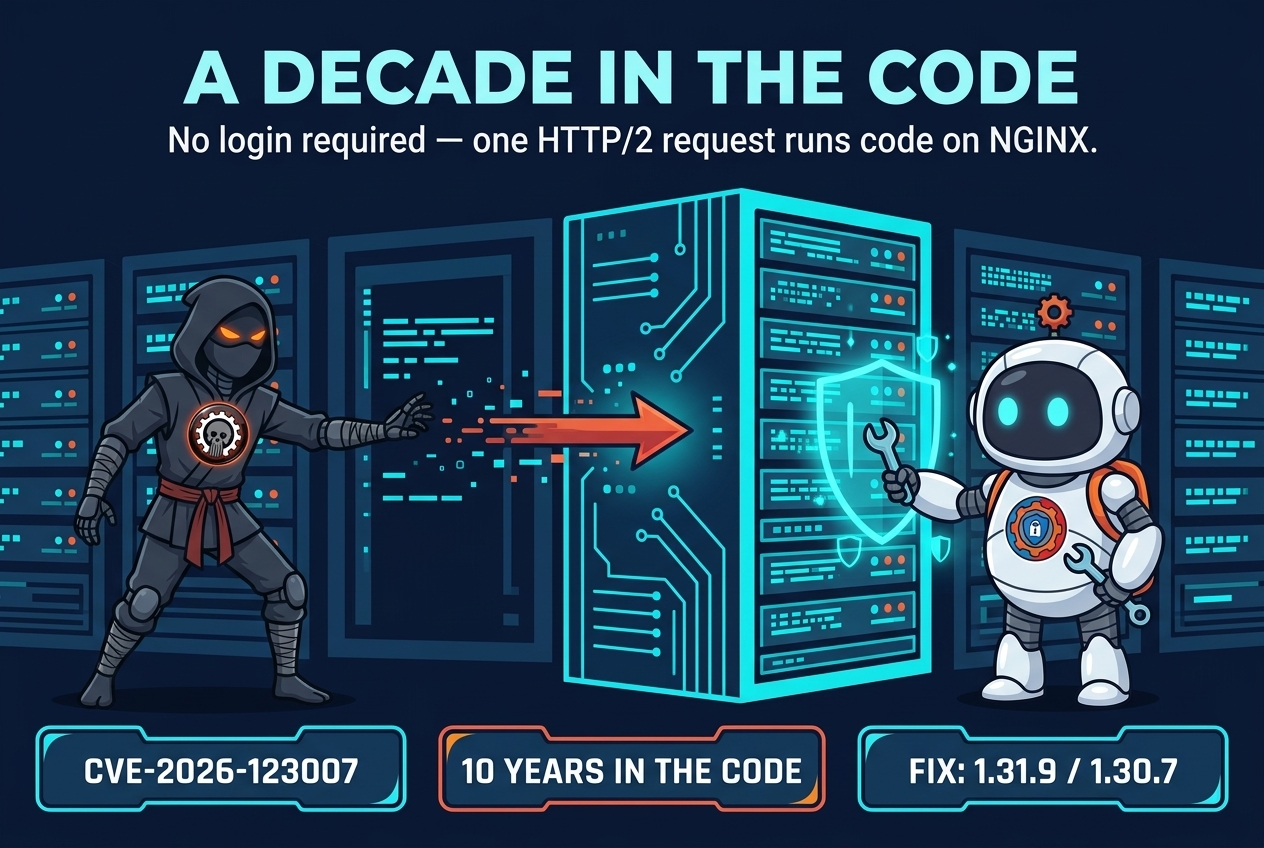
The context makes it sharper. On September 22, F5 disclosed CVE-2026-94127, another APM flaw. That one was later exploited, and CISA added it to its Known Exploited Vulnerabilities catalog the same day. Today’s six are different bugs, but the pattern is familiar: the window from disclosure to exploitation is measured in days, not months. The same day also brought ten NGINX advisories — F5’s own NGINX had a no-login flaw just days earlier, as covered in A Decade in the Code. No Login Required.
The fix is awkward — and that is the story
There is no scheduled software release that fixes these six flaws. The only fixes are engineering hotfixes — custom builds F5 support hands out on request. And there is no workaround at all.
F5 is unusually blunt about that. Engineering hotfixes, it warns, “do not undergo the extensive QA assessment of scheduled software releases” and come with no warranty or promise they will work. A system already on a custom hotfix needs a fresh one from support. Container editions have versioned fixes — BNK-2.4.2-EHF1, BNK-2.3.4-EHF1, and BNK-2.2.5-EHF1, with matching CNF releases for the PEM and PSC flaws. And F5 only checks versions still in support: if your release is missing from its tables, that does not mean you are safe — it means nobody checked.

Six more flaws behind them
F5 published 22 advisories in total. The sharpest of the six lower-severity flaws is CVE-2026-125274, an 8.8 flaw in iControl SOAP: an attacker with a Guest-role account and network access to the management interface could send an unauthorized management request and potentially run system commands. It is fixed in BIG-IP 21.1.0.3, 17.5.1.10, and 17.1.3.6 — and iControl SOAP should be limited to trusted networks only.
Next to it sits CVE-2026-120718, an 8.1 flaw in iControl REST where authentication tokens may not expire — fixed in the same release train, with one hygiene rule: delete tokens when you are done with them. The remaining four are APM flaws rated 7.5, each able to crash the traffic engine without a login: a form-based Logon Page, two SAML flaws, and one tied to the tmm.access.policytrace setting, off by default.
What to do now
1. Audit your iRules for the six commands. Search every iRule for PEM::subscriber, MR::message route, PSC::ip_address, GENERICMESSAGE::route, and DNS::scrape. Any hit on client traffic is an exposed setup. Check APM per-request policies for the Client Information plus Endpoint Security combination too.
2. Request the engineering hotfix from F5 support. Do not wait for a scheduled release — there isn’t one. Open the case now, and test the hotfix in staging before production, given F5’s QA caveat.
3. Verify your version is still in support. Check your BIG-IP, BNK, and CNF versions against F5’s tables. If your release is missing, assume you are exposed and plan the upgrade.
4. Tighten the management plane while you are there. Restrict iControl SOAP to trusted networks, delete stale REST tokens, and review APM and SAML. Edge appliances keep proving to be the softest target — the same lesson as the SonicWall firewall flaws in The Firewall Let Them In. Then Came the Wiper.
Six flaws, all critical, all unauthenticated, and a fix you have to ask for. The crash is the headline. The missing workaround — and the hotfix with a warning label — is the reason to move today, before exploitation reports arrive.