





Five Million Requests. Forty Credit Unions Exposed.
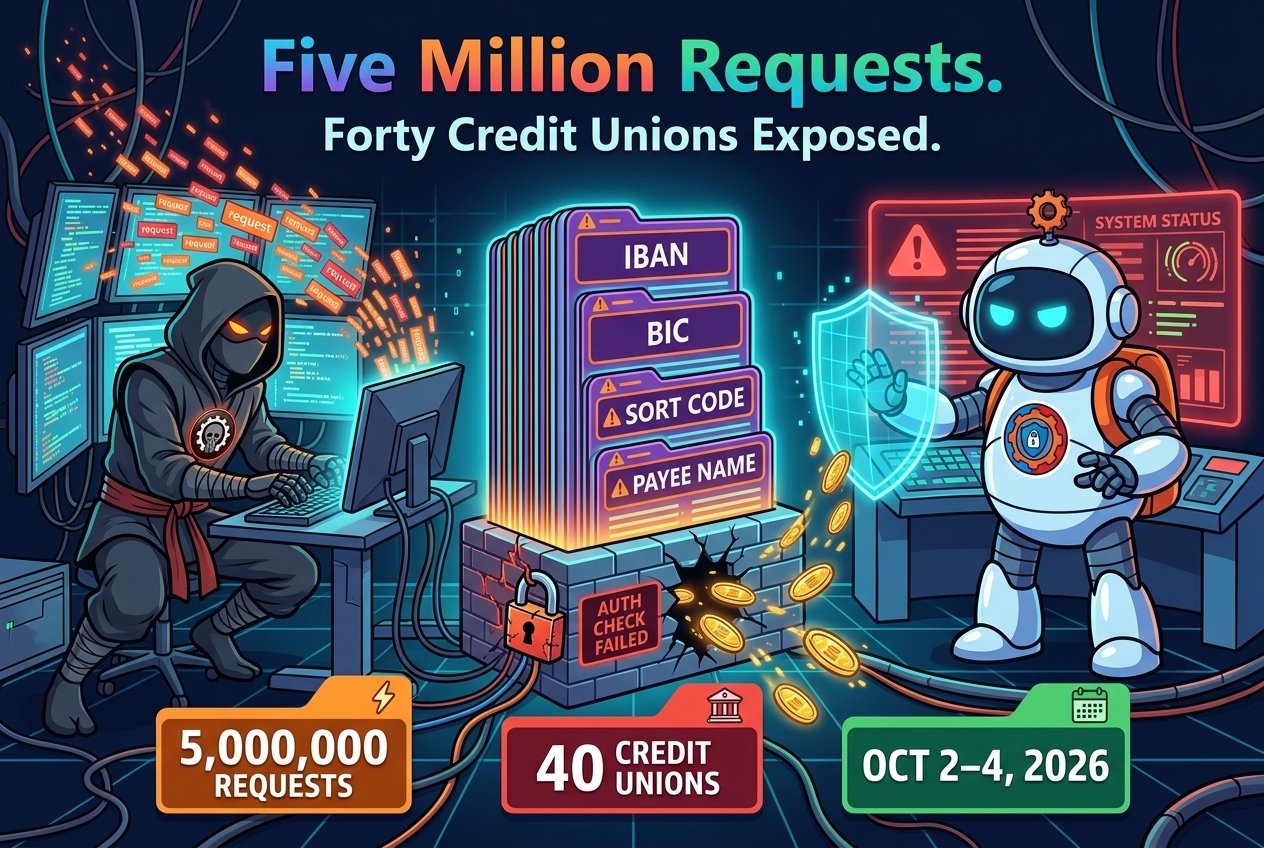
Forty credit unions in Ireland. One shared IT supplier. And an automated script that knocked on the door five million times before anyone noticed it had walked in.
The breach hit Wellington IT, a Belfast-based supplier whose online banking platform is used by about 50 credit unions, 43 of them in Ireland. Minister of State Robert Troy confirmed to RTé that Wellington IT is the third-party provider at the center of the incident, which exposed data belonging to members of around 40 Irish credit unions. The company itself has not publicly disclosed a security incident.
Five million requests, one authorization flaw
According to the Irish Examiner, which saw the notices Wellington IT sent to its customers, an automated script made five million requests to exploit an authorization flaw in the company’s infrastructure. The attack ran between October 2 and 4, 2026, and the attacker accessed private records using valid credentials.
That combination is worth pausing on. This was not a smash-and-grab with a stolen admin password. It was an authorization flaw — the system failed to check whether the credentials making the request were actually allowed to see what they asked for — hammered at machine speed until it gave up the records. Five million requests is not subtle. It is the kind of volume that should light up every monitoring dashboard a supplier has.
It gets worse. Wellington IT told its customers it lacked the activity logs that would specify exactly which member data was compromised, so it cannot verify the impact on individual payees. The total number of impacted individuals is unknown.

What was exposed
At least six credit unions have independently disclosed impact linked to the incident: Capital Credit Union, Phoenix Credit Union, St. Canice’s Credit Union, First South Credit Union, Malahide Credit Union, and Limerick & District Credit Union. Their notices confirm unauthorized access to payee information saved in online banking platforms.
The records potentially exposed read like a fraudster’s shopping list:
- Payee name, or the name associated with the payee’s bank account
- The nickname the member used to save the payee
- International Bank Account Number (IBAN) and Bank Identifier Code (BIC)
- Bank account number and sort code
- Payee address information
- Payment reference information entered for the saved payee
The records could also reveal which credit union member saved a particular payee — mapping real people to real accounts and the people they pay.
One piece of good news: account passwords, PINs, payment card details, and online banking credentials were unaffected. Nobody’s money moved and nobody’s login was taken. But what was taken is the raw material for the next attack — convincing impersonation and targeted phishing, built on real names, real account numbers, and real payment relationships.
The delay is the second breach
The attack happened in early October. The credit unions were notified weeks later, and the story only became public in mid-November. Minister Troy called the delay “not acceptable” — and he has a point: every week of silence was a week members had no reason to be extra suspicious of a convincing message about their payees.
Wellington IT CEO Colin Mitchell said in a November 19 statement that the company alerted its customers as soon as it confirmed the potential risk, has engaged external cybersecurity experts, and is collaborating with the Data Protection Commissioner, the National Cyber Security Centre, and the Garda National Cyber Crime Bureau. The investigation is ongoing.
The pattern here will be familiar to anyone who follows this lane. A single supplier sits underneath dozens of small organizations, and when the supplier fails, the blast radius is every customer at once. We saw the same shape in the Norad grants portal breach, where one portal exposed more than 20,000 users, and in the Iris Ohyama cloud breach, where a third-party service put 7.7 million shoppers’ details at risk. Small institutions inherit their supplier’s security posture, good or bad.
What members should do now

If you bank with an Irish credit union, here are four concrete checks:
1. Treat every payment message as suspect. Attackers now hold real payee names, IBANs, and payment references, so a message saying “your payee details changed” can look exactly right. Never act on a link in a message — call your credit union on a number you already trust.
2. Review your saved payees. Open your online banking and look at the payee list. If a payee you do not recognize appears, or a familiar payee’s details look different, report it immediately.
3. Watch your statements, not just your balance. Scan statements for unfamiliar transactions or new payees, and set up transaction alerts if your credit union offers them.
4. Verify before you pay anyone new. If a supplier, landlord, or contact sends new bank details — especially by email or text — confirm them through a second channel before sending money. An IBAN that looks right is no longer proof of anything.
The credit unions did not cause this. Their members did not cause this. A supplier’s authorization flaw, hit five million times, caused this — and the members are the ones who will have to stay vigilant while the investigation plays out. If your credit union contacts you about the incident, read it carefully, act on the checks above, and remember: the people who want this data most are the ones who will now try hardest to sound like the people you trust.