




The Cloud Server Was Breached. The Mail Kept Flowing.
N-able has confirmed a breach in its hosted email-security cloud — and the strangest part of the story is what did not break. The mail kept flowing.
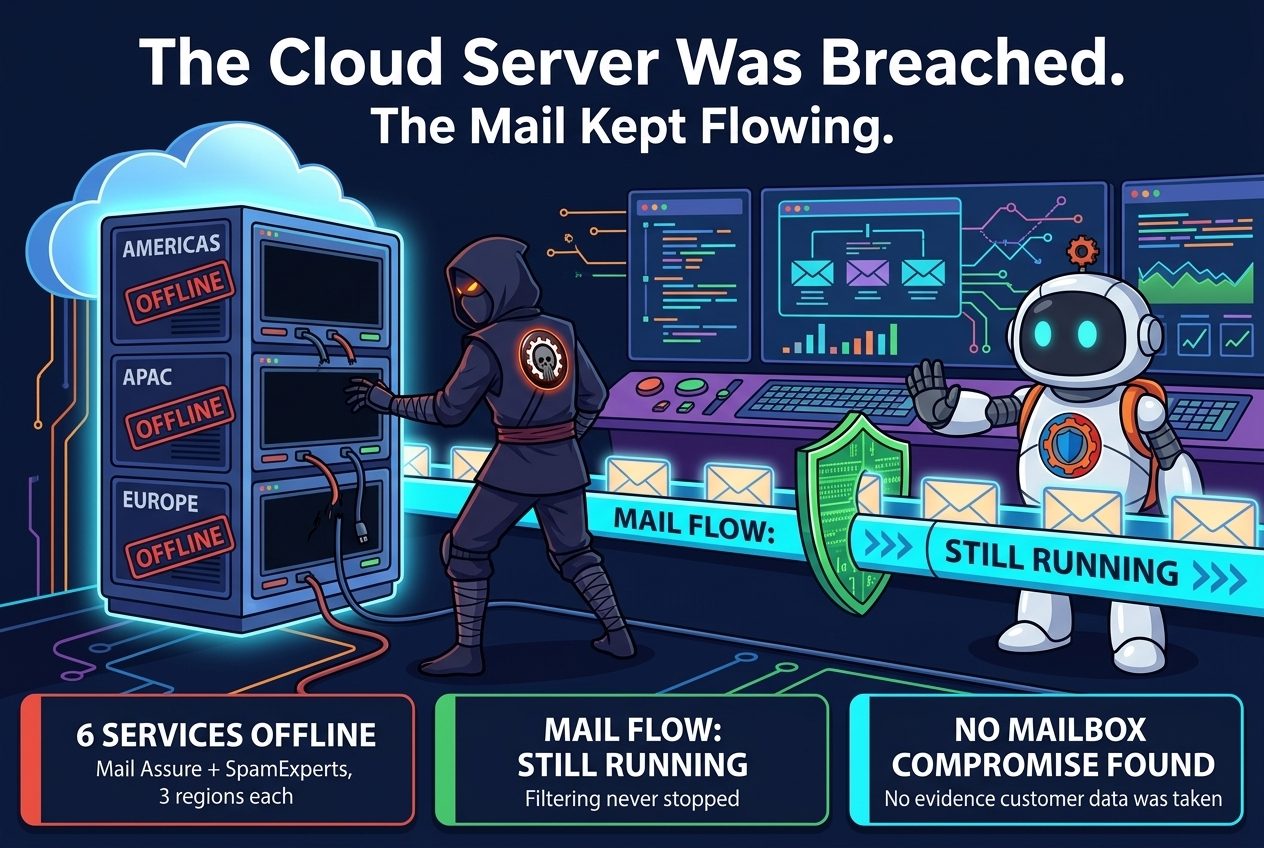
On Wednesday, November 19, N-able disclosed that unknown threat actors gained unauthorized access to one server in the hosted cloud behind two of its products: Mail Assure and SpamExperts. The company responded by disabling the management interfaces and APIs for both products across all three regions — the Americas, APAC, and Europe. Six services offline in one move.
But the core of the service never stopped. Core mail flow and inbound and outbound filtering remain available, so the protection these products exist to provide is still running while the controls that manage it are dark. The management portal, the APIs, quarantine, and logging stay offline while N-able restores them securely, with access returning once validation is complete. As of 8 a.m. UTC on November 19, restoration was underway, with steady progress on validating and hardening the systems.
On the question every customer asks first, N-able’s answer is reassuring but carefully worded: there is currently no evidence that customer data was compromised, including access to tenants’ mailboxes. No evidence is not a final verdict — the investigation is still open.
Three days from disruption to disclosure
The incident did not start with an alarm about intruders. N-able began investigating on November 16, after a service disruption in the hosted cloud. The first working theory pointed inward: a platform configuration problem, or a failure in the service dependencies the platform relies on. Further investigation showed it was neither — the disruption was a security incident, an unauthorized party inside one of the cloud servers.
That three-day path from “something is broken” to “someone got in” is how these incidents usually unfold. A disruption looks like an operations problem until the evidence says otherwise. Disclosure followed the determination, which gives partners time to act on facts instead of rumors.
N-able says it has directly reached out to Mail Assure and SpamExperts partners with information specific to their environments, including whether any action is required. If you are a partner and have not seen that notice, chase it down — the message is tailored to your setup, not a generic status page.

Why this one matters — and what it is not
First, the scope is contained in the way that matters most. One server was accessed, not the whole cloud, and the filtering between inboxes and the internet never stopped. For an email-security product, that is the line between an incident and a catastrophe: had the filtering gone down with the management portal, every customer would have been exposed at once.
Second, that operational damage is still real. Quarantine and logging are how admins catch what the filters miss and prove what happened afterward. With both offline, partners have less visibility than usual and should give anything suspicious in this window a closer look. The restore is gated on validation, not on a deadline — the right call, since bringing a portal back before it is verified clean would turn a contained incident into a second one.
Third, and most important for anyone who follows N-able: this incident is unrelated to the Able2Shell flaws in N-central. Those vulnerabilities — the ones behind the thirty zero-days disclosed in a single night and the follow-on exploitation we covered when the fix was in but the miners moved in anyway — hit a different product through a different mechanism. Keep them separate in your tracking.

Four checks for partners and admins
1. Read N-able’s partner notice — and act on what it says for your environment. The notice is specific to your setup, including whether any action is required. If it has not reached you, contact N-able or your distributor now rather than waiting for the portal to come back.
2. Verify mail flow and filtering rules are still enforced. Core filtering is still running, but trust and verify: confirm mail is flowing and filtering rules are behaving as expected, and that nothing drifted during the disruption.
3. Watch the quarantine and logging restore — then review what you missed. While they are offline, some messages and events are not being captured the usual way. When access returns, work through the backlog and give anything unusual in the gap a second look. Do not assume the quiet window was a clean window.
4. Review who has management-portal access — and keep this incident separate from N-central. Use the downtime to audit portal accounts, remove stale or shared logins, and confirm multi-factor authentication is enforced on every admin account. The N-central flaws need their own patching — nothing here changes that work.
N-able shut down the controls to protect the service, and so far the service is holding. This is a developing story: the investigation is ongoing, and the restore has no published completion time. The test now is the restore: a portal that comes back validated and hardened, a clear final answer on customer data, and partners who used the outage to tighten their own access. The mail kept flowing. The next question is whether the controls come back stronger than they went down.