









The Cookie Was the Key. Root Was the Prize.
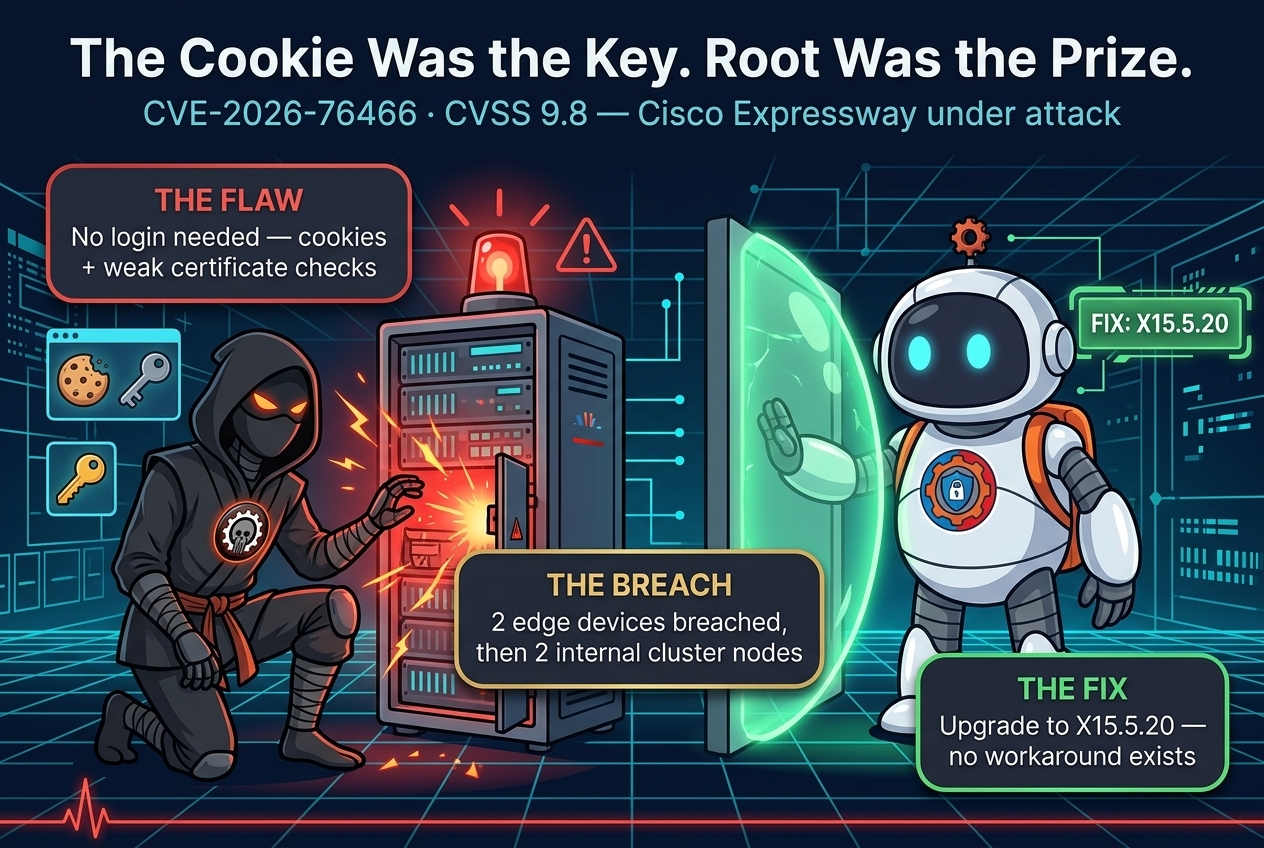
The fix had been out for nearly a month. The attackers came anyway. On November 19, Russian cybersecurity firm F6 reported what appears to be the first in-the-wild exploitation of CVE-2026-76466, a critical flaw in Cisco Expressway that lets an unauthenticated remote attacker run arbitrary operating-system commands as root. The severity score says it all: 9.8 out of 10. No login. No password. Root.
Cisco Expressway is the gateway that sits at the edge of an organization, brokering video calls and remote collaboration sessions between the inside and the outside world. It is, by design, internet-facing. That is exactly what makes this flaw so dangerous: the device an attacker needs to reach is the one already exposed to them.
The flaw comes down to two ingredients combining badly. Expressway uses persistent cookies, and when TLS Verify Mode is set to Enabled for clustering, it does not validate client certificates strictly enough. An attacker holding the right cookies can connect to the device’s database service and invoke specific remote procedure call commands — and those commands run as root. Cisco released the fix on October 21, 2026: systems running X15.5.3 and earlier should move to X15.5.20, and systems on X14 and earlier should migrate to a fixed release. No workaround was mentioned, which leaves patching as the only defense.
The exploitation F6 documented arrived shortly after a public proof-of-concept exploit appeared — the familiar pattern of a published PoC turning into live attacks within days. Two internet-facing Expressway devices running X15.5.3 were breached, and the attackers pivoted through one of them to two additional cluster nodes on the internal network. The edge device was not the target. It was the door.
Root was the start, not the finish
Once they had root, the intruders got to work with custom Python scripts that scanned the network, discovered shared folders over SMB, and interacted with SQL Server and WinRM — the everyday management plumbing of a Windows environment. They also reached into GitLab repositories, exfiltrating credentials and sensitive data. The scripts themselves carried a curious signature: comments and descriptions of fixes that suggest they were written with the help of AI tooling. F6 attributed the activity to no known threat actor.

This is the part worth sitting with. Nothing in the intrusion was exotic. The attackers did not need a zero-day of their own — Cisco had already patched this one. They needed a device that had not been updated, a cluster that trusted its edge, and an internal network that let a compromised gateway talk to databases, management interfaces, and code repositories. The perimeter device was the beachhead; the flat network did the rest.
It is also a reminder of a pattern this blog keeps returning to: the devices guarding the front door are themselves the softest targets. We covered a similar lesson when a SonicWall SSL-VPN flaw let attackers past MFA that was switched on and working — the firewall let them in anyway. And the N-able incident showed what happens when a platform that manages everything becomes the compromise itself — thirty zero-days in one night, and the platform went dark. Expressway belongs in the same file: infrastructure that is supposed to protect the network becomes the way in.
Four checks to run now
1. Patch or migrate today. If you run Expressway X15.5.3 or earlier, upgrade to X15.5.20. If you are still on X14 or earlier, migrate to a fixed release. There is no workaround, so every day unpatched is a day the public PoC is sitting there for anyone to use.
2. Hunt for the known footprints. F6 shared indicators of compromise: the IP addresses 66.179.31.32 and 18.130.47.116, the string “wombat@127.0.0.1” in erlang.log, and Python scripts staged in paths matching /mnt/harddisk/i{0-9}{4}[a-zA-Z]?/*.py. Search your logs and your Expressway filesystems for all three. Finding any of them means the device was already breached, and patching alone will not close the incident.
3. Audit past the edge device. The attackers pivoted from the breached gateways into internal cluster nodes, then into SMB shares, SQL Server, WinRM, and GitLab. If an Expressway box in your environment was exposed, treat the cluster nodes as compromised until proven otherwise, review GitLab access logs and service-account activity, and rotate any credentials those repositories held.
4. Segment the perimeter from the crown jewels. A video gateway has no business reaching your SQL servers, your Windows management interfaces, and your code repositories. Lock down what Expressway systems can talk to, and watch for lateral movement from them — an edge device scanning the internal network is never normal traffic.

The uncomfortable truth of this incident is its timeline. The fix shipped October 21. The first reported exploitation came November 19. That is a 29-day window in which the patch existed, the PoC went public, and the attacks began — and the organizations hit were the ones still running X15.5.3. Patching a perimeter device is never the exciting work. This week, it is the only work that matters.