




















The Form Field Was the Exploit.
Nobody typed a payload. Nobody logged in. A visitor filled in a form field, hit submit, and the web framework itself did the dangerous work before a single line of the application’s own code ran. That is Ruby2Shell — the headline flaw in a Ruby release patching seven memory-safety bugs, five with working remote-code-execution exploits.
Ruby shipped the fixes on November 18 in versions 4.0.10, 3.4.13, and 3.3.14. Three of the seven flaws are rated critical, three high, and one moderate. Five already have proof-of-concept exploits that demonstrate remote code execution. No attacks have been reported — but the researchers say a public exploit is about a week away.
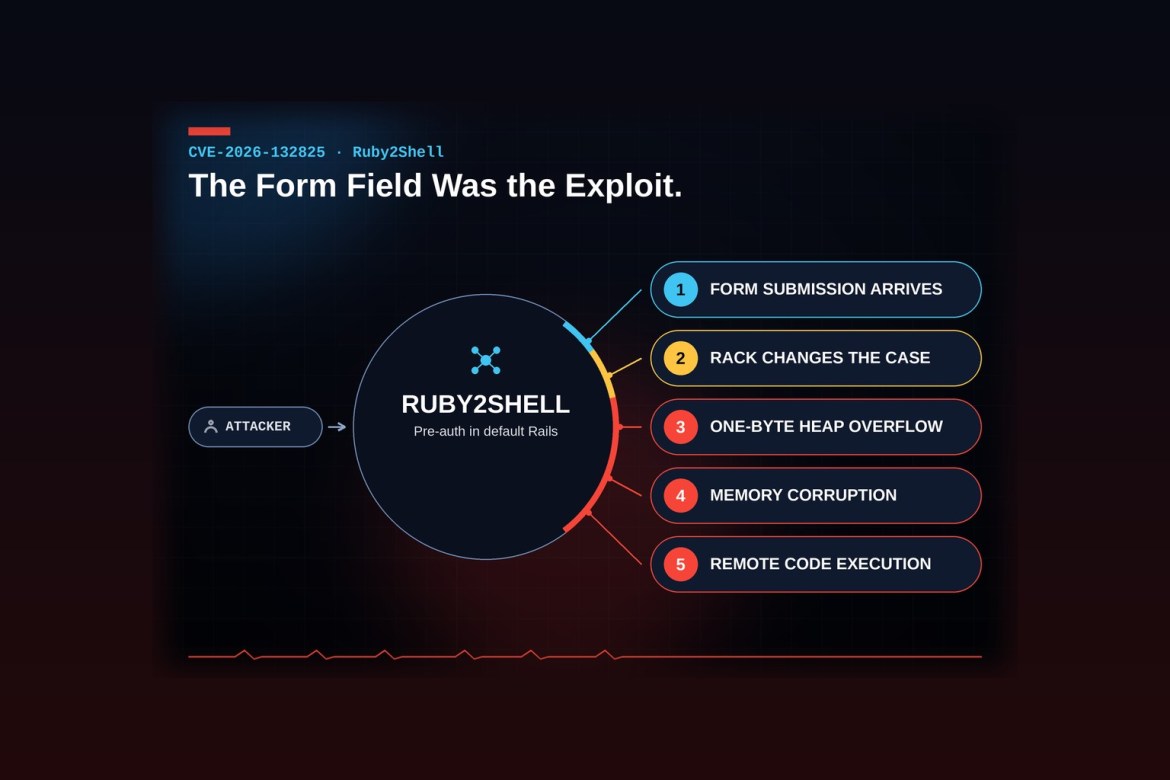
Ruby2Shell: the form field was the exploit
The headline flaw is CVE-2026-132825, which researchers have named “Ruby2Shell”: a one-byte heap overflow when Ruby changes the case of a string in certain single-byte encodings — ISO-8859-1 and Windows-1252. Veria Labs research, published November 19, says the flaw is reachable over the network without authentication in the default configuration of Rails and classic-style Sinatra apps. Moritz Sanft’s analysis explains why: during normal processing of a crafted form submission, Rack — the layer underneath Rails — changes the case of one request field, so a newly generated Rails app reaches the flaw before any of its own code runs.
That ordering is what makes this flaw different from the usual web bug. There is no vulnerable endpoint to avoid, no input validation to add, no authentication gate to strengthen. The dangerous step happens in the plumbing, on an ordinary form submission, in a brand-new app with default settings. Veria Labs will publish its proof of concept about a week after disclosure.
The other six flaws
The other six split between the regex engine and the same case-conversion code. All three criticals carry remote-code-execution proofs — and so do two of the highs:
| Severity | Flaw | Mechanism | Proof of concept |
|---|---|---|---|
| Critical | CVE-2026-132825 (Ruby2Shell) | One-byte heap overflow when Ruby changes the case of a string in single-byte encodings | RCE proof of concept |
| Critical | GHSA-7x2q-68qv-6p8x | Double free when Ruby compiles a crafted regex using a character-class intersection (&&) | RCE proof of concept |
| Critical | GHSA-3p8q-wmhx-vm2w | Heap overflow when the size of a compiled regex overflows during compilation | RCE proof of concept |
| High | GHSA-87fm-7w84-j2px | Heap overflow when a case change produces a result larger than 4 GiB | RCE proof of concept — the size needed puts it out of reach for most requests |
| High | GHSA-7whj-cfh7-xgm4 | Heap overflow when Ruby turns a crafted compiled regex back into text with Regexp#to_s | RCE proof of concept |
| High | GHSA-wpqw-5qxg-m68r | Out-of-bounds read during case-insensitive matching | Attacker-controlled memory corruption shown; RCE possible but not demonstrated |
| Moderate | GHSA-pvgc-g7gj-pv6h | Out-of-bounds read matching a case-insensitive backreference against a crafted subject | May disclose memory contents or crash the process |
Who is affected — and which patch you need
The fix depends on your branch: Ruby 4.0.0 through 4.0.9 is fixed in 4.0.10; 3.4.0 through 3.4.12 in 3.4.13; and 3.3.13 and earlier in 3.3.14. Ruby 3.2 and earlier are end of life and will not be fixed — the only move there is to migrate. With the 3.3.14 release, Ruby 3.3 moved from security maintenance to legacy maintenance, and support still ends at the end of March 2027.
Six of the seven flaws have no CVE number yet — only CVE-2026-132825 has been assigned. The project has requested the rest; until they are assigned, the GitHub advisory IDs in the table above are the only tracking handle. Stephan Lipp of Ada Logics and Anthropic found four of the flaws; baba__yaga, aphantom, Hiroya Fujinami, and Hiroshi SHIBATA found the other three.
What to do now
Update the Ruby interpreter itself — on app servers, background workers, and container images — then restart the application or rebuild the image. Updating gems or the framework does not fix this: the bug lives in the interpreter, and the interpreter is what has to change. PHP had its own seven-flaw week just days ago, when we covered seven critical PHP flaws, all scoring 9.2 — and the lesson is the same one Java4Shell taught when we covered its fix landing: the runtime is the foundation, and a flaw in it is a flaw in every application standing on it.

A familiar pattern — but different bugs
This is the second regex-engine patch in a month. On October 23, Ruby shipped fixes in 4.0.9, 3.4.12, and 3.3.13 for compilation bugs that GitLab’s researchers found, behind four critical GitLab flaws. One of those drew an attempted attack on Alpine Linux’s own GitLab server, and CISA later added it to the Known Exploited Vulnerabilities catalog as actively exploited. Those are different bugs from this week’s seven — the October flaws were compilation bugs; this week’s are a case-conversion overflow and fresh regex memory-safety flaws. But the pattern is the same: the regex engine keeps proving to be the softest part of the interpreter, and the window between a fix and a public exploit keeps shrinking.
Seven flaws, five with working exploits, one reachable from an ordinary form field with no login. The patches are out. Update the interpreter, restart or rebuild, and do it before the proof of concept lands.
Sources: The Hacker News; ruby-lang.org security advisories; Veria Labs and Moritz Sanft research.