







Seven Critical Flaws. All of Them 9.2.
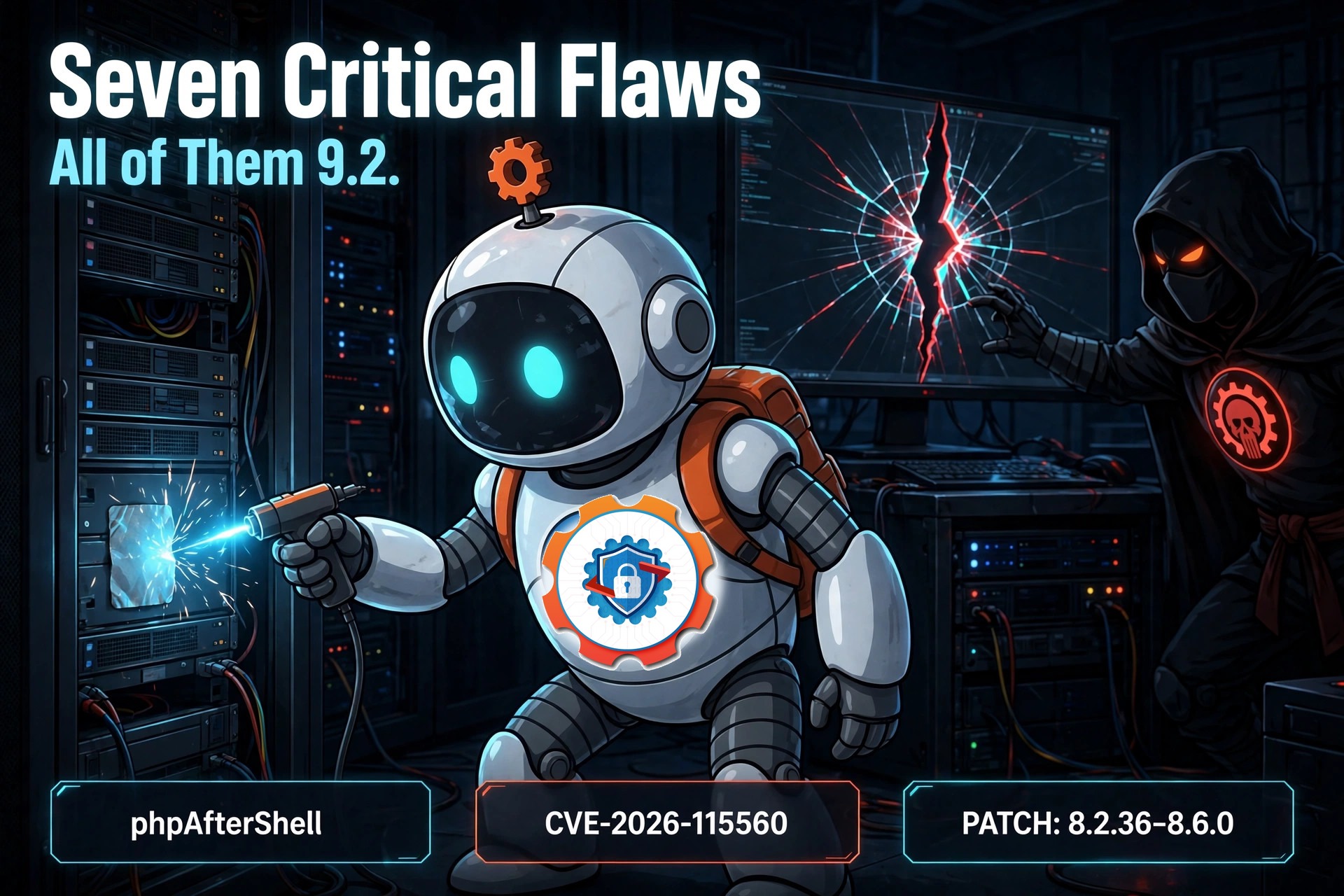
Seven critical flaws. Every one of them scores 9.2. The PHP Foundation shipped emergency security updates on November 19 for all supported PHP versions, and the headline flaw — codenamed “phpAfterShell” — turns an interrupted file write into remote code execution on the server. If your site runs PHP, this update is not optional.
The patches are PHP 8.2.36, 8.3.37, 8.4.28, 8.5.13, and 8.6.0, released after an advance warning that multiple critical flaws were coming. Exploitation can lead to remote code execution, session corruption, denial-of-service, memory corruption, or local privilege escalation. There is no single flaw to watch — there are seven, and they all score the same.
The headline flaw: a session file, half-written
The most striking is CVE-2026-126714, which researchers at Depthfirst codenamed “phpAfterShell”: a time-of-check time-of-use flaw in how PHP writes session data to disk that turns bad timing into code execution.
When PHP updates a session file, it rewrites the data with pwrite() or ftruncate(). Interrupted at the wrong moment, the write leaves a malformed file behind: the prefix of the new session spliced onto the tail of the old one. Nothing looks broken yet. The trap is set on disk, and it waits.
Next time the application calls session_start(), PHP loads the spliced file and its decoder reads the leftover bytes as legitimate session entries — including serialized objects the attacker chose. Researcher Yuhang Wu described it plainly: “By carefully choosing the length fields in the new prefix, an attacker can make PHP’s Session decoder interpret leftover bytes that were previously just part of an ordinary string as separate Session entries and serialized objects.” Chained with another PHP-native deserialization-to-RCE finding, that yields an arbitrary deserialization primitive — then remote code execution as the PHP worker.
Exploitation is not free: it needs influence over the session data, an interruption at a useful point in the write, and an application with a suitable deserialization gadget chain. It affects any application on affected PHP with file-based sessions. If patching must wait, the Foundation’s advice is to turn off session upload progress.

The other six — and the eighth flaw
phpAfterShell leads the list, but the other six 9.2s are each a remote code execution path on their own:
CVE-2026-115560 (9.2) — improper input validation that can lead to remote code execution, file modification, session corruption, or denial-of-service. Fixed in all five patched versions.
CVE-2026-129182 (9.2) — a use-after-free flaw that can corrupt memory and allow full remote code execution, in the same pattern as CVE-2026-109619 — the PHP2Shell flaw already being exploited against Check Point gateways when we covered it last week. Fixed in 8.5.13 and 8.6.0 only.
CVE-2026-129289 (9.2) — an inconsistent interpretation of HTTP requests that can let an attacker run their own PHP code as the worker, with no user interaction and no non-default configuration. It needs a front end that keeps backend connections alive — nginx with fastcgi_keep_conn on, Apache mod_proxy_fcgi with enablereuse=on, HAProxy FastCGI, or LSAPI — plus an app path that opens “php://input” without reading it fully. Fixed in all five versions.
CVE-2026-129474 (9.2) — a use-after-free flaw that can lead to remote code execution on PHP 8.5 and later, if the attacker controls enough request data to influence memory allocation, reaches a magic method call, and triggers a fatal error at the relevant point. Fixed in 8.5.13 and 8.6.0 only.
CVE-2026-129481 (9.2) — a use-after-free flaw that can break session cleanup, corrupt memory, crash a reused PHP worker, or allow remote code execution. Fixed in 8.3.37, 8.4.28, 8.5.13, and 8.6.0.
CVE-2026-129496 (9.2) — a use-after-free flaw that lets an unauthenticated remote attacker crash PHP workers or execute arbitrary code with their privileges. Fixed in all five versions.
Eighth, just below the critical line: CVE-2026-129291 (8.8), a use-after-free that can escalate a local attacker — but only with local code execution inside an FPM worker, a pool with catch_workers_output enabled, the epoll backend, and control over worker lifetimes and inherited pipe descriptors. Narrower, but real — fixed in all five versions.
Who is affected — and which patch you need
The exact patch depends on your branch: CVE-2026-129182 and CVE-2026-129474 are fixed only in 8.5.13 and 8.6.0, and CVE-2026-129481 only from 8.3.37 up. On PHP 8.2 or 8.3, a branch update closes most of the list — check the two 8.5-only fixes against your setup, because a branch update alone does not cover them.
The pattern is familiar: Java went through the same week with Java4Shell, the Base64 decoder flaw we covered when its fix landed. The runtime is the foundation — a flaw in it is a flaw in every application standing on it.
What to do now
Update PHP to the latest patch release for your branch: 8.2.36, 8.3.37, 8.4.28, 8.5.13, or 8.6.0. On 8.2 or 8.3, confirm whether the two 8.5-only fixes affect you and plan the branch move. If you cannot patch immediately, turn off session upload progress — the Foundation’s stated stopgap for phpAfterShell — and audit which applications use file-based sessions, because those are in the blast radius.

Seven 9.2s in one release is not a routine patch day. PHP powers a huge share of the web, and every one of these flaws is a path to running code on the server. The fixes are out and waiting. Apply them.
Source: The Hacker News.