



The Countdown Ended. The Rich List Leaked.
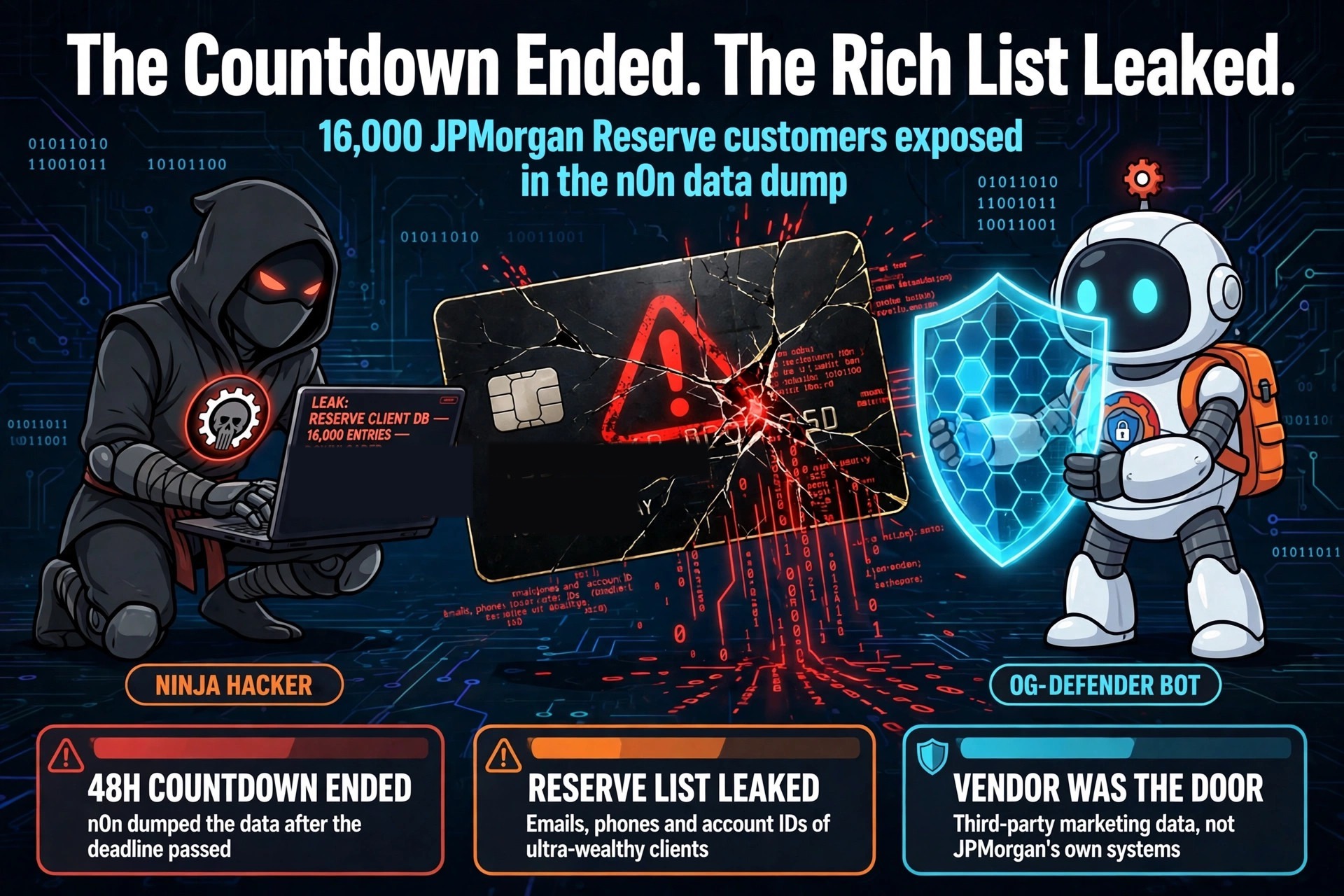
The countdown ran out, and the data went public. The ransomware gang n0n has dumped stolen JPMorgan Chase data on the dark web after the 48-hour deadline it set for the bank — and the leak is not a random customer list. It is the Reserve list: roughly 16,000 email addresses tied to JPMorgan’s invitation-only Reserve card program, the card for clients with typically $10 million or more in managed assets.
Cybernews researchers who studied the leak say it also includes phone numbers in some cases, JPMorgan account IDs, and 124 bank employee email addresses. The whole file is just 502KB — small enough to pass around in seconds, and small enough that nobody can yet say whether it is everything n0n took, or only a sample meant to prove the rest exists.
Why this list is different
Sixteen thousand records is a small breach by the standards of this year. What makes it dangerous is who is on it. Reserve is not a card you apply for; it is an invitation-only Visa program for high-net-worth clients. Every address on that list belongs to someone a scammer would love to reach — and now the scammers know exactly who they are. “This association alone makes the leak a lot more sensitive as essentially all affected individuals can be a lucrative target to cyber criminals,” Cybernews senior information security researcher Aras Nazarovas told the outlet.
The employee addresses matter just as much. One hundred and twenty-four staff emails in criminal hands means spear-phishing aimed at the bank’s own people, credential-stuffing against staff accounts, and help-desk impersonation or business email compromise. As Nazarovas put it, a single compromised employee can open a path into internal systems. The leak is small; the leverage it gives an attacker is not.

The door was a vendor
JPMorgan says its own systems were not breached. The attack hit third parties that provide services to the bank, and what the attackers reached was marketing data held by those vendors. “We have learned that third parties who provide services to the firm were the target of a cyberattack,” a JPMorgan spokesperson told Cybernews. “Based on our investigation so far, we believe the attackers accessed certain marketing data held by those vendors, which may include some customer names and email addresses.”
That distinction matters, and it also has a limit. Marketing data sounds harmless until it is paired with names, phone numbers, and account IDs — the exact ingredients of a convincing phishing email. The bank says there has been no disruption to its services, that it will contact affected customers directly, and that it will offer complimentary credit monitoring where appropriate. It also stressed there is no connection between this leak and the service outage some customers experienced earlier in the week. The bank had already resolved that outage on Monday.
This is the second act of a story we covered when the countdown started. n0n, first tracked in mid-September, had listed JPMorgan alongside Visa and given both 48 hours to pay. Visa confirmed at the time that it was aware of the gang’s claims and that its incident traced to a third-party provider in Asia Pacific. The countdown passed, and n0n followed through — at least on JPMorgan. Whether more data follows, and whether Visa’s name comes up again, is the open question now.
What comes next
The most likely next step is not another dump. It is the phishing wave. With 16,000 verified high-value email addresses, attackers can send messages that reference the real Reserve program, the real bank, and the real breach — and sound legitimate doing it. The member directory n0n described earlier, with membership categories and postal codes, plus marketing campaign data covering hundreds of thousands of interactions, gives a scammer enough detail to personalize the lure.
There is also a regulatory footnote that cuts both ways. Because the leak appears to be emails and marketing data rather than passwords, Social Security numbers, or financial account numbers, the breach-notification exposure is probably limited. That is good news for JPMorgan’s lawyers. It is no comfort to the people on the list, whose risk is not a fine — it is a phone call or an email that knows too much.

What to do now
If you are a Reserve client, assume your email address is in circulation and treat any message about your account with suspicion — especially one that references this breach. Do not click links in emails claiming to be from JPMorgan; reach the bank through its app or the number on the back of your card. If a caller claims to be from the bank and already knows details about your account, that is not proof they are legitimate. It may be proof they read the leak.
If you work at a bank — any bank — treat the 124 employee addresses as the warning they are. A help-desk call asking you to reset a password, approve a login, or share a code is exactly the attack this leak enables. Verify the request through a second channel before you act on it. And for everyone else, the pattern is now familiar: the breach is rarely in the vault. We have seen it before — a French bank lost $133 million when attackers used the bank’s own account — and the list a vendor holds is worth more than its size suggests.
Source: Cybernews.