
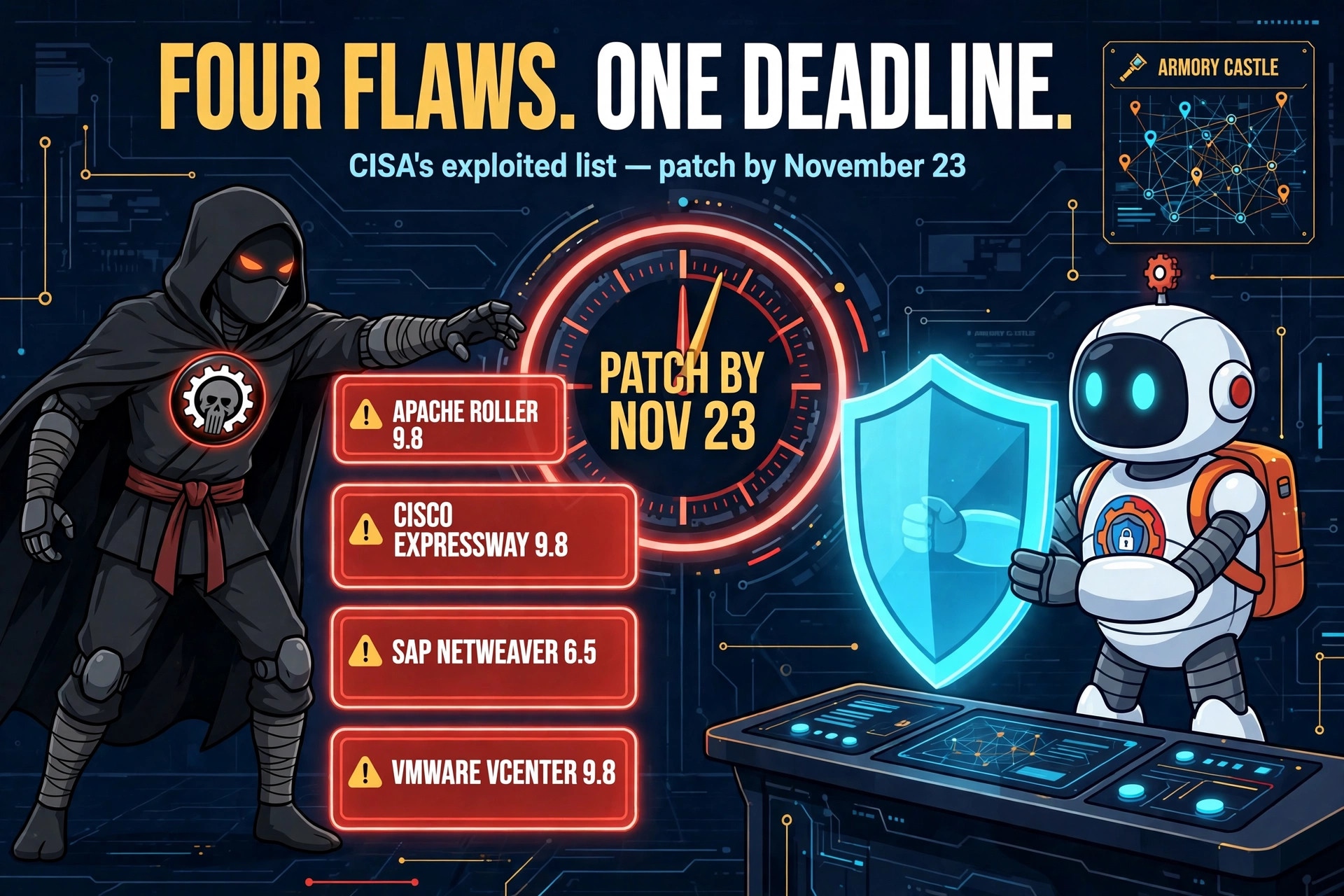














Four Flaws. One Deadline. Patch by November 23.
On Friday, November 20, CISA added four flaws to its Known Exploited Vulnerabilities catalog — the list for weaknesses attackers are already using. Federal agencies have until Monday, November 23, to patch all four, under Binding Operational Directive 26-04. Three days from listing to deadline.
Three of the four names will look familiar: we covered Roller, Expressway, and vCenter individually as each one broke. This post is about what changes when four flaws land on the same exploited list on the same day — the deadline, the priority, and the espionage thread. The fourth, SAP NetWeaver, has not been covered here yet.
The four, in one line each
Apache Roller, CVE-2026-129448 (9.8). A deserialization flaw in the XML-RPC endpoint lets an unauthenticated attacker run code remotely, no login required. Fixed in November 2026, and Apache’s maintainers have acknowledged it is being actively exploited.
Cisco Expressway, CVE-2026-76466 (9.8). Hard-coded credentials let an unauthenticated remote attacker with persistent cookies run commands as root on a clustered device, through the database service. Fixed in October 2026. F6 reported the flaw was used to breach a Russian organization, after which the attackers moved laterally and reached sensitive data. The activity has not been attributed to any group.
SAP NetWeaver Enterprise Portal, CVE-2025-42884 (6.5). A JNDI injection flaw lets an unauthenticated attacker disclose or modify server information. Fixed in November 2025. Unlike the other three, no public reports say it is being exploited — yet it made the same list, on the same deadline.
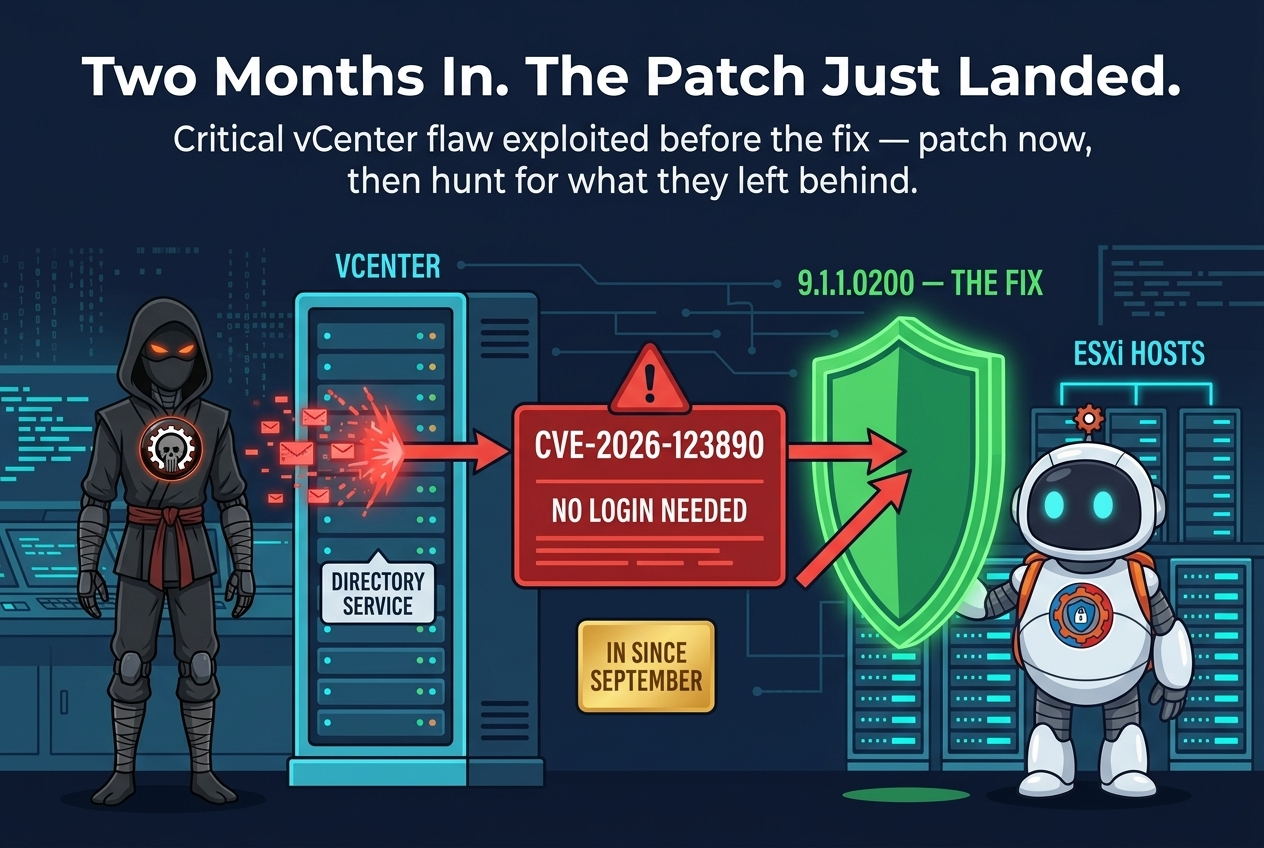
VMware vCenter, CVE-2026-123890 (9.8). An authentication bypass through an alternate path lets an unauthenticated attacker with network access walk past vCenter’s login entirely. Fixed in November 2026. This is the one with the espionage link.

What the listing actually changes
A flaw landing in the KEV catalog is not the same as a flaw getting a high severity score. Scores predict how bad a flaw could be. The list is evidence of what attackers are already doing. When CISA adds a flaw, exploitation is confirmed, not theoretical — and for federal agencies, patching becomes a dated order.
The deadline matters because of how short it is. A normal patch cycle gives IT weeks to test, stage, and roll out a fix. Three days does not. Outside the federal government, the deadline is not a legal order — treat it as one anyway. When a flaw makes this list, every attacker not already using it gets the same signal you do: this one works, and plenty of targets have not patched it yet.
The espionage thread
The vCenter flaw turns a patching batch into a story about who is exploiting it and why. The listing links CVE-2026-123890 to a suspected China-nexus espionage group tracked as Armory Castle, formerly UNC5221. The group reportedly chained the vCenter bypass with a second flaw, CVE-2026-102764 (9.3) in BeyondTrust Remote Support, to plant custom backdoors for persistent access and data theft.
The attackers used the vCenter bypass to get in and the BeyondTrust flaw to stay in, building persistence that survives a reboot, a password change, even the patch itself. A backdoor planted this way does not disappear when the vulnerability closes. We covered the vCenter flaw itself when its patch landed — what the KEV listing adds is the campaign behind it, and the warning that patching is only half the job if the backdoor is already there. The Expressway case followed the same pattern.

The one flaw nobody has seen exploited
SAP NetWeaver’s CVE-2025-42884 is the odd one out. It scores 6.5 — the lowest of the four by a wide margin — it was fixed a full year ago, and no public reports document its exploitation. So why is it on a list called Known Exploited Vulnerabilities, sharing a deadline with three 9.8s?
Either CISA holds exploitation evidence that has not been made public, or confirmed use exists that the public record has not caught up with. The KEV catalog is not a rumor board; entries are added on evidence. A 6.5 that makes this list is not low-priority. The score measures how bad the flaw is in isolation. The listing measures whether anyone is using it.
What to do before November 23
Patch all four by Monday, November 23. Apache Roller, Cisco Expressway, SAP NetWeaver Enterprise Portal, and VMware vCenter. If you run any of them, the federal deadline is a reasonable stand-in for your own. Do not wait for the next maintenance window — three days is the window.
Hunt for persistence, not just the flaw. If you run vCenter or BeyondTrust Remote Support, assume the Armory Castle campaign may have visited. Check for unexpected administrator accounts, unfamiliar scheduled tasks, and outbound connections to hosts you do not recognize. Patching the bypass closes the door; it does not evict anyone already inside.
Audit Expressway access. The Expressway flaw turned a persistent cookie into root access, so review cookie sessions, database service access, and command history on clustered devices, and look for lateral movement from any Expressway host.
Inventory your SAP NetWeaver exposure. Find every Enterprise Portal instance, especially any reachable from the internet, confirm the November 2025 fix is actually applied, and check logs for unusual JNDI lookups.
Four flaws, three confirmed exploited, one espionage campaign, one deadline. These are not theoretical anymore. Patch by November 23 — and check whether someone already walked through the door before you do.