







GoFundMe Was Breached. The Donors’ Names Went With It.
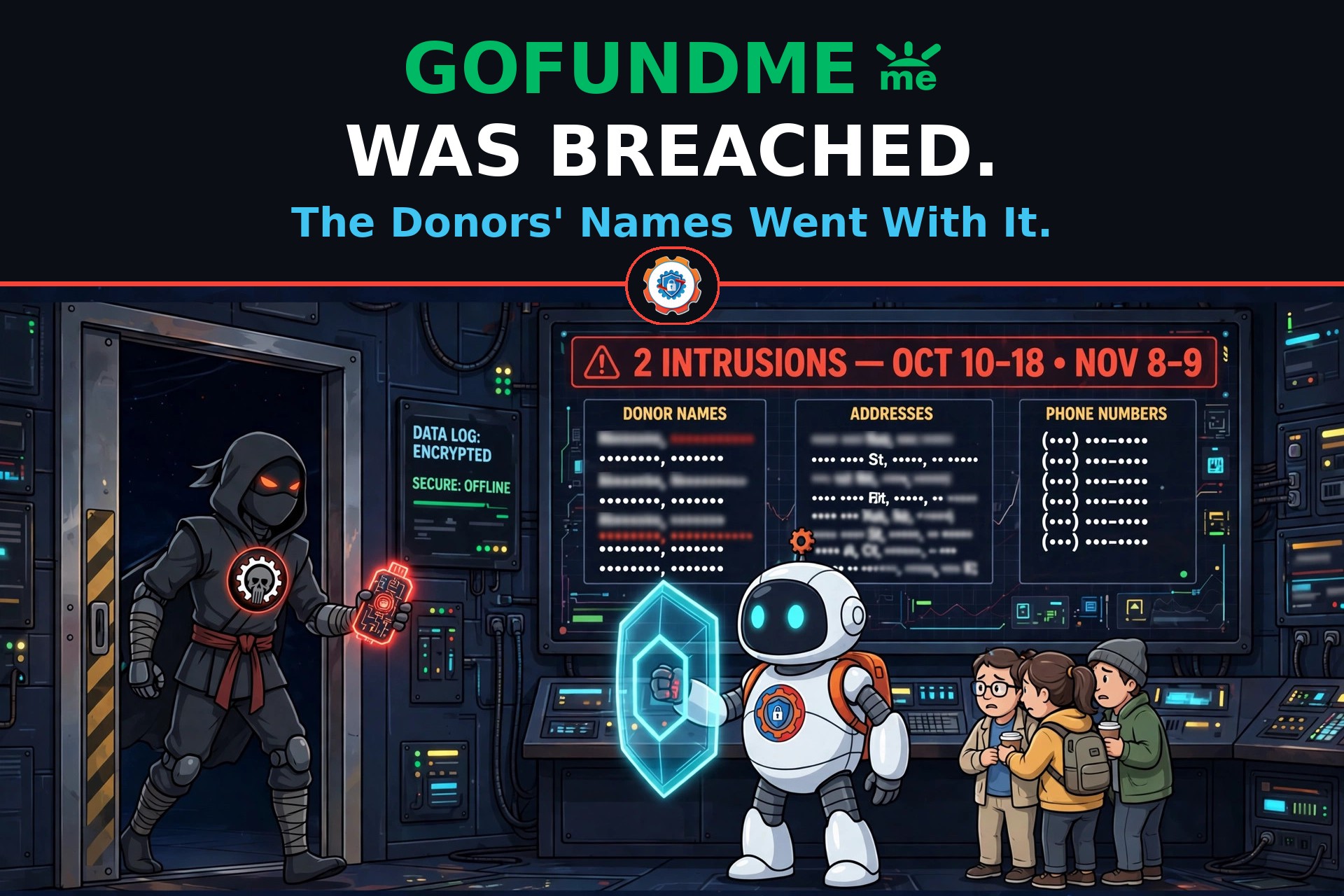
GoFundMe has confirmed a data breach that exposed the personal information of donors on its nonprofit fundraising platform. No passwords were taken. No card numbers were taken. What the attackers got instead may be more useful to them in the long run: the names, addresses, and phone numbers of people generous enough to give.
The breach hit GoFundMe Pro, the company’s platform for nonprofit fundraising, formerly known as Classy. GoFundMe disclosed the incident in a security notice published on November 20, 2026.
Two break-ins, a month apart
According to GoFundMe, attackers gained unauthorized access to the GoFundMe Pro API in two separate incidents: the first between October 10 and 18, 2026, and the second between November 8 and 9, 2026. That is a gap of roughly three weeks between the two windows — and the company has not said whether the second incident was a fresh intrusion or the same access route reopened.
The company says it has secured the platform, addressed the known access methods, disabled the unauthorized accounts, and brought in external cybersecurity professionals. Law enforcement has been notified, and the investigation is still ongoing.
What was taken — and what was not
The stolen data includes donor names, postal addresses, and phone numbers. For some donors, it also includes dates of birth and other information people voluntarily provided in registration forms.
GoFundMe was equally specific about what was not accessed: donor and supporter credentials were not accessed, and no full card numbers, security codes, or bank account details stored by GoFundMe Pro were accessed.
That distinction matters. This is not a credential-theft story, and it is not a payment-card story. It is a personal-data story — and the danger it creates is slower and harder to spot.
Why names and addresses are the real prize
A name, a home address, a phone number, and a date of birth are the raw materials of a convincing scam. With them, a fraudster does not have to guess who you are or what you care about. They know you donated, they know roughly where you live, and they know which causes move you.
The most likely play is impersonation: attackers pose as the organizer of a campaign you actually supported and ask for another contribution — with your name, your town, and the cause spelled out correctly, the message reads like it comes from someone who knows you. The other is fake account-verification phishing: a message that appears to come from GoFundMe itself, warning that your account needs updating and pointing to a lookalike login page.

It is the opposite of the Cleverbridge breach we covered yesterday, where attackers walked away with full card numbers and CVVs. Here, the theft is quieter — and the follow-up scam is the attack. We have seen this playbook before: after the TfL breach, stolen customer details were used to make follow-up messages look genuine.
GoFundMe has not said how many donors are affected, and it is not known whether the stolen data has been exploited in the wild. A breach with an undisclosed victim count and two intrusion windows is a story that may still grow.
Four checks if you donate on GoFundMe

1. Verify every donation request on GoFundMe itself. If a message asks you to give again — by text, email, or social media — do not tap its link. Open the GoFundMe site or app yourself and find the campaign there. A real organizer’s campaign will be waiting for you; a scammer’s link will not survive the detour.
2. Treat “verify your account” messages as phishing until proven otherwise. GoFundMe will not ask you to confirm your account through a link in an unexpected message. If you get one, ignore the link and sign in through the official site or app to check whether anything actually needs your attention.
3. Be suspicious of organizer messages that know too much. A message that names you, your town, and the exact campaign you supported feels personal — but that is exactly what the stolen data makes possible. If an organizer asks for money outside the platform, or asks you to pay by gift card, wire transfer, or a different link, stop. Real follow-up donations happen on GoFundMe, not in a private chat.
4. Consider a credit freeze if your address and date of birth were exposed. Neither alone opens an account in your name, but together with your name and phone number they are the building blocks of identity theft. A freeze is free, takes minutes with the major credit bureaus, and blocks new accounts from being opened while it is in place. At minimum, watch your credit reports and any unexpected account notices over the next few months.
The bigger picture
GoFundMe was founded in 2010 and has helped raise more than $50 billion for personal emergencies, medical expenses, and humanitarian campaigns. The platform runs on trust — and its donors are people who gave money to help strangers.
The company says the platform is secured and the unauthorized accounts are disabled. The open questions are how many donors were caught in the two intrusion windows, whether the data has already been used, and whether the access route has truly been closed. Until those answers arrive, the safest assumption for any GoFundMe donor is simple: your name is out there, and someone may try to use it.