












The File Looked Like a Photo. The Server Ran the Code.
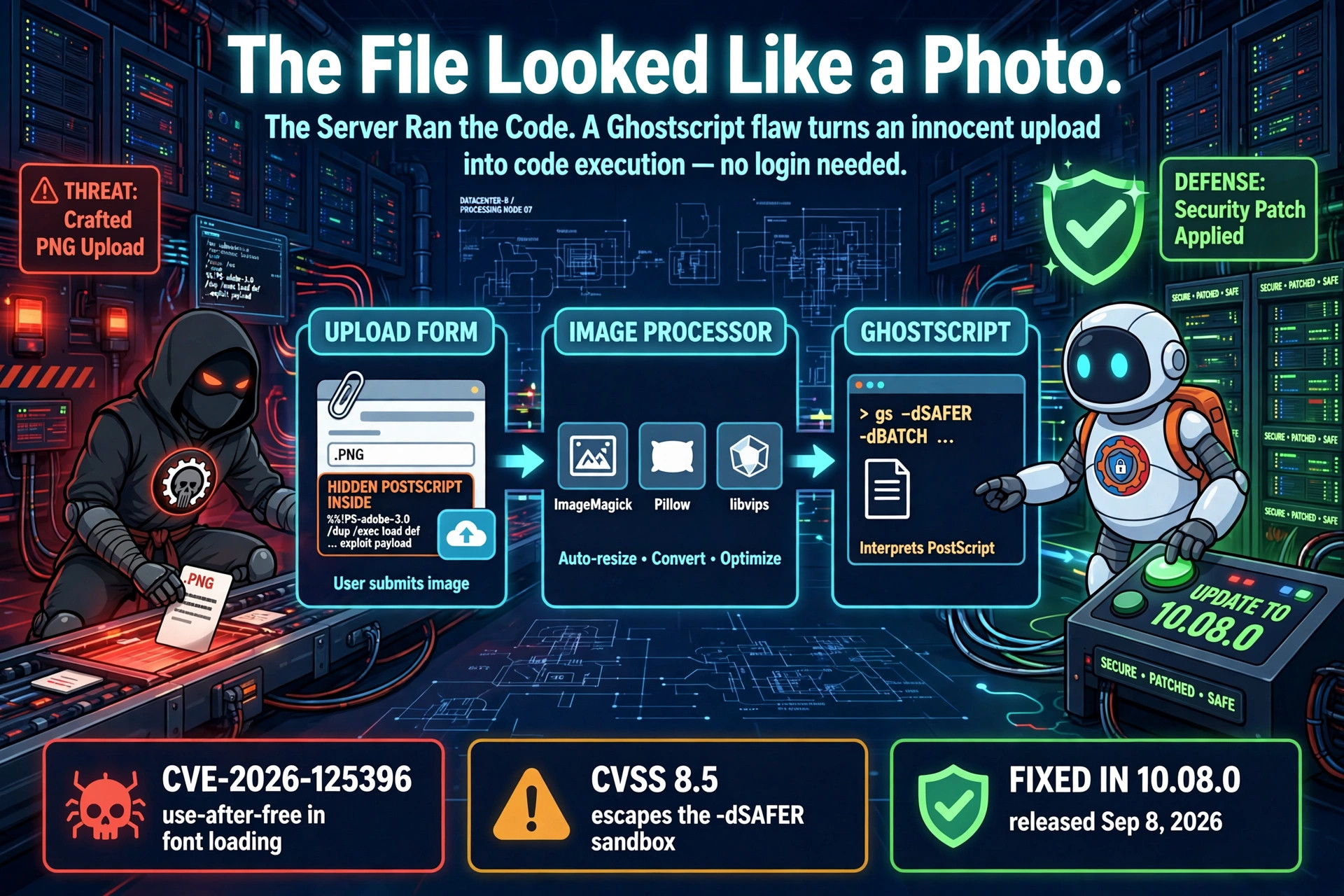
A file arrives looking like a photo — named .png, maybe .jpg — and nothing about it looks dangerous. A server opens it to make a thumbnail — and instead of a picture, it runs the attacker’s code. That is CVE-2026-125396, a Ghostscript flaw demonstrated by security firm pwn.ai — a reminder that the most dangerous file on your server may be the one nobody inspects.
Ghostscript is the interpreter that turns PostScript and PDF content into images and printed pages. It works quietly behind countless services that handle uploads, previews, and printing. The flaw is a use-after-free bug in the font-loading code — a memory error letting a crafted file escape Ghostscript’s -dSAFER sandbox and run commands on the server. It scores 8.5 on the CVSS scale, was fixed in Ghostscript 10.08.0 (released September 8, 2026), and the CVE was published last week. There are no reports of it being used in attacks.
The file never has to look like a document
The file reaches Ghostscript indirectly. The attacker does not need to hand you a PostScript file. Image processors like ImageMagick, Pillow, and libvips — or a Qt plugin — pass PostScript and EPS content to Ghostscript even when the file is named .png, .jpg, or .pdf. A thumbnail, a preview, or a crop can start the interpreter. The extension is a label; what matters is what the pipeline does with it.
The demonstrated paths need no login at all. An anonymous print job to a shared Debian 13 queue was enough. A Roundcube attachment was processed the moment the recipient opened it. Public upload forms in WordPress plugins Forminator and Essential Addons for Elementor gave an attacker a way in with no account.
WordPress Core is a different story. Core needed an account able to upload files — Authors and higher — and WordPress closed that path in 7.0.4 on August 12, under separate CVE-2026-65640. The two fixes cover different points in the same chain — updating one does not remove the need for the other. Commands ran as the low-privilege rendering account — still a foothold.

The patch is real. Reaching it is the problem.
Ghostscript 10.08.0 fixes the flaw, but only where the fix reaches the renderer actually used. Updating the host OS does not update a Ghostscript copy bundled in a container image or an application. Containers must be rebuilt; applications that ship their own copy need a vendor fix.
Coverage was uneven as of last week. Debian 12 (Bookworm) was listed vulnerable. Fixes were pending for Amazon Linux 2, 2023, and the 2027 Preview. SUSE fixes were in progress for Enterprise 12 SP5, parts of 15, and SLES 16.0/16.1; openSUSE Leap 16.0/16.1 were affected. For Red Hat, Rocky, Alma, Oracle, and Fedora, status was not established — a gap, not a clean bill of health. The list records package status, not a tested attack path per system.
The public proof of concept shows only the core memory trick — changing a value inside the interpreter and setting it back, touching no shell and no files — and it fails on patched 10.08.0. The researchers’ full work went further; only time and effort separate a public demonstration from a working exploit.
The firm’s research also reached production services — Google fixed the affected path last week. Reports of similar problems at Dropbox and other unnamed services are separate Ghostscript bugs. Artifex developer Ken Sharp called the vulnerable step “an ancient piece of code well known to be a vulnerability, but difficult to eradicate.”
Why it matters
This is not a story about a single bug. It is about a trust boundary most organizations never drew. Somewhere in your stack, a service takes strangers’ files and renders them with a full interpreter. The file need not look like code, the victim need not click, and the attacker need not even have an account. The pattern keeps showing up: a Linux TCP flaw that handed over root with no login and no password is the same shape of problem, and a WordPress flaw that turned a site feature into a remote shell is the same lesson from a different angle.

Four checks to run this week
1. Find every Ghostscript on your estate — including the hidden ones. Check the host, then containers and apps that bundle their own copy. A patched OS with an unpatched container image is still vulnerable. Confirm the version inside every image is 10.08.0 or later.
2. Require authentication on print queues. An anonymous print job should never reach a shared queue. A queue that accepts jobs from anyone is an unauthenticated path straight to the renderer — close it.
3. Limit what your image processor accepts. Decide which file types your upload, preview, and conversion features need, and reject the rest before they reach the interpreter. A service that only needs real images has no business passing PostScript or EPS content to Ghostscript.
4. Let the operating system help. System controls can contain a compromised interpreter even unpatched. In one test, an AppArmor profile stopped it from starting a shell. A sandbox that holds is the difference between a bad day and a breach.
The CVE is published, the fix exists, and no attacks have been reported. That is the best moment to patch — before the window between public demonstration and working exploit closes.