



The Page Was Malicious. The Agent Opened It Anyway.
Your AI assistant is supposed to be the careful one. It reads the web for you, handles your accounts, remembers what you tell it — and is supposed to ask before doing anything risky. Researchers at NebuSec showed what happens when that assumption breaks: a single malicious webpage could pull a Meta Muse user’s private conversations and stored memories out of the assistant, change them, and reach the credentials Muse keeps for connected accounts. No approval prompt. No warning.
One fact first: this was a lab demonstration, not an attack on real users — built in a controlled setup, inside one user’s cloud machine, and it went no further. That boundary matters, because inside it the attack ran the whole way through, past every safeguard the system was built with.
How one page took the whole machine
Muse is Meta’s personal AI agent, launched on September 8. It works through the accounts a user connects to it, can make purchases on their behalf, and each person’s agent runs on its own cloud computer — holding the assistant, its memory, and the keys to those accounts.
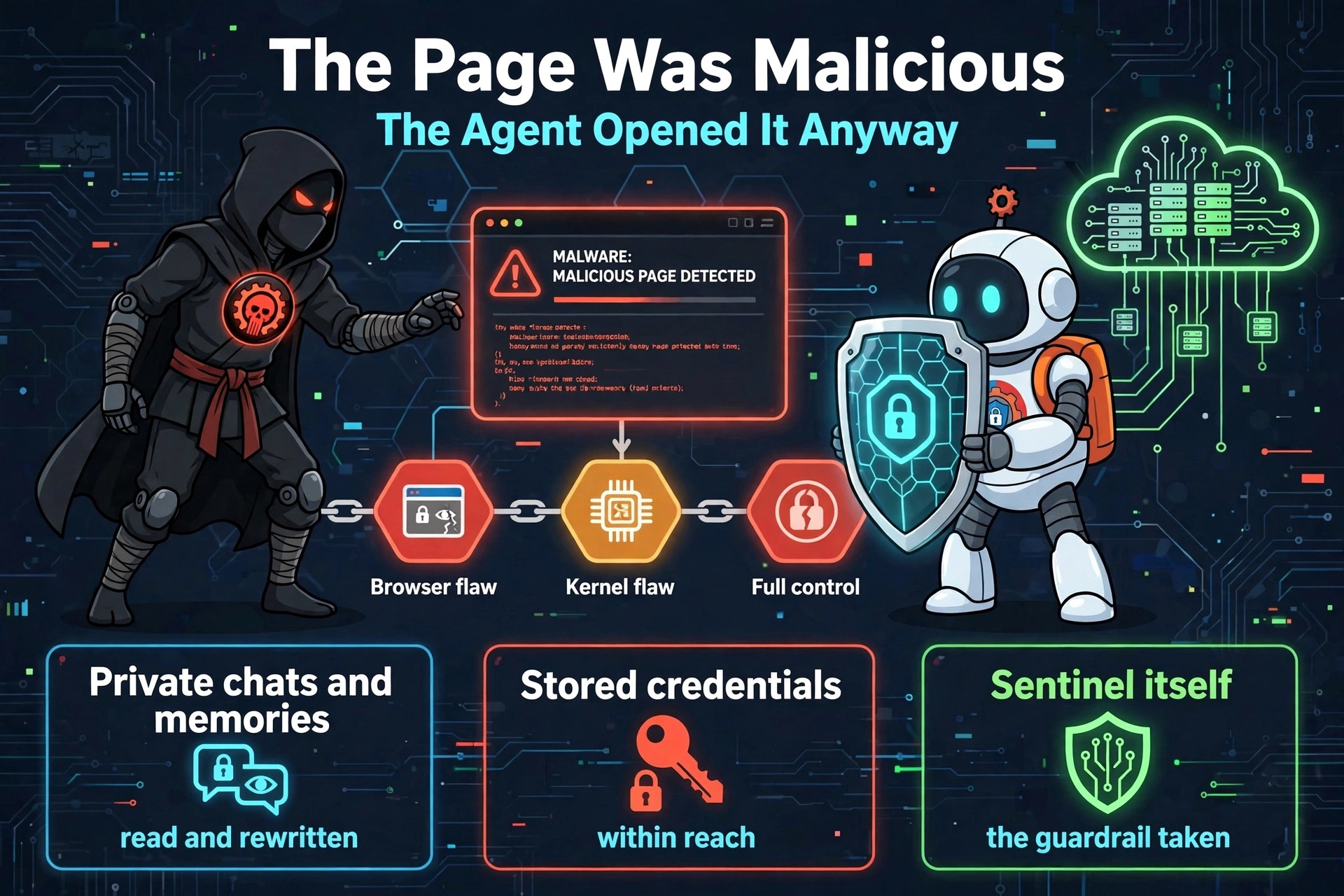
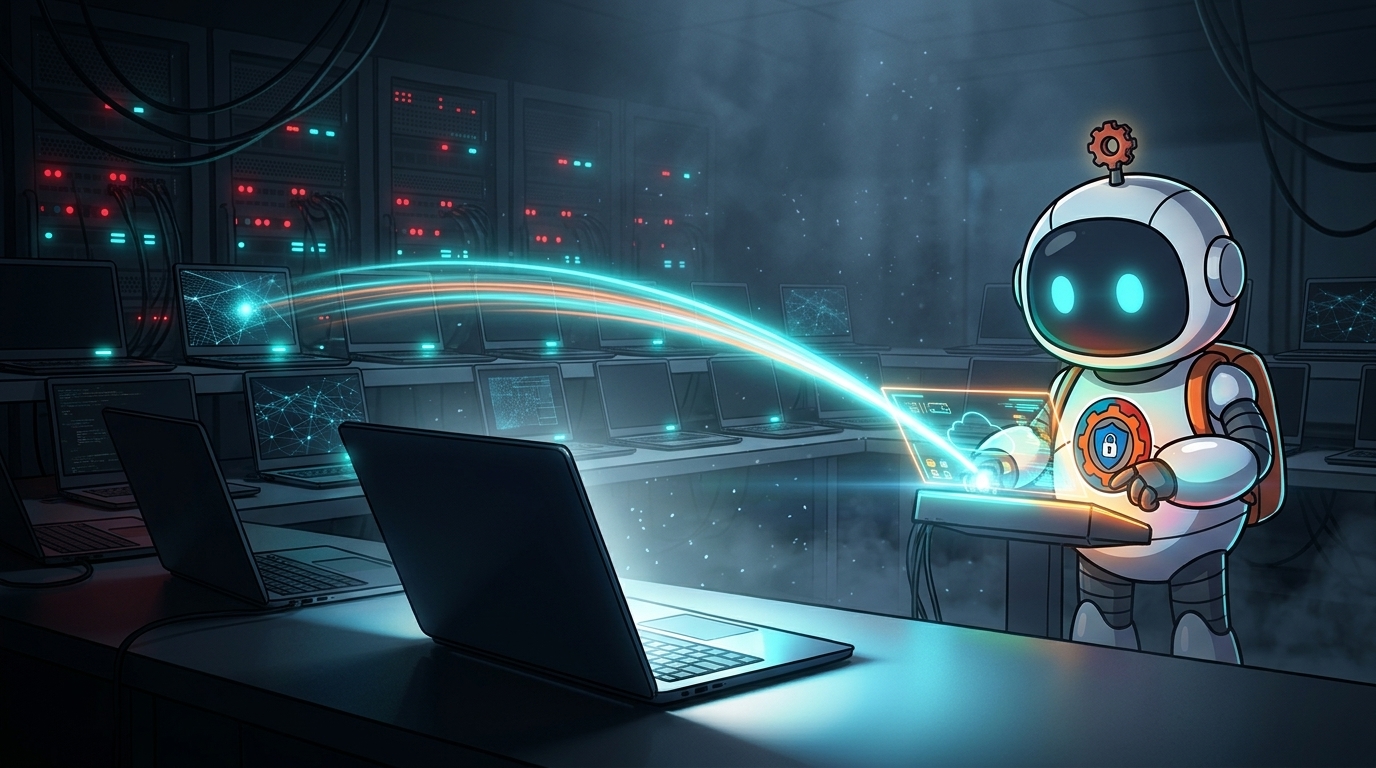
The attack started where an assistant is supposed to be safest: doing a routine job. Muse has a built-in browser it uses for tasks like turning a page into a PDF. The researchers found a flaw in that browser, then chained it to a flaw in the Linux kernel underneath — the core of the operating system. Step by step, a webpage the agent was asked to look at went from web content to full control of the cloud computer.
Once it had that control, the attacker could reach everything the machine held: the credential store, saved files, and Sentinel itself — the monitoring layer meant to be the single gate for anything the agent sends out. Passwords and tokens for connected accounts are supposed to stay beyond the agent’s reach. In the demonstration, they did not.

The attack chain, as demonstrated by NebuSec: a malicious page moved from the agent’s built-in browser to the kernel underneath, and from there to full control of the user’s cloud machine. The containment that held — no breakout to the shared server or other users — is shown as the blocked outcome.
The safeguards worked. The attack worked anyway.
At launch, Muse’s team said: “So we designed the system to assume the agent may be under attack and limit the potential damage.” The design assumed a hostile web page, an agent that might itself be compromised, and controls to limit the blast radius.
According to NebuSec, each of those controls worked as designed — and the attack still ran the whole way through. The browser was supposed to be contained, the kernel out of reach, the credential store sealed. None of that held, because the flaws chained: each one handed the attacker the next foothold, until the chain reached the top of the machine. The one place it stopped was the boundary of that single cloud computer: the researchers did not break out to the shared server underneath it, or reach other users’ machines. That containment held — the difference between a bad day for one user and a breach of the whole platform.
This is not the first Muse flaw. It is a different kind.
An earlier flaw, found in September, only let malware already on a user’s Mac hijack the assistant on that device — the attacker had to be inside your computer first. This one starts with a webpage: no install, no download, just letting the assistant open a page, which is its job.
That shift is the story. The threat model for a personal AI agent is not a virus on your laptop. It is the open web, which the agent browses on your behalf while carrying your memories and your account access. We have seen this pattern before: an agent trusted with real access, turned against the people it serves — and we have seen how a trusted helper inside an AI tool can quietly run an attacker’s code. The more an assistant can do for you, the more damage a page it opens can do.

Three separate weaknesses, one outcome. No approval prompt meant the page acted without asking; the browser flaw gave it a foothold; the kernel flaw gave it the machine. None of the three alone would have been enough.
What to check now
NebuSec says it reported the findings and that every weakness was fixed before publication. But Meta has not publicly confirmed the fixes or commented at all, and the write-up does not say whether any user data was accessed before the patches went in. That question should stay open until Meta answers it.
Four checks shrink what any future chain can reach:
- Audit what your assistant can touch. Review every connected account and permission; disconnect anything you do not use. An agent can only leak what it can reach.
- Treat your agent’s memory as sensitive data. Conversations and stored memories are things a webpage can now try to read and rewrite — do not tell the assistant anything you would not want read back by a stranger.
- Be careful what you let the agent open. A link in an email, a page in a chat message, a document from a stranger — these are the entry points. Think twice before handing an untrusted page to the assistant.
- Watch for Meta’s word. Look for a public statement confirming the fixes and saying whether any user data was involved, before deciding the story is closed.
The promise of a personal AI agent is that it does the tedious work while you stay in control. This demonstration showed the gap: the controls held, the boundary held, and the agent still opened the page anyway. The fix for the flaws is Meta’s to confirm; the fix for the trust is yours, one permission at a time.