



The CAPTCHA Was Fake. The Spying Was Real.
A fake verification prompt tells you to click a button and run a command. You do it — the page looks official, the instructions harmless. Behind that one click waits a delivery service called ROMULUS — and what it delivers is a remote access Trojan that can watch your screen, listen through your microphone, and take over your computer.
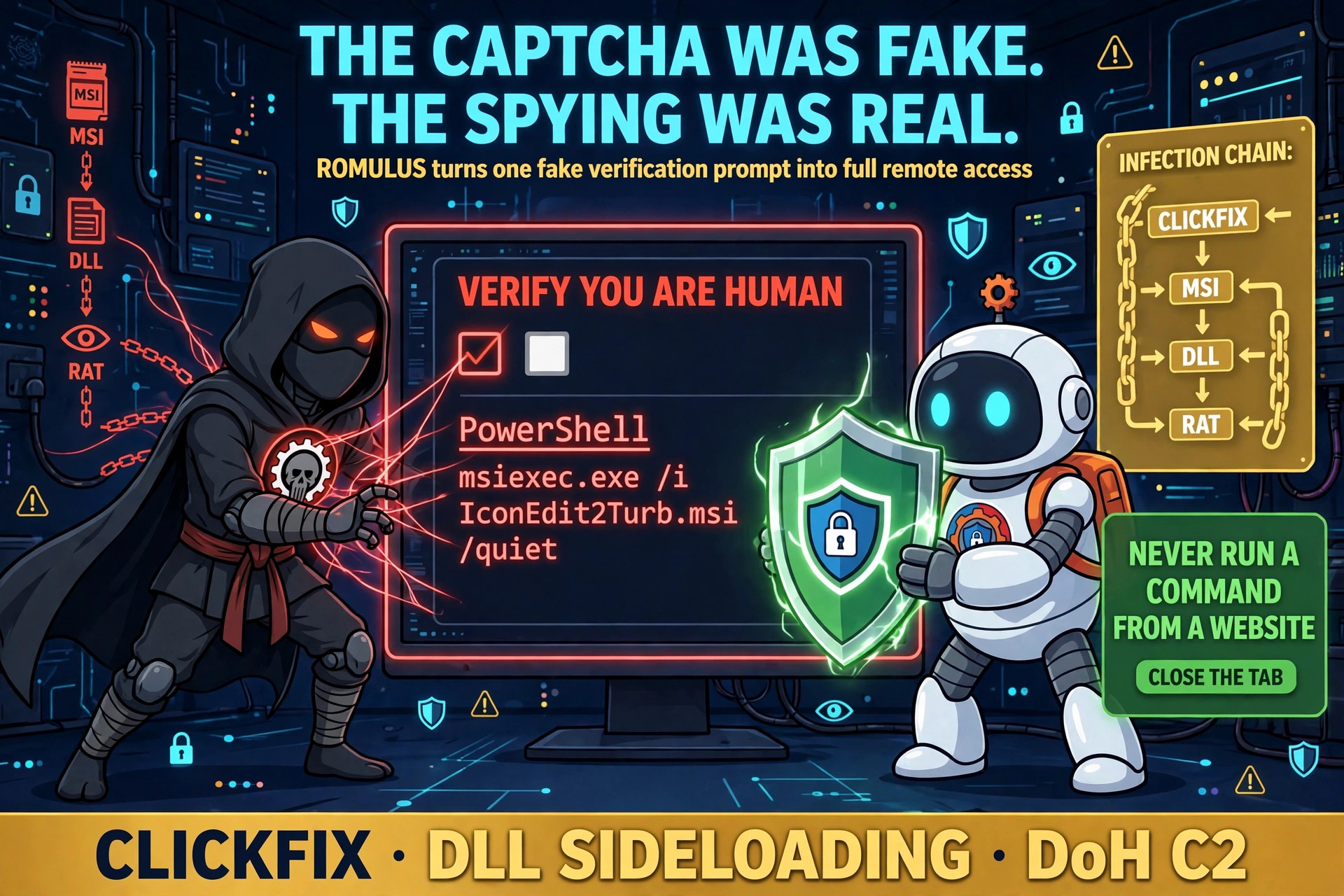
ROMULUS was first publicly documented last month by Forescout Research, as a malware delivery service that uses ClickFix-style lures to distribute LegionLoader, also known as Satacom downloader, CurlyGate, and RobotDropper. Now Blackpoint Cyber researchers Sam Decker, Nevan Beal, and Andi Ursry have traced ROMULUS to a previously undocumented remote access Trojan, CNCMachineRMS, delivered through the same ClickFix tricks. As Blackpoint put it: “ROMULUS likely operates as a delivery service, distributing CNCMachineRMS and Legion Loader through separate chains while retaining ClickFix and signed binary sideloading techniques.”
How ROMULUS gets in
ClickFix is the social-engineering trick at the heart of it. The victim lands on a page — sometimes after following a link from a ChatGPT Custom GPT — and sees a fake verification prompt, a CAPTCHA-style check asking them to run a command — the command does the attacker’s work for them. In the ROMULUS attacks Blackpoint tracked, those lures sent victims to malicious sites that delivered the RAT through DLL sideloading — malicious code hidden inside a legitimate, signed application.
It is not the only route. CNCMachineRMS was also delivered through BabaDeda Loader in ClickFix attacks abusing the legitimately signed IBM SPSS IDE executable for the same DLL sideloading trick. The lure, loader, and signed application change; the delivery service underneath stays the same. Criminals are even turning AI chatbots into the bait — stolen AI credentials are already resold by the million — and here a chatbot’s custom GPT points victims at the trap.

The installer that wasn’t what it claimed
One payload Blackpoint dissected shows the chain in detail. A malicious MSI installer named “IconEdit2Turb.msi” runs with msiexec.exe through a PowerShell command — the same kind a ClickFix prompt tricks the victim into running. The installer masquerades as the Stardock Smart DeElevation Tool, a real utility.
Once running, it starts a DLL sideloading chain to run a malicious DLL called “I++u.dll”. That DLL decodes and executes embedded shellcode, and the shellcode launches CNCMachineRMS. It is the same implant distributed through the ChatGPT Custom GPT lures — two roads, one destination. A fake utility is all it takes to open the door — a downloaded scanner that installed a backdoor instead showed the same trick from the other side.
What the RAT can do
CNCMachineRMS shares similarities with an earlier remote access tool, and its capability list reads like a surveillance kit. It offers remote desktop control and screen streaming, letting the attacker watch and operate the machine from afar. It captures microphone and camera input, manages files, runs system reconnaissance, and launches additional payloads on demand.
Its command-and-control traffic runs over DNS over HTTPS, or DoH, which encrypts DNS queries and blends the attacker’s traffic with ordinary encrypted web traffic — harder to spot, harder to block without breaking legitimate browsing. The victim sees nothing: no window, no warning, no obvious slowdown.

Why it matters
ROMULUS is not one attack. The same ClickFix playbook is running across many campaigns at once: EtherHiding has compromised more than 70,000 websites to render a fake Cloudflare CAPTCHA; fake Zillow review pages install the NetSupport RAT; and fake “Download Claude” Google Ads tricked Mac users into a Terminal command deploying Atomic macOS Stealer. A Huntress report last week found ClickFix has broadened beyond simple loader delivery into chains with persistence, lateral movement, reconnaissance, credential theft, and steganographic tricks — executables rebuilt from data hidden in PNG files. As Blackpoint’s researchers wrote: “As attackers continue to change the applications and loaders used to distribute their payloads, the underlying malware architecture provides a more consistent way to identify related activity and understand the threats being delivered.” Watch the architecture, not just the lure.
What to do
1. Never run a command a website tells you to run. No legitimate check will ever ask you to paste a command into PowerShell, Run, or Terminal. If a page asks, close it.
2. Treat “verify you are human” pages with suspicion when they ask for more than a click. A real CAPTCHA is a checkbox or a puzzle — a prompt that opens a Run dialog or asks you to copy text is an attack.
3. Do not follow links from chatbots or AI assistants to download software. Go to the vendor’s official site yourself — a Custom GPT, sponsored result, or ad can point anywhere.
4. Be wary of installers for tools you did not go looking for. If an installer arrives through a link, a message, or a “verification” step, do not run it — check the vendor’s site and the file’s signature first.
5. Watch for the quiet signs of remote access. A mouse that moves on its own, settings changed without you, or software you did not install. If anything looks off, disconnect and get the machine checked by a professional.
The lesson of ROMULUS: the most dangerous click is the one that looks like a security check. The prompt promises to prove you are human. The command it hands you proves the opposite — someone else is now in charge of your machine.