









Microsoft Got Breached. Through Its Own Identity Service.
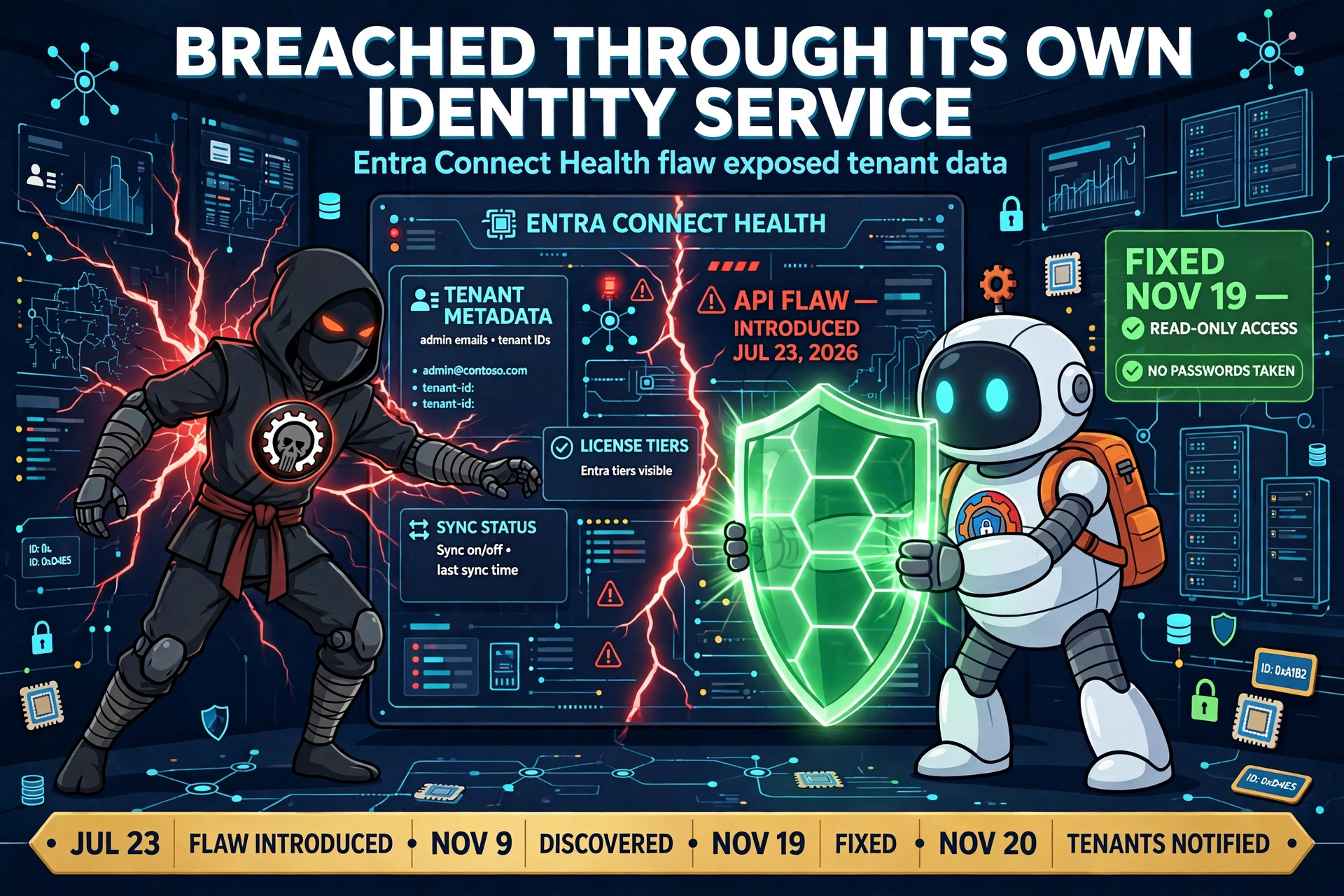
Microsoft has confirmed a data breach — and the way in came through one of its own identity services. Attackers exploited a vulnerability in the Entra Connect Health API, the cloud service that monitors on-premises identity infrastructure through the Entra admin center. The flaw gave them read-only access to tenant-level metadata.
Entra Connect Health watches over identity health — the monitoring layer for the systems that decide who gets in. In this case, the watchdog itself was the hole.
The flaw lived in the API for months
The vulnerability was introduced on July 23, 2026, and Microsoft did not discover it until November 9 — more than three months later. Microsoft’s investigation determined the flaw was exploited, though who was behind the attacks and when they began has not been disclosed.
Microsoft deployed a server-side fix on November 19, finished its investigation on November 20, and began notifying affected organizations through Azure Service Health. Because the fix was server-side, no software updates or other customer remediation is required.
Actively exploited is the detail that matters most. It is the same exploited status that put SonicWall on CISA’s Known Exploited Vulnerabilities list with a hard patch deadline — except this flaw lived in Microsoft’s own cloud, not in a box on a customer’s network.

What the attackers could see — and what they could not
The access was read-only, and Microsoft found no unauthorized configuration changes — nobody reconfigured anyone’s identity infrastructure. But read-only access to tenant metadata is still a haul, and the list of what was exposed reads like a phishing kit’s shopping list.
Exposed data included the email addresses of tenant technical contacts and administrator accounts, plus tenant IDs, display names, initial domain names, country codes, and regional information. Attackers could also see Microsoft Entra license tiers, directory sync status — whether sync was on and the last sync time — and Connect Health onboarding status. The API even returned an expired certificate once used to register Connect Health agents with a Microsoft internal service shut down in late 2024.
Just as important is what was not exposed: no user passwords, no password hashes, no authentication tokens, and no valid cryptographic keys. On-premises server and Active Directory topology details were not exposed, and neither was Azure subscription information. What leaked was the map and the address book — not the keys.

How big is it? Microsoft is not saying
Microsoft has not disclosed how many organizations were impacted. The early signals suggest it was not a handful: more than a dozen administrators reported receiving the notification in a Reddit post, and some managed service providers reported notifications for multiple customer tenants.
Why this one matters
Three reasons. First, the target: identity infrastructure is the trust layer everything else stands on. A flaw there need not hand over passwords to be dangerous — it hands over what makes the next attack believable.
Second, the exposed data is purpose-built for the next phase. Admin email addresses, tenant display names, initial domains, and license tiers are exactly what a targeted phishing campaign needs to look legitimate. A message that knows your tenant’s real domain and admin contacts is not generic spam — it looks like it already knows you.
Third, the irony is the warning: the breached service is the one that monitors identity health. If the monitoring layer can carry a flaw for three months unnoticed, no layer gets a free pass.
Four checks to run now
1. Warn your security team about targeted phishing. Microsoft’s own recommendation is the first move: alert security teams that the exposed admin email addresses and tenant information could fuel targeted phishing and social-engineering attacks. Brief the exposed contacts — tenant technical contacts and administrators — and tell them to expect messages referencing real tenant details. A warning before the phish arrives beats one after someone clicks.
2. Make sure privileged accounts use phishing-resistant MFA. Standard MFA is not the same as phishing-resistant MFA, and the gap is what attackers exploit. MFA was on in the SonicWall bypass — and attackers still walked in. For admin accounts, that means FIDO2 security keys or certificate-based authentication — not push approvals or codes that can be phished or fatigue-attacked. If your admins are still on push-based MFA, this breach is the reason to move them.
3. Review your Connect Health configuration — and see what was visible. Microsoft recommends reviewing Connect Health configurations, and it published a PowerShell script at aka.ms/ConnectHealth/scripts showing the types of tenant metadata that could have been exposed. Note what it does and does not do: it shows current values, not what the attackers actually accessed. Use it to understand your exposure surface, not as proof of what was taken.
4. Examine your Entra audit and sign-in logs. Look for suspicious activity in Microsoft Entra audit and sign-in logs — unusual sign-ins, unfamiliar locations or devices, activity around administrator accounts since July. The attackers had read-only access to metadata, not the ability to change configuration, but a careful log review is cheap insurance in case the metadata exposure was a stepping stone rather than the whole story.
No patch to install, no emergency remediation — but no reason to file this one away. The leaked data is what makes the next attack convincing, and it will arrive addressed to someone whose name the attackers already know.