



Zero Data Retention. Zero Privacy Anyway.
You send a prompt to an AI model through a gateway, tick the box that says your data will not be kept, and assume the words you typed stay between you and the model. For months, that assumption was wrong in three places at once, and nobody inside knew.
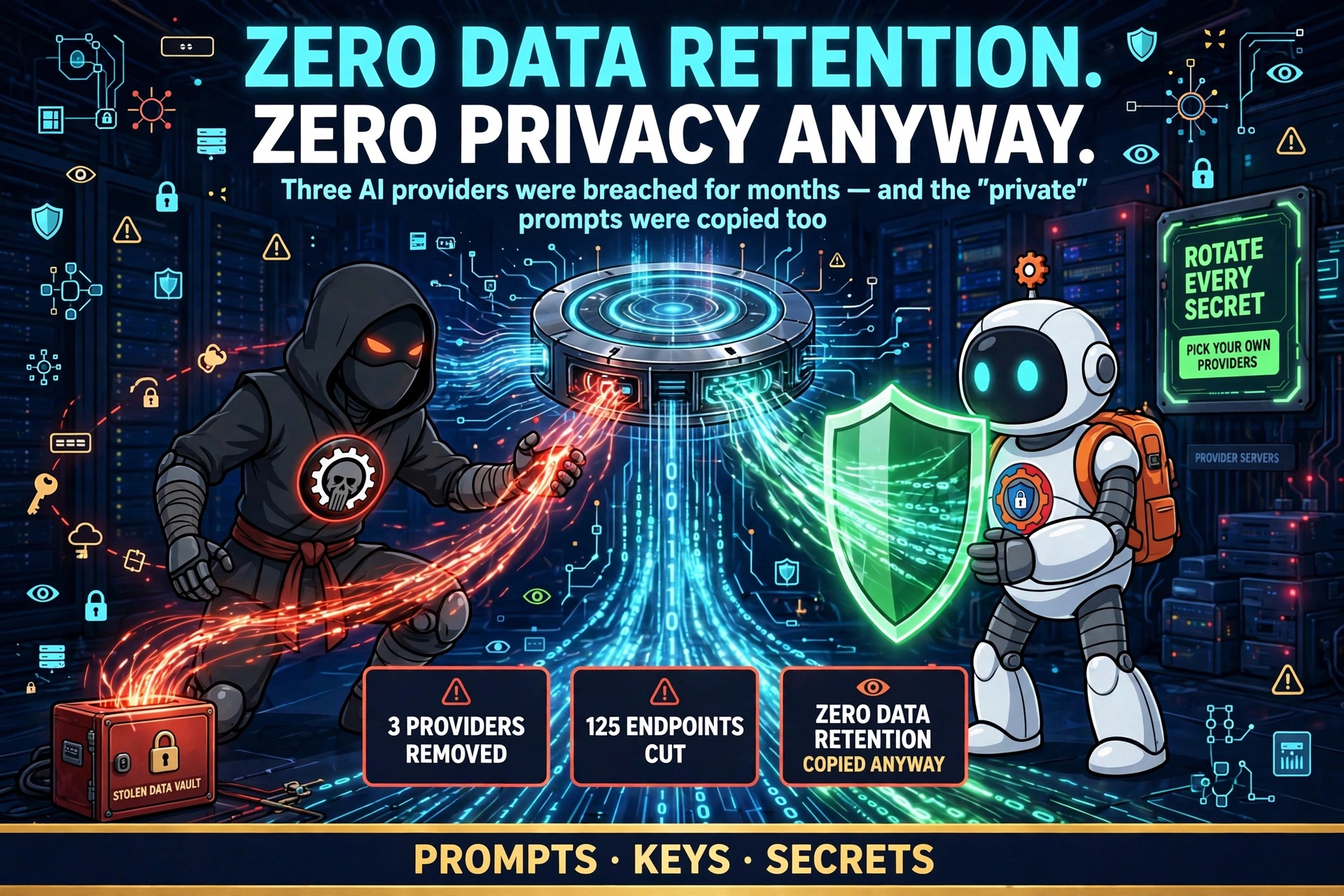
Dragos seeded about 2 million prompts with unique links and credentials from July to November 2026, then watched for anyone using them. A planted secret can only be learned from its prompt, so any use proves someone read it. Attackers had been stealing data inside three AI inference providers for months; none knew until researchers told them. OpenRouter, the gateway routing customer requests to third-party providers, said it removed three providers, cut 125 endpoints from Zero Data Retention eligibility, and notified customers. It was not itself breached.
Three providers, months of theft
The earliest breach began in mid-July. The largest came in late October: a couple hundred planted AWS keys, each sent in exactly one request to one provider, during a few short windows. Every request in those windows was stolen — including requests rejected before a model ever ran — pointing to copying at the first point of arrival, not deeper in the stack.
The thief tested stolen keys within hours, listed S3 buckets, searched Secrets Manager and Parameter Store, and tried to create Bedrock API keys — tens of thousands of calls in all. On November 1 it used ARTEX, an AI-driven penetration-testing framework, to check its keys were still live; two of its user agents, artex-agent and artex-judge-r121, appear in no public indicator list. As HD Moore, Dragos chief research officer, put it: “A privacy flag doesn’t help when the attacker is already inside.”
The “private” prompts were copied too
The second finding needed no break-in: marketplace sellers listed models at the lowest prices, switched on request logging, and collected whatever flowed through — individuals on home internet. One, on a Mac in France, took passwords from two prompts, typed root SSH logins by hand, then tested several planted AWS keys from the same machine.
An unnamed Chinese AI lab fetched the secret links from more than half of the seeded prompts sent to its models between July and October, including about two-thirds marked no data collection or Zero Data Retention. Prompts sent to U.S. hosting providers reselling the lab’s models triggered the same scraper.
The clearest proof came 24 days after one prompt was sent, when its secret link appeared in a Feishu chat — the workplace app known elsewhere as Lark — and was opened within two minutes in Beijing and Shanghai. Only the first 8 characters of the link had ever been disclosed, so whoever posted it was reading a cached copy of the full prompt. Moore: flagged prompts were kept, passed to other companies, and read by human beings.

What the three named companies said
Neither Dragos nor OpenRouter has named the three providers, or said whether they are the same three. Three providers have posted publicly about separate incidents. Phala said an attacker took control of an inference server and could view request data in process, contained on November 8. DeepSeek V4 Flash 0731 requests via the gateway from October 21, 00:00 UTC to November 8, 05:35 UTC count as exposed — rotate every secret in them.
Together AI said an unauthorized party downloaded stored prompt samples after an AI coding agent committed a credential to its public GitHub repository. The June and July samples, from requests to MiniMax M3, GLM-5.2, and Kimi K2.6, were searched for credentials and tested; five were canaries from the researchers’ experiment. The company says the data has been deleted; zero data retention is now the default for new accounts. Novita said a routing configuration issue sent some MiniMax requests on to MiniMax’s official API.
The provider behind the mid-July breach first blamed an internal misconfiguration, then a partner’s data processing, before finding attackers had compromised its internal credentials. It had still not disclosed publicly as of this week.
Why it matters
Stolen AI keys have already run up a $740,000 bill; attackers have been stealing AI keys and leaving victims with the bill for years. Self-hosting is the only option where no third party reads a prompt; going direct leaves one company, one contract, one privacy policy.
What to do
1. Rotate every secret you sent through a router. Any secret that went through a gateway recently should be treated as exposed — starting with cloud keys, tested within hours.
2. Pick your own upstream providers. Stop accepting the default pool: choose the companies that process your prompts, and verify your privacy settings change where requests go — not just what a dashboard claims.
3. Stay away from reseller marketplaces. The cheapest model may be cheap because it logs everything, or because its capacity runs on stolen keys. Price is not a privacy policy.
4. Seed a canary credential as a tripwire. Put a fake credential into the context your agents and pipelines already send, and watch for anyone using it — a free Thinkst Canarytoken is enough. Settings that scrub known credential formats help too, though they miss sensitive data not shaped like a key.

The promise was zero data retention; the reality was zero privacy anyway. The flag on your prompt was never the protection — the route it takes is.