



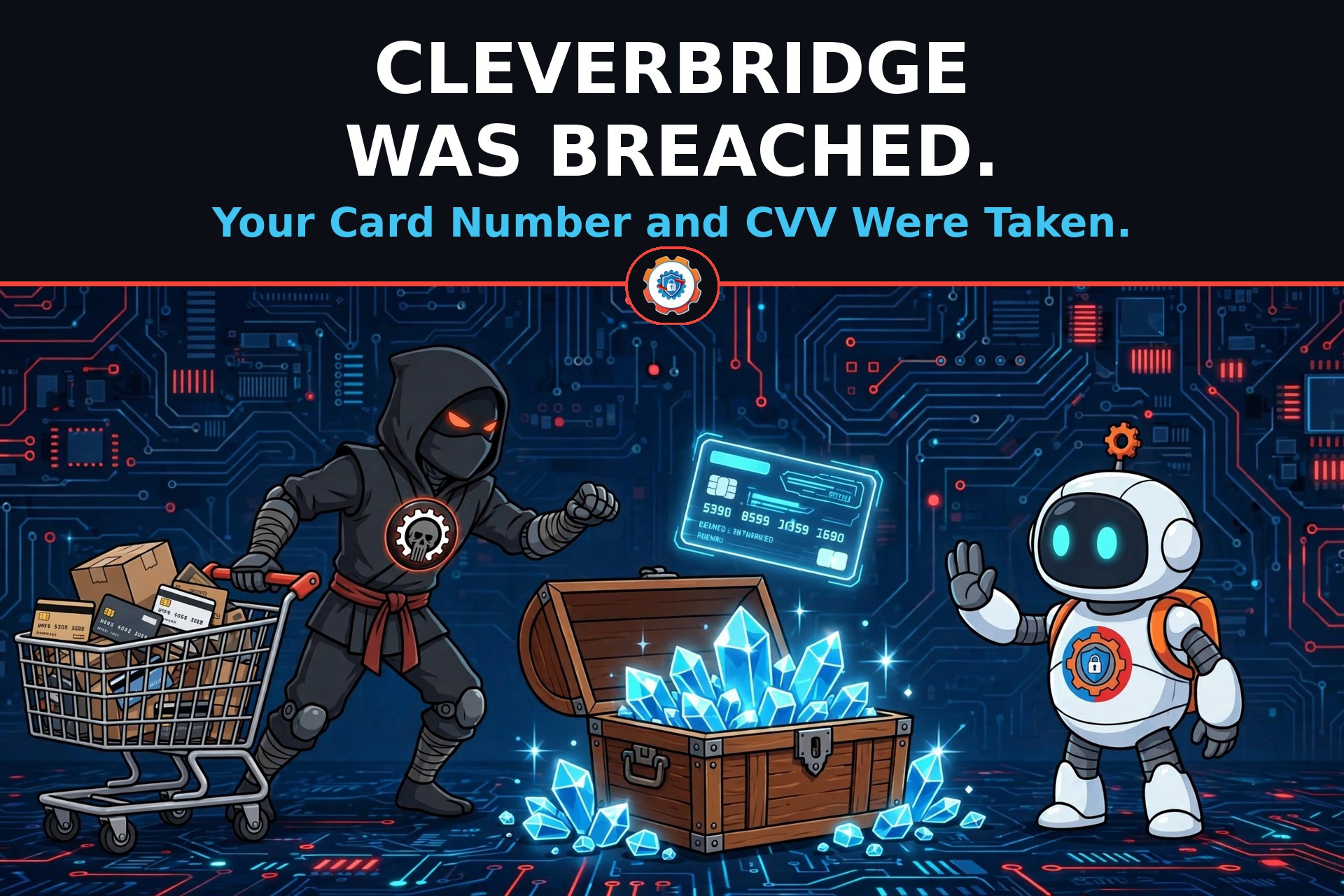






Cleverbridge Was Breached. Your Card Number and CVV Were Taken.
If you have ever bought software online and paid through Cleverbridge, your card details may be in a thief’s hands right now. Cleverbridge, the e-commerce platform that processes payments for software and SaaS companies, says hackers broke in and copied customers’ payment card information — card number, expiration date, and CVV security code. Customer notifications began November 20, more than two weeks after the intrusion was spotted.
That last detail is the one that should make you check your statements. A card number alone is bad enough; with its expiry date and CVV it is a complete set — everything a criminal needs to spend your money online.
What was taken — and what was not
According to the breach notification shared with BleepingComputer, only payment card details were copied: the card number, the expiry date, and the CVV/CVC security code. The notice states no other personal data was copied — “for example your name, contact or billing details” — and identifies the affected card only by its last four digits: “The affected card ends in XXXX.” Watch the card itself, going back to the start of November at least.
Cleverbridge lists Red Hat, SUSE, Tenable, Veeam, Jamf, Sony, and Parallels among its customers. It has not disclosed which of those businesses’ customers were impacted — so do not assume any particular company’s buyers were hit. If you paid through Cleverbridge, you cannot rule yourself out from the public disclosure alone.
The timeline: November 4 to November 20
Cleverbridge detected unauthorized activity on November 4, 2026, took systems offline temporarily to contain it, and had everything back online the same day. The investigation found a third party had copied payment card data stored on the platform. Notifications did not begin until November 20 — sixteen days later. Companies usually want to know what was taken before telling people, but that is a long time for a stolen card to sit in criminal hands.
The company says it has notified data protection authorities, law enforcement, payment card networks, and payment partners, and is working with TransUnion’s Cyberscout on notifications and complimentary credit monitoring and fraud assistance.

Why the stolen CVV matters so much
The CVV — the three- or four-digit code on your card — proves the person using the number actually holds the card. Stores ask for it precisely because a stolen number alone is not supposed to be enough. When the CVV is stolen with the number and expiry date, that check is defeated before it starts. Complete card records get tested quickly and quietly, often with small charges designed to pass unnoticed. Stolen card data has a long afterlife: once copied, it can be sold and tried again months later.
One more uncomfortable detail: card security codes are not supposed to be stored after a transaction is authorized — the payment industry’s own rules forbid it. Cleverbridge has not answered whether the card data was encrypted, or why the CVVs were accessible at all. Until it does, assume the stolen data is usable exactly as taken.
What is still unknown
Cleverbridge has not disclosed how the attackers got in, how long they stayed, or how many customers were affected. BleepingComputer asked all three questions, plus whether the card data was encrypted and why the CVVs were accessible; the company has not responded. None of that should be filled in with guesses.
What is known is what the company has ruled out: this was not a ransomware attack, and its systems were not encrypted. They were there to take data — quietly, and then leave. For a cardholder, the facts that count are already established; waiting for the full story before checking your card would be the one mistake that costs real money.
What to do now
1. Review your card statements, starting from early November. Look for any transaction you do not recognize, however small. Thieves often test a stolen card with a tiny charge first. Report anything unfamiliar to your card issuer immediately.

2. Contact your card issuer and ask about a replacement card. If you received a breach notice, say so. Banks may decide to replace a compromised card, and a new card number with a new CVV closes the door on the stolen data entirely.
3. Take the free credit monitoring. Cleverbridge offers complimentary credit monitoring and fraud assistance through TransUnion’s Cyberscout. Use it. The stolen data is card data, not identity data, so monitoring is a safety net rather than the main defense — but it is free, and it gives you an early warning.
4. Watch for phishing that uses the breach as a lure. Expect emails and messages claiming to be from Cleverbridge or your bank, asking you to click a link or “verify” your card. Do not click through — go to your bank or the vendor directly, using an address or number you already trust. No legitimate message will ever ask you to send your full card number or CVV by email.
The pattern is always the same: the theft is quiet, the notification comes weeks later, and the damage lands on the people who never checked. A million cards were stolen through compromised payment terminals in an earlier breach — and the lesson holds here too. If that place was Cleverbridge, check the statements, call the issuer, and get the card replaced.
One thought on “Cleverbridge Was Breached. Your Card Number and CVV Were Taken.”