





Volant Manticore Hid Its Backdoor in IPFS. Nobody Was Looking.
A previously unknown espionage group has been working through Cyprus since late August 2025 — its main tool hiding its orders where almost nobody monitors: a peer-to-peer file-sharing network.
Check Point calls the group Volant Manticore — assessed as likely former MuddyWater operators, the long-running Iranian espionage group, who branched off to run their own operation. Both are assessed affiliates of Iran’s Ministry of Intelligence and Security (MOIS). Targets so far: telecoms, airlines, and critical infrastructure in Cyprus — and more recently, healthcare in Saudi Arabia.
The lure: a résumé that never existed
The way in starts with a person who never existed: Volant Manticore builds AI-generated personas — fake job candidates — and sends bogus CVs inside the target organization. The recipient is invited to download the full résumé — the trap that installs the backdoor, KuboShell.
One campaign aimed at a Cyprus-based airline flying between Cyprus and Israel. Cyprus does not match MuddyWater’s usual pattern, and the group runs separate infrastructure — its own objectives, tracking regional geopolitics.

The attack chain in one picture: the lure gets the backdoor in, then the group decides how deep to go.
How KuboShell turns a file-sharing network into a remote control
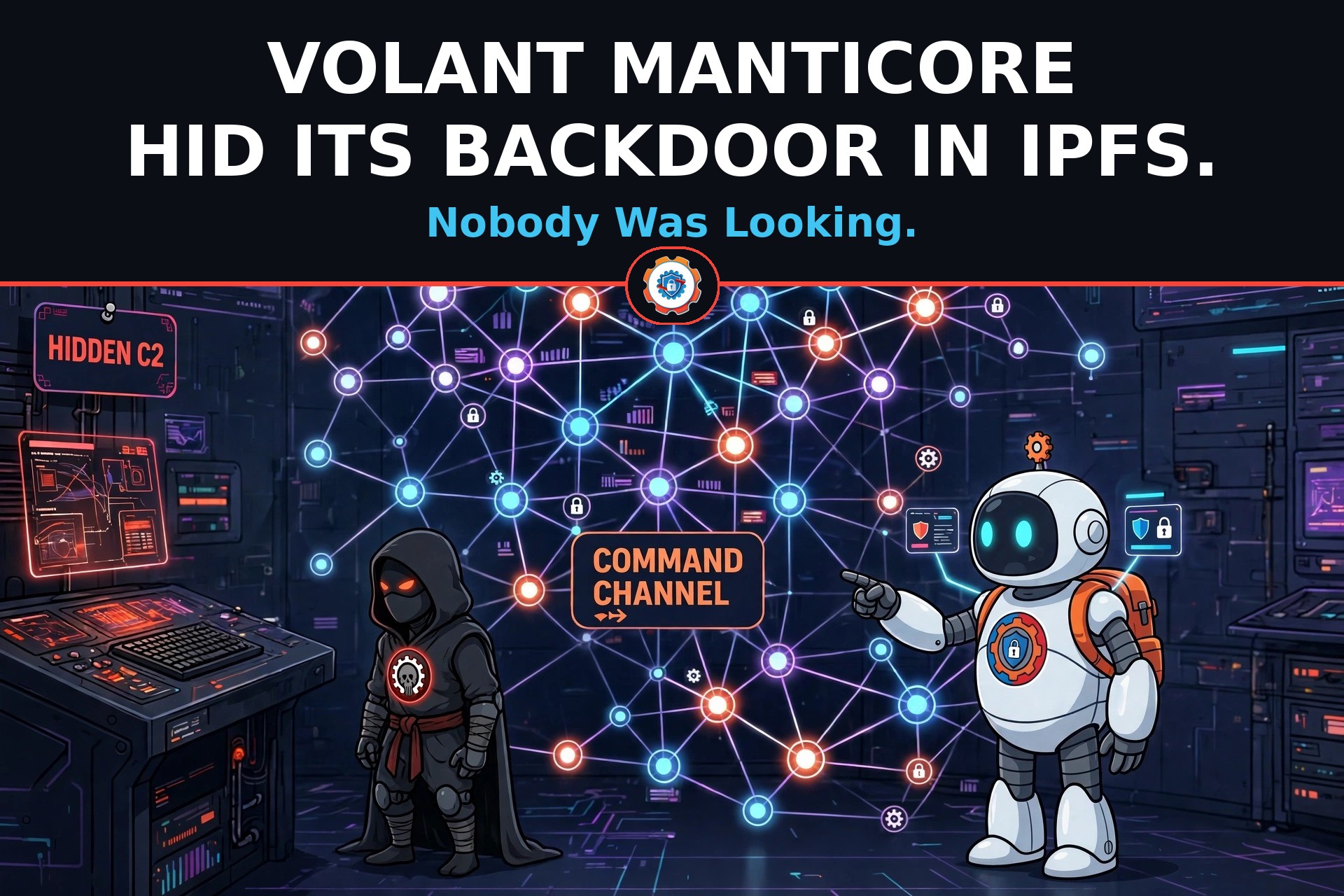
KuboShell is a Windows backdoor with an unusual way of taking orders: IPFS — the InterPlanetary File System, a peer-to-peer network with no central server — as its command-and-control channel (C2, the hidden link attackers use to steer infected machines). File transfers ride on Pinata, which pins files to IPFS.
On startup, KuboShell checks for administrator privileges; without them, it tries to relaunch higher — triggering a User Account Control (UAC) prompt, the Windows permission dialog most users click through without thinking.
The distinctive part: it takes the MAC address — the hardware identifier — of the first network adapter as a unique victim ID, then registers the host by uploading a file containing “hi” to C:\Users\Public\<MAC>.log, using a hard-coded Pinata access token. Orders arrive as a <MAC>.txt file in Pinata: KuboShell downloads it through the public gateway, runs it via hidden PowerShell, returns results to C:\Users\Public\<MAC>re.txt — then waits, checking again every 60 seconds.
No central command server to seize, no suspicious domain to blocklist — orders move through public file-sharing infrastructure millions use, hiding in plain sight.

KuboShell’s loop, step by step. Every 60 seconds it asks the file-sharing network: anything for me?
The second stage: Homa, remote tools, and stolen credentials
KuboShell is deliberately lightweight: basic reconnaissance first, then the operators decide if the target is worth a heavier implant. That upgrade is Homa, a post-compromise framework Check Point describes as a JavaScript reimplementation of MuddyWater’s older MuddyC2Go, reusing its server side with minimal changes.
Homa arrives in three stages: a PowerShell stager contacts a hard-coded address — 185.205.187.109 on port 8000 — to fetch a loader and run it in memory; the loader decodes and launches a JavaScript backdoor; that backdoor loops, executing PowerShell, SSH, and cmd.exe commands. The third stage may run more modules, purpose unknown.
Homa has also turned up in a macro-enabled Word document, “MilitaryHeritageProposal.doc”, believed to target a Cypriot defense-related government entity — enable the content and a VBA backdoor runs follow-up payloads via cmd.exe.
Alongside the custom malware, the group deploys legitimate remote monitoring and management (RMM) tools — MeshCentral, NetLock RMM, N-able RMM — for persistent access, plus credential harvesting. RMM abuse is a long-standing MuddyWater hallmark, and we have seen it before: a ScreenConnect session pushed a file with no prompt at all. When the tool is one your IT team might install, the attack looks like administration.
The target list moved — and the timing tells a story
In September 2026, the campaign shifted to Saudi healthcare entities as Saudi–Houthi hostilities escalated. Phishing emails distributed the backdoor and N-able RMM through two healthcare-themed ZIPs, “AI_Healthcare_Seminar.zip” and “Ai_Healthcare_Seminar_Online.zip” — some sent from a compromised account at a private Saudi hospital. Check Point notes this fits MOIS’s record of targeting hospitals in wartime.
Why it matters
Three things stand out. First, the hiding place: a file-sharing network as a command channel is hard to detect — no attacker-owned server to find, traffic blending with legitimate use. Second, the lineage: experienced operators who left with the old playbook and their own objectives — Iran’s cyber ecosystem reshaping itself. The researchers know the terrain first-hand — they disclosed this week that their own servers were compromised, exposing 22 organizations. Third, the target: hospitals in wartime are not collateral.
No vulnerability to patch, no CVE to track — the defense is detection, not an update.
What defenders can do
1. Hunt for the artifacts. Search endpoints for C:\Users\Public\*.log and *re.txt files — especially ones named after a MAC address — and for 185.205.187.109:8000 in firewall and proxy logs. No legitimate software leaves such fingerprints.
2. Watch the file-sharing exits. Flag or block Pinata and IPFS gateway traffic from endpoints. Ordinary workstations rarely need IPFS — a machine quietly swapping small text files through a public gateway deserves a closer look.
3. Inventory your remote tools — all of them. List every RMM tool across the fleet — MeshCentral, NetLock RMM, N-able RMM included — and treat any your IT team did not deploy as an incident. Attackers choose them because they look like yours.
4. Treat AI-polished CVs as a phishing vector. Brief hiring managers and HR: an unsolicited résumé with a download link is now a delivery mechanism — verify the candidate elsewhere first.
The group may be new, but its methods are familiar parts — a fake person, a trusted file-sharing service, tools your help desk knows. Know what normal looks like — and notice a résumé phoning home every 60 seconds.