
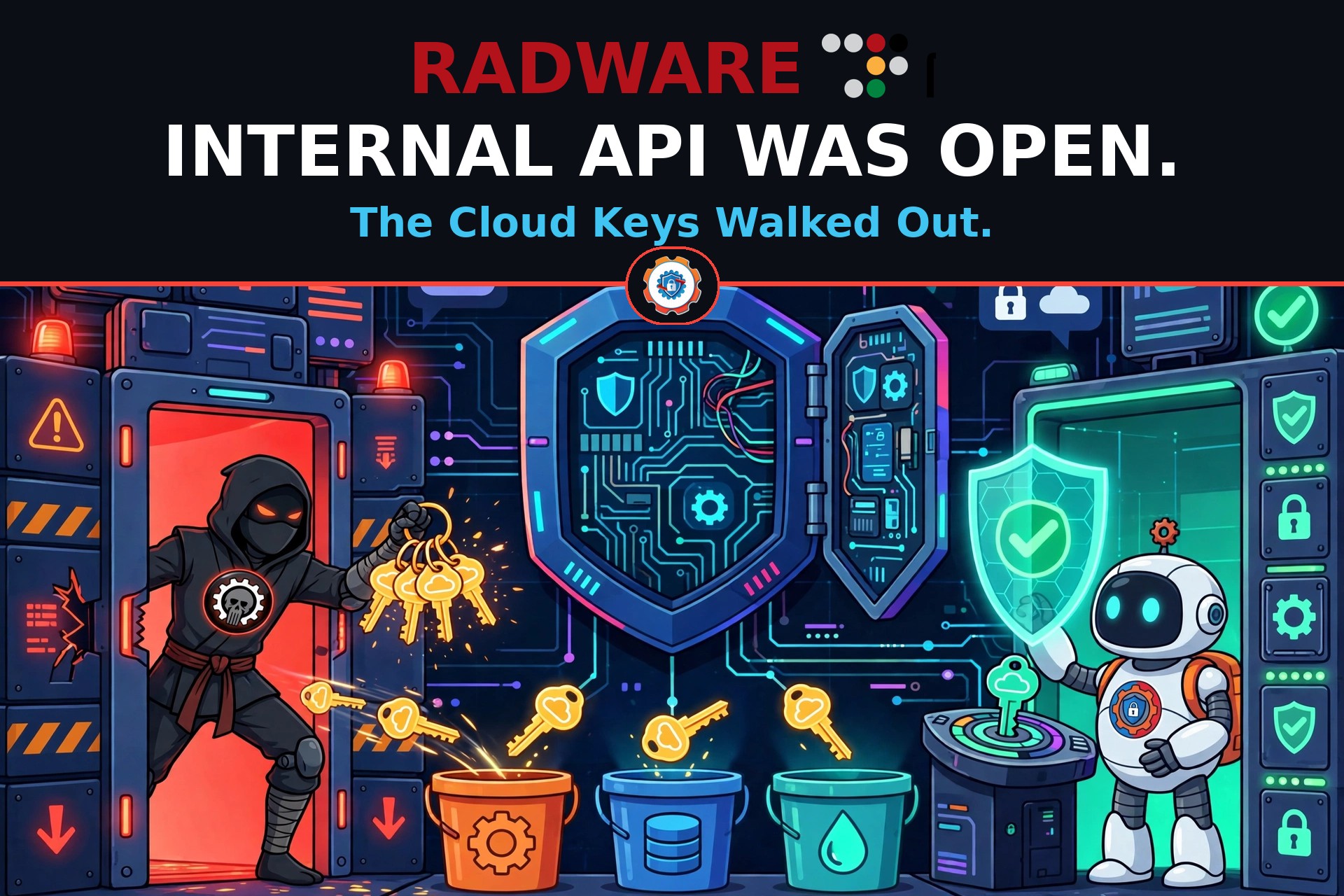













Radware’s Internal API Was Open. The Cloud Keys Walked Out.
Radware sells protection. Its Cloud WAF (web application firewall — the filter that stands in front of a website and blocks attacks before they reach it) guards more than 12,500 enterprise and telecom carrier customers. On November 19, 2026, the attackers had not gone through that shield at all. They had walked in through a door Radware itself had left open — an internal management API reachable from the public internet, with no authentication required. The keys that walked out with them were not Radware’s. They were customers’ cloud keys.
What happened
Radware’s own root cause analysis says an unauthorized party accessed an internal-only Cloud WAF management API on November 19. The API was supposed to be reachable only inside Radware’s own network. Instead it was exposed to the internet — and it asked for no login at all. Anyone who found it could simply use it.
Radware detected the intrusion on Thursday, November 19, about ten hours after the first unauthorized access. The company blocked the originating IP address and cut off access to the internal API, then revoked and replaced all of its internal account credentials. Ten hours is a long time for an open door with no lock — and Radware is still investigating whether the exposed keys were actually used.

What was taken — and what was not
Radware confirmed that customer contact details were potentially accessed, and that for a subset of customers the attacker could also have reached the credentials configured for log export into the customers’ own self-managed storage: AWS S3 access keys, Azure Blob Storage keys and SAS tokens, and SFTP credentials. Those are the keys Radware uses to deliver WAF logs into a customer’s own bucket. In the wrong hands, they open the customer’s storage, not Radware’s.
What was not exposed matters too. Radware says WAF traffic inspection was not affected, and neither were certificates, end users’ data, customer application traffic, or its cloud DDoS services and data. Traffic inspection and protection continued without interruption, and there is no evidence that customer security policies were changed or that application traffic was accessed. No number of affected customers has been disclosed, and no ransomware claim, no CVE, and no confirmed misuse has surfaced. The danger is not what has already happened — it is what those keys still allow.
Early signs suggest the keys are already being tested. Radware has received customer reports of AWS alerts flagging an unfamiliar IP address attempting to access their log-export buckets. That is exactly the move you would expect next: take a stolen storage key, try the bucket, see what is inside. Log exports look boring — routine copies of firewall traffic — but the buckets that receive them often sit beside far more interesting data.
Why this one stings
There is a particular irony when a security vendor is breached through its own hygiene, and Radware is not the first to learn it in public. Check Point disclosed this same month that its own servers were breached and 22 organizations exposed — read Check Point’s Own Servers Were Hacked. 22 Organizations Exposed. The pattern is the real story: the companies we hire to guard the perimeter keep getting hurt by the same ordinary failures — an internal tool left internet-facing, an authentication step skipped, an asset nobody inventoried. The Qubole breach told the same tale from the other side, where one vendor key opened every customer’s cloud.
Radware has issued no public statement and filed no breach report with the US SEC. BleepingComputer reached out to the company and has received no response yet. Silence changes nothing for customers — the keys are out there, the buckets are being probed — but it leaves every affected customer to work out the risk alone.
What to do now
If you are a Radware AppSec customer — WAF or BOT — Radware “strongly” advised rotating your Cloud WAF log-export credentials as soon as possible. Do not wait for confirmation that your keys were used: rotation is cheap, a quiet read of your storage is not. That means new AWS S3 access keys, Azure Blob keys and SAS tokens, and SFTP credentials, everywhere those exports land.

Then check the evidence. Review the access logs on every cloud storage account that receives those exports, looking for unexpected access since at least November 19 — unfamiliar IP addresses, reads at odd hours, access from regions you do not operate in. If your cloud provider flagged an unfamiliar IP touching a log-export bucket, treat it as real until proven otherwise — and check whether anything else in that account shares the same credentials.
Finally, turn the lesson inward. Audit your own internal management APIs and admin panels: anything labeled “internal-only” should be unreachable from the internet, and anything reachable should demand authentication — ideally from a known network. Radware’s API was not attacked through a clever zero-day. It was simply there, open, waiting. The cheapest security control there is: make sure your own back doors are not on the public internet.
The incident specifics in this post come from Radware’s root cause analysis report, shared with BleepingComputer by an anonymous source. No records count was disclosed, and Radware has not yet issued a public statement.