

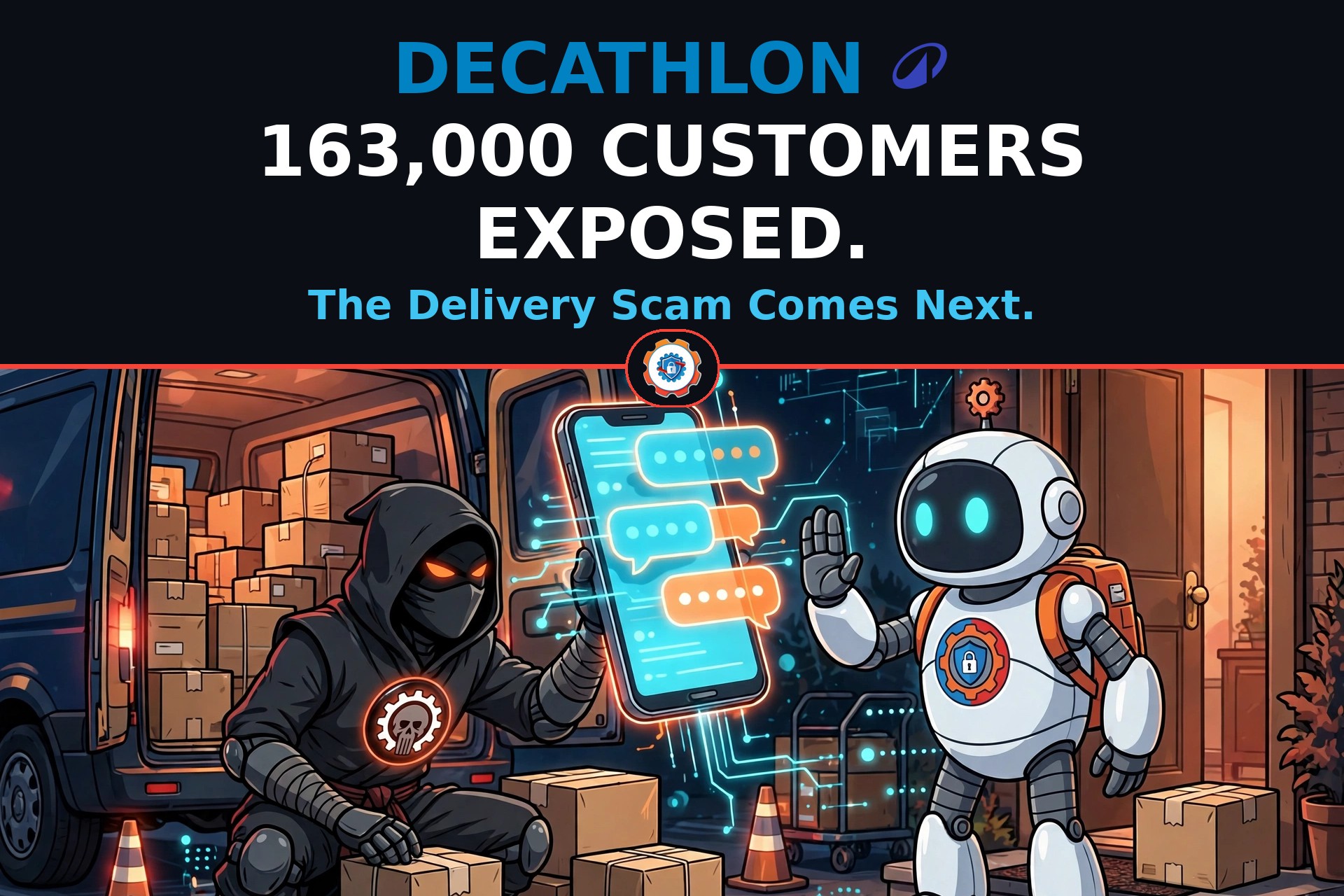







163,000 Customers Exposed. The Delivery Scam Comes Next.
Your parcel is on its way. That is the message Decathlon customers in France may now receive from someone who is not Decathlon at all — and it will look convincing, because the sender knows your name, your address, your order number, and possibly even the code to your building’s front door.
Decathlon has confirmed a data breach affecting 163,000 customers — and the attack did not hit its own systems directly. Attackers breached a third-party delivery provider on November 22, and customer delivery data flowed out onto a well-known cybercrime forum, where a threat actor using the pseudonym 4me1 advertised it for sale.
Decathlon confirmed the breach to the French newspaper Ouest-France. The retailer says it has blocked the unauthorized access, plans to notify affected customers by email, and will report the incident to France’s data protection authority, the CNIL.
What was taken — and what was not
The exposed data is the kind that makes a scam message feel personal. The forum listing shows it includes names, emails, phone numbers, postal addresses, and order references — plus delivery details that go much further: shipping notes that can include building access codes, delivery times and statuses, delivery feedback, package dimensions and weight, and internal warehouse names. No parcel tracking numbers turned up on Decathlon’s own platforms — a detail that points to the delivery provider, not the retailer, as the source.
There is one piece of good news. Decathlon says no bank details and no passwords were compromised. Nobody’s payment card or account login came out in this breach. But that does not make the stolen data harmless. It is the same pattern seen when a store that looked fine while 37.6 million records walked out the door: the raw count matters less than how usable the data is, and delivery data is extremely usable.

Why a delivery breach is a phishing breach
The real damage in a breach like this rarely happens on the day of the attack. It happens in the weeks after, one text message at a time. A scammer who knows your name, your address, and your order number does not need to guess — they can write about a failed delivery or an unpaid fee and sound exactly like the courier you are already waiting for.
That is the risk Decathlon’s customers now face. The stolen details are tailor-made for fake SMS messages about deliveries that never arrived or fees that were never owed, asking you to click a link, pay a small charge, or hand over more information. With more than 300 stores across France, the pool of targets is large — and each has a plausible reason to expect a parcel.
Text-message scams are not new — we recently covered a leak that put 125 million text messages, and the bank codes inside them, in criminal hands. What makes this case sharper is the delivery context: a message about your parcel arrives when you are already expecting one, and its details check out because they are real. Only the sender is fake.
Four checks before you tap anything
If you shop at Decathlon — or you simply get a delivery message that feels slightly off — run these four checks first. They take seconds, and they break the exact trick this breach enables.
1. Never tap a link in a delivery text. Go to decathlon.fr yourself, or open the Decathlon app, to check your order. A genuine update will be visible in your account; a link in a text is the one thing a scammer controls completely.
2. A fee request is a red flag, full stop. Decathlon will not ask you to pay a delivery fee, a customs charge, or a redelivery cost by text message. Any message demanding payment to release a parcel is a scam, no matter how real the order number in it looks.
3. Real details do not prove a real sender. This is the hardest check, because it cuts against instinct: if a message quotes your name, your address, or your order reference, that proves nothing now — those details are exactly what was stolen. Judge the message by where it asks you to go, not by what it already knows.
4. Verify in your account, then report it. If a message claims a delivery failed or needs action, check the order status on Decathlon’s official website or contact its official customer support. If the message is fake, report it as spam and delete it. Do not reply, and do not call any number printed in the message.

The third party is the story
There is a wider lesson beyond one retailer. Decathlon’s own systems were not the entry point. A delivery provider was — a company most customers have never heard of, holding their names, addresses, and building access codes because a parcel had to reach their door.
Every online order quietly shares your data with a chain of companies — the store, the warehouse, the courier, and whoever the courier subcontracts. Each link is a place your data can leak, and the customer has no say in how well any of them protect it.
For the 163,000 customers in this breach, the advice is simple: expect the scam texts, and treat every delivery message with suspicion until you have checked it yourself. The parcel is real. The message might not be.
One thought on “163,000 Customers Exposed. The Delivery Scam Comes Next.”