
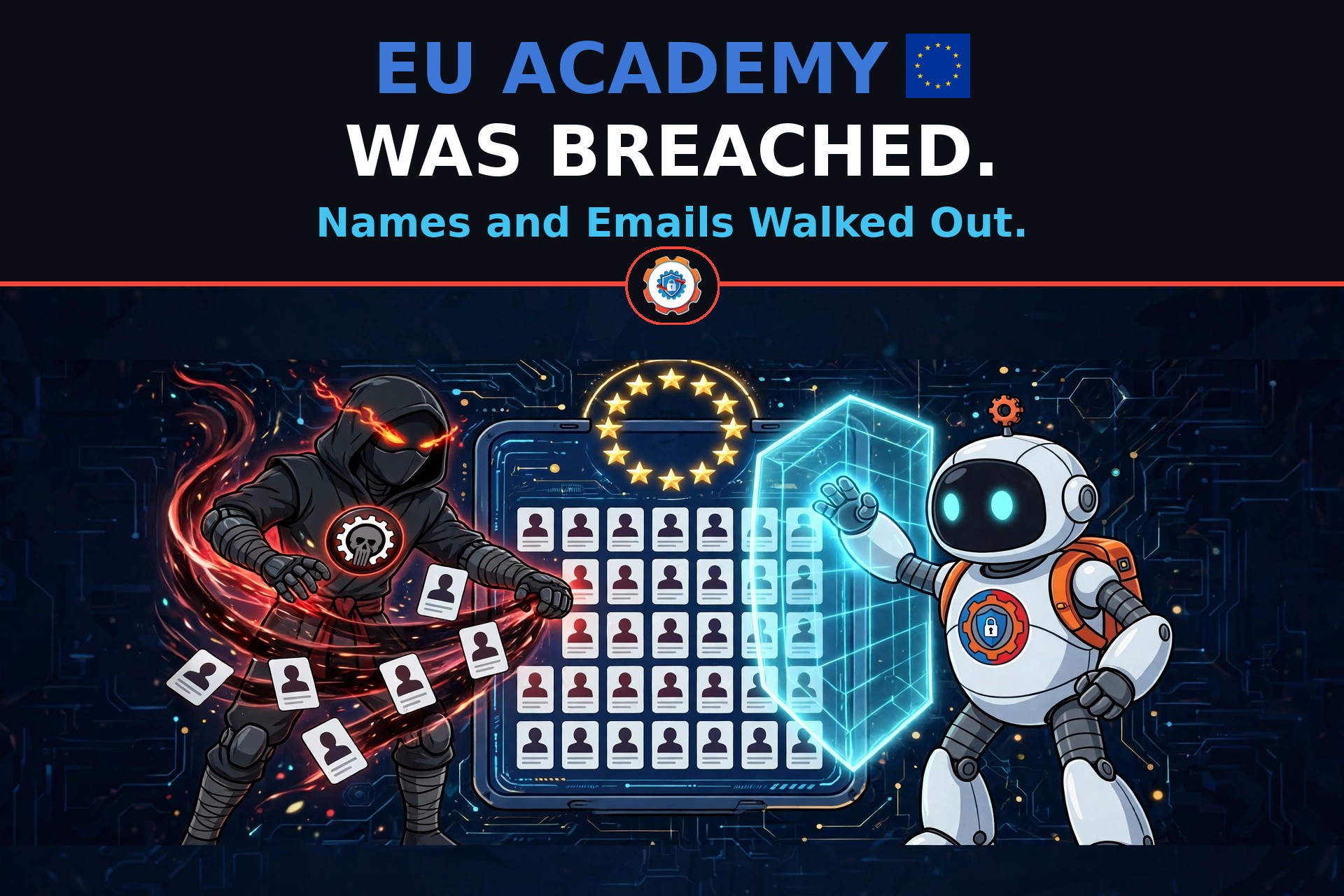






EU Academy Was Breached. Names and Emails Walked Out.
The European Commission has confirmed the October attack went further than disrupted services. Attackers broke into the EU Academy, the Commission’s online learning hub, and walked out with users’ personal data — names and email addresses, from an undisclosed number of people.
This is not a new incident. It is the same attack, coming into focus. On October 22, hackers breached the Commission’s systems using ARTEX, an AI-powered penetration testing framework. The intrusion caused service disruptions that also disrupted Sysper, the Commission’s internal HR platform. At the time, spokesperson Thomas Regnier said the Commission had temporarily taken down several applications as a protective measure, that most had since been restored, and that the investigation was still ongoing. He added that no evidence of a data breach affecting Commission staff as a whole had been detected, and that no ransom demand had been received.
A month later, in a Monday press briefing, Regnier confirmed the EU Academy breach and the data theft. A message went to all users, and the Commission published a notice on the EU Academy website: public access to the platform has been disabled, and users are warned to be suspicious of unsolicited emails or messages that may be phishing attacks.
Regnier left little room for doubt: “This is definitely a cyber attack, a cyber campaign that was targeted against the Commission via an AI assisted tool. When it comes to the attribution, we would need the investigation to be concluded to be able to find out who is behind this.” No attribution yet, no ransom demand — but a confirmed data theft, the detail the first disclosure could not yet rule in or out.
Readers who followed the October 22 attack when it first broke will remember the shape of it: an AI-assisted tool, aimed at the Commission, disrupting its own HR systems. What has changed is the scope. The attackers did not only disrupt services. They got into the learning platform and took the one thing that makes every follow-up attack easier — a list of real people, with real names and real email addresses.
Names and emails are not the most sensitive data a breach can expose. But they are the raw material of the next attack. A phishing email that addresses you by name and references the EU Academy, arriving while the platform is publicly known to be down, does not look like spam. It looks like an official update. That is exactly why the Commission’s notice tells users to treat unsolicited messages with suspicion — the stolen data is most dangerous in the hands of someone writing the next email.
The campaign behind it reaches further than Brussels. The same ARTEX campaign has been hitting other governments, and the Commission itself has now been breached three times in a year. In February, it disclosed a breach discovered on January 30 in a mobile device management platform used for staff devices. In March, it disclosed another incident in its Amazon cloud environment; CERT-EU later attributed that hack to the TeamPCP threat group and said it exposed data of at least 29 other Union entities.
Three breaches, three different doors, one target. The February incident hit the platform managing staff devices. The March incident hit the cloud. The October incident hit the learning hub and the HR system. Together they describe an institution attackers keep coming back to — and keep finding a way in. The Commission proposed tougher cybersecurity legislation in January precisely because cybercrime groups and state-backed actors are targeting Europe’s critical infrastructure. Nine months later, its own learning platform was breached and its users’ data stolen.

What EU Academy users should do now
If you have an EU Academy account, these four checks turn the Commission’s warning into action:

1. Treat every unexpected EU Academy or Commission email as suspect. Attackers now hold real names and email addresses from the platform. Any message claiming to be about the breach, an account reset, or a platform update should be treated as a potential phishing attempt until proven otherwise.
2. Never click links in unexpected messages. Go to the EU Academy website directly by typing the address yourself, or use a bookmark you already trust. A link in an email is the one thing you should never trust right now.
3. Verify through the official site, not through the message. If an email tells you something has changed, check the notice on the EU Academy website itself. That is the Commission’s own channel for this incident — and with public access to the platform disabled, anything claiming to come from inside it deserves scrutiny.
4. Change the password if you reused it anywhere else. The stolen data is names and emails, not passwords. But if the password you used for the EU Academy is the same one you use for your email or another service, change it there now — a known email address paired with a reused password is the oldest trick in the book, and it still works.
The investigation is still ongoing, and attribution must wait for it to conclude. What does not have to wait is the response from the people whose data was taken. The breach is confirmed. The platform is offline. The warning is public. The next move belongs to the users — and it starts with not clicking the email that pretends to help.