
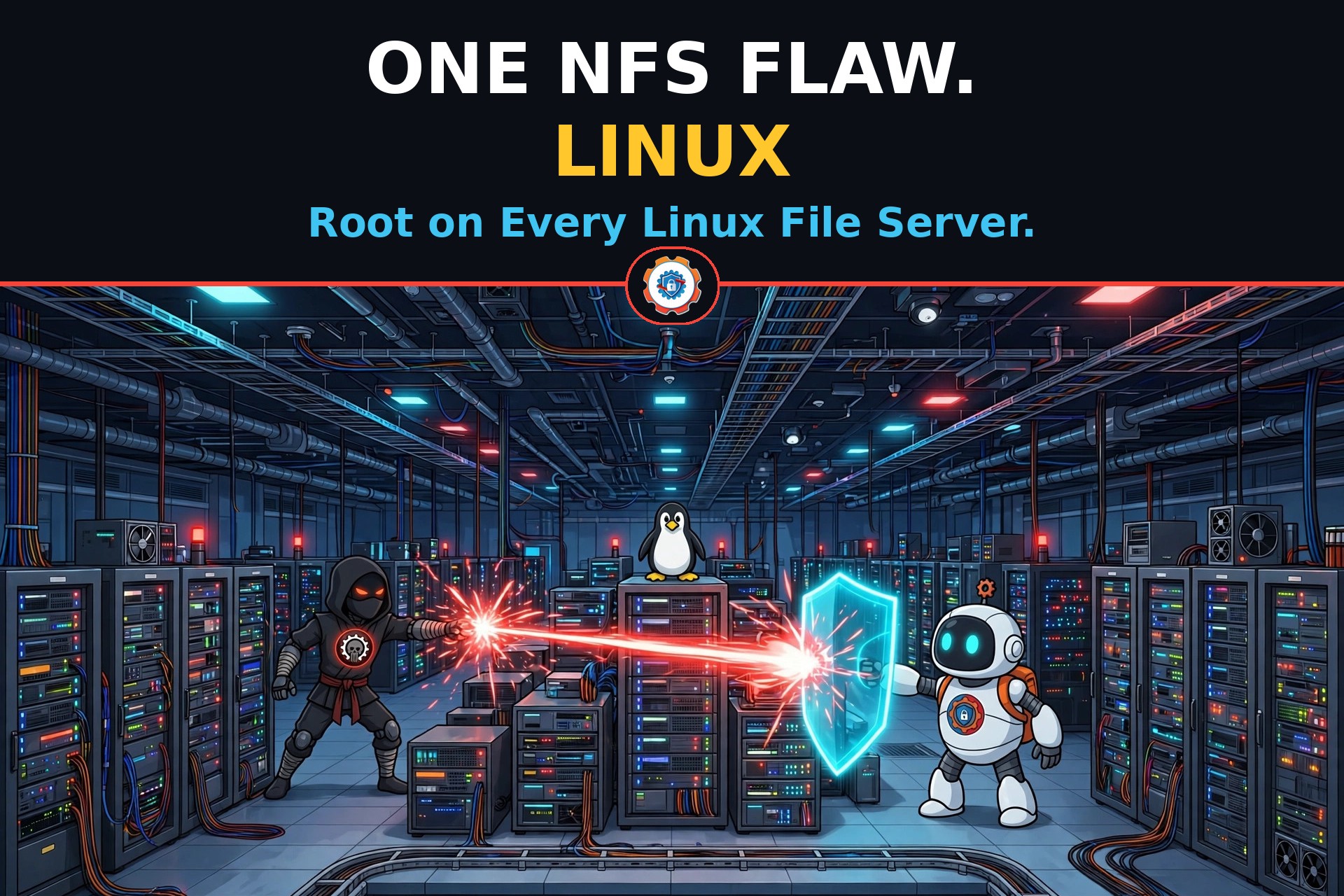









One NFS Flaw. Root on Every Linux File Server.
A single open port. No password. No account. No click. That is all a stranger on the internet needs to walk away with root — total control — over a Linux file server. The flaw is called NFS2ROOT, tracked as CVE-2026-99362, severity 9.8 out of 10, and it has been sitting in the Linux kernel for twelve years.
OpenSec’s researchers found it; Cybernews reported the details on November 26. The bug lives in nfsd, the kernel’s NFS file-sharing server. If your server answers NFS requests on TCP port 2049 — and plenty do — reaching that port is all an attacker needs. One connection is enough.
Most serious server flaws still ask the attacker to clear a hurdle: a stolen password, a tricked employee, a misconfigured account. This one asks for none of that. Kernel flaws that need no login at all are rare — we covered a similar one earlier this year in our write-up of the last no-login, no-password root flaw — and NFS2ROOT targets the file server itself, the machine that holds the data.
How one connection becomes root
When a client asks an NFS server for a file, the server keeps a small scratch area in memory — a reply cache — where it builds its answer before sending it back. The crafted request in this attack first shrinks that scratch area down to zero bytes. Then the server writes its reply into the space anyway.
Just 61 bytes past the end of that undersized buffer corrupts the memory sitting next to it. That is the crack the attacker widens: first they read kernel memory back out, revealing the secret addresses where the kernel’s own code lives — defeating a protection called KASLR. Then they overwrite memory to steer which code the kernel runs next. The chain ends in a root shell, with full control of the server.

Who is in the firing line
Anyone running a Linux file server with port 2049 reachable from outside is exposed — in practice, three groups: NAS devices holding backups, media, and shared folders; Kubernetes storage nodes, where shared volumes feed whole clusters; and any plain Linux file server doing NFS duty.
NFS was designed for trusted local networks, not the open internet — but ports get forwarded, security groups get opened a little too wide, and a storage box meant for the office ends up answering the whole world. NAS boxes also tend to sit unpatched the longest. Readers who remember the QNAP breach will recognize the pattern: storage devices, exposed to the internet, turned into the way in, as we told in our account of the four flaws that opened one QNAP door. NFS2ROOT is a different bug, but the lesson is the same.
Twelve years, found by an AI
The flaw hid in the kernel for twelve years, running on millions of machines while nobody spotted it. It was finally found by Antara, OpenSec’s AI system for hunting deep, quiet bugs. OpenSec disclosed it to the NFSD developers and the Linux kernel security maintainers on September 22, 2026, and the fix has now landed.
The discovery cuts two ways: machine review can now catch what twelve years of human eyes missed — but nobody knows how many more such flaws sit in trusted code. No exploitation has been reported, and it is not in CISA’s Known Exploited Vulnerabilities catalog. That is the window to act in, before proof-of-concept code turns theory into a scanning campaign.
What to do now
Four checks, in order. The first two tell you whether the other two are urgent.
1. Check your kernel version. The fix is in kernel versions 6.12.117, 6.18.61, 7.3.2, and 7.4-rc1. Run uname -r on every Linux file server, NAS box, and Kubernetes storage node. Anything older than the fixed version for its line is vulnerable.
2. Check whether port 2049 is reachable from the internet. Scan your own public addresses, or check firewall and cloud security-group rules for anything allowing TCP 2049 inbound. A port that only answers inside your network is a far smaller problem — confirm it rather than assuming it.
3. Patch and reboot. Install the fixed kernel and reboot. A patch that is installed but not yet loaded after a reboot does not protect you — do not let it sit pending until the next maintenance window that never comes.
4. If you cannot patch right away, block TCP port 2049 at the firewall. This is the temporary shield, not the fix: it cuts off the attacker’s only route in while you arrange the patch. The port needs to stay blocked until the server is patched.

The timing is bad: it lands amid a run of critical patches, on Thanksgiving week, when teams are short-staffed. The exhaustion is a joke in the story’s comments — “I’m tired, boss,” one reader wrote; “Boss is tired too,” answered another; “updates will continue until morale improves,” added a third. Funny because it is true — but patching does not pause for the holiday, and neither do the scanners. Check the version, check the port, patch, reboot — and if you cannot patch today, block 2049 before you log off.