













Drupal’s Critical RCE Flaw Is Being Exploited. Sites Are Being Hijacked.
A critical flaw in Drupal is no longer a warning on a security advisory. It is an active hijacking campaign. The Drupal security team has confirmed that attackers are exploiting the vulnerability on live sites, and the U.S. Cybersecurity and Infrastructure Security Agency has now put it on its list of flaws that federal agencies must fix — with a deadline of Friday, November 27. If your site runs Drupal and you have not patched yet, the clock is not your friend. It is the attacker’s.
What happened
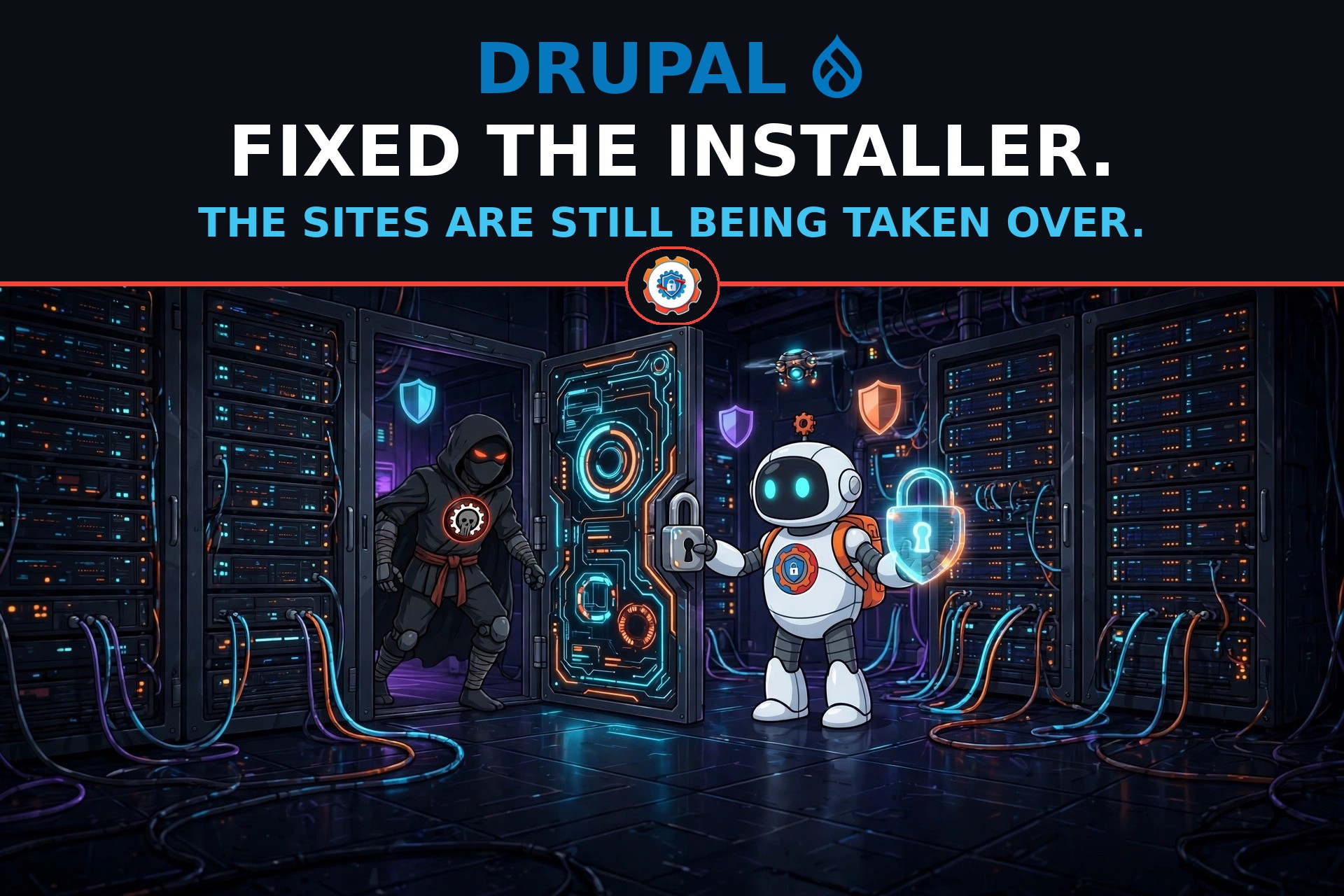
The flaw is tracked as CVE-2026-132165, nicknamed Fail2Install, and it was discovered by Anthropic’s OSS Scanner. It lives in something every Drupal site ships with: the installer. Drupal core includes an install.php file whose job is to set the system up the first time. Under specific conditions, an anonymous user — no account, no login — can abuse that installer to attempt a reinstall of Drupal. A successful reinstall hands the attacker the keys: a full site takeover, or remote code execution on the server underneath.
There is one partial safety net. Some exploit paths are mitigated if the web server cannot write to settings.php or change its permissions. That is a narrow exception, not a fix — it depends on server configuration, and it does not cover every path an attacker can take. The Drupal security team was blunt about the timeline: the flaw has been “exploited on live sites as early as 2026-11-19 19:00 UTC.” That was days before the advisory landed — the exploitation window opened before most site owners knew there was something to patch.

The attack needs no credentials, no phishing email, no victim clicking anything. The attacker simply finds a Drupal site, reaches its installer, and turns the setup process against the site itself. That is what makes this flaw so dangerous: the barrier to entry is an internet connection and a list of targets.
Why it matters
Drupal is not a niche blogging tool. It powers large organizations — government entities, major research universities, and high-profile enterprise and media organizations. A hijacked Drupal site is not just a defaced homepage. It is a trusted domain that can serve malware, harvest credentials, or quietly redirect visitors, all under a name people recognize. Attackers love that: the reputation of the victim does the attacker’s work for them.
The pattern is familiar, and that is exactly the problem. Flaws that need no login and give full control are the ones attackers weaponize first. We saw the same dynamic this week, when a perfect 10.0 flaw in Hex.pm let attackers compromise six servers in minutes — read the full story of Hex.pm’s perfect 10.0, and six servers compromised in minutes. And we saw it again with SonicWall, where an SSL-VPN flaw let attackers through even with MFA switched on. The lesson from both is the same: the window between disclosure and mass exploitation is now measured in hours, not weeks.
CISA’s move underlines the urgency. On Tuesday, November 24, the agency added CVE-2026-132165 to its Known Exploited Vulnerabilities catalog, ordering federal civilian agencies to secure their systems by Friday, November 27. CISA’s own warning is plain: these types of vulnerabilities are a frequent attack vector for malicious cyber actors and pose significant risks to the federal enterprise. Since November 2021, CISA has tagged five Drupal vulnerabilities as abused in the wild — and two were also exploited by ransomware groups.
What to do now
If you run Drupal, treat this as an incident you can still prevent — four checks, in order:
1. Patch now. Upgrade to the latest available Drupal version. This is the fix. Paid Drupal Steward WAF customers are already protected from known attack vectors, but the Drupal team still advises upgrading in case other attack vectors surface. A WAF rule is a shield; the patch removes the hole.
2. Block the installer. If you cannot upgrade immediately, block access to /core/install.php in your web server configuration or in the .htaccess file in the web root. This closes the exact door the attackers are walking through. It is a mitigation, not a cure — keep the upgrade on the schedule — but it buys you the time the patch needs.
3. Check settings.php. Verify that your web server cannot write to settings.php or change its permissions. That writability is what decides whether some exploit paths work at all. If the file is writable by the web server user, tighten it now and treat the site as potentially exposed until you can prove otherwise.
4. Hunt for reinstall artifacts. Check for unexpected administrator accounts, new users or roles you did not create, unfamiliar files or modules, and any sign of a reinstall — changed configuration, reset settings, or content that appeared out of nowhere. If anything looks off, assume the site is compromised and start incident response: take it offline, restore from a known-clean backup, rotate credentials and secrets, and then patch before it comes back.

Drupal sites are being hijacked right now by attackers who need nothing more than an internet connection and an unpatched installer. The fix exists, the deadline is Friday, and the check takes minutes. Patch, block the installer, lock down settings.php, and look for footprints. Your site stays yours only if you act before someone else claims it.
2 thoughts on “Drupal’s Critical RCE Flaw Is Being Exploited. Sites Are Being Hijacked.”