




Boston Scientific Was Breached. 117,789 People’s Medical Data Walked Out.
A Phone Call Opened the Door
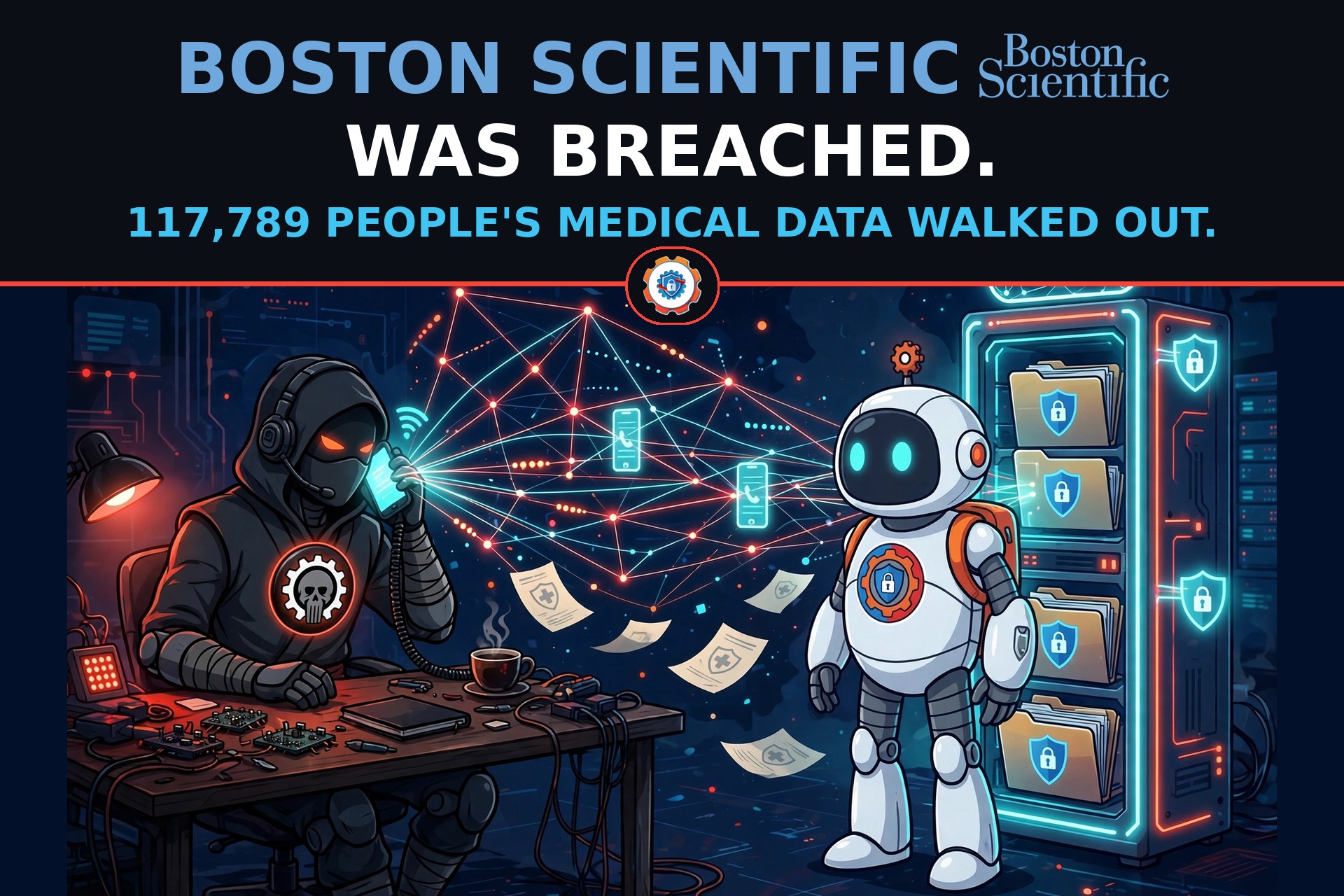
A phone call did what firewalls could not. Boston Scientific, the Massachusetts medical device maker behind stents, catheters, pacemakers, defibrillators and endoscopes, has disclosed a data breach that exposed the personal and medical information of 117,789 people — and the way in started with a voice.
According to the company’s breach notice, a voice-phishing attack — known as vishing — gave an attacker access to Boston Scientific’s cloud IT business applications. The unauthorized access ran from May 7 to May 12, 2026, and data was downloaded during that window. The company spotted the intrusion on May 12, and its investigation concluded on November 5 that a breach had occurred. The figure of 117,789 people affected comes from the Texas Attorney General breach portal.

What Was Taken — and What Was Not
The exposed data is the kind that builds a complete identity kit: full name, physical address, Social Security Number, government-issued ID number such as a passport or state ID card, medical information, health insurance information and date of birth. With that combination, an attacker can open accounts, file false claims and impersonate a victim for years — the Social Security Number and date of birth do not expire the way a password does.
The line the company draws matters just as much. Patient medical records were not exposed, and neither was data from remote monitoring systems, connected medical devices, or clinical case management and workflow applications. Saying “medical information” was exposed is not the same as saying patient records leaked — the breach reached the company’s business systems, not the clinical systems that hold your chart or talk to your device.
That distinction is cold comfort for the people affected, because medical information paired with an insurance number opens a second door: medical identity fraud, where someone else’s care gets billed in your name. Breaches keep starting with a single human moment — an aid agency’s portal exposed 20,614 users earlier this year — and the damage keeps landing on ordinary people, not on the company that was breached.
Why This One Stings
Boston Scientific is not a small vendor. It employs more than 59,000 people, runs 13 manufacturing facilities, operates in 127 countries and took in more than $20 billion in revenue in 2025. The company says the incident caused no disruption to manufacturing, ordering, distribution or service to patients and healthcare providers, and no impact on operations, performance, remote monitoring or product safety. It says it contained the incident, investigated with outside cybersecurity experts and notified law enforcement.
What the breach notice does not offer is free credit monitoring. Instead, it recommends getting free credit reports and considering fraud alerts and credit freezes. That is sound advice the victims now have to act on themselves. When a breach hands out Social Security Numbers and government IDs, the people affected carry the cleanup — and the financial stakes keep climbing, as one bank lost $133 million when its own account was drained.
The Second Incident in 2026
This is Boston Scientific’s second cybersecurity incident of the year, and the company has confirmed the two are unrelated. On August 25, the company disclosed a cyberattack that caused network outages and global operational disruption, hitting order processing and shipping. CrowdStrike’s investigation found that attacker breached an internet-facing network device and pivoted to a limited part of the company’s on-premises IT environment, with no evidence that cloud applications were compromised then.
The new incident is the mirror image: it started with a voice call, not a network device, and it reached the cloud business applications the August attack never touched. Two different doors, two different attackers’ playbooks, one company, one year. That is the pattern worth noticing — an organization can close one gap and still be opened through another, especially when the gap is a person answering the phone.
What to Do Now
If your information may be involved, act on four checks. First, place a credit freeze with each of the three major credit bureaus — it is free, it stops new accounts from being opened in your name, and you can lift it temporarily when you need credit. Second, consider a fraud alert as a lighter-weight companion to the freeze. Third, pull your free credit reports and look for accounts you do not recognize. Fourth, watch for medical identity fraud specifically: read every explanation of benefits statement, and question any treatment, bill or insurer letter you do not recognize.

If you run a company, the lesson is about the help desk. Vishing works because a confident voice on the phone feels like a colleague. Build vishing-resistant verification for IT help-desk and cloud-access requests: no password reset, no access grant and no MFA change on the strength of a call alone. Use phishing-resistant MFA — hardware keys or passkeys, not codes read out over the phone. And make call-back verification the rule: hang up, look up the real number yourself, and call back. A legitimate IT request survives a call-back. An attack does not.
A pacemaker company was not beaten by a zero-day. It was beaten by a phone call, a trusting employee and six days of quiet access. The fix is not a new product. It is a habit: verify first, trust second — every time, on every call.