

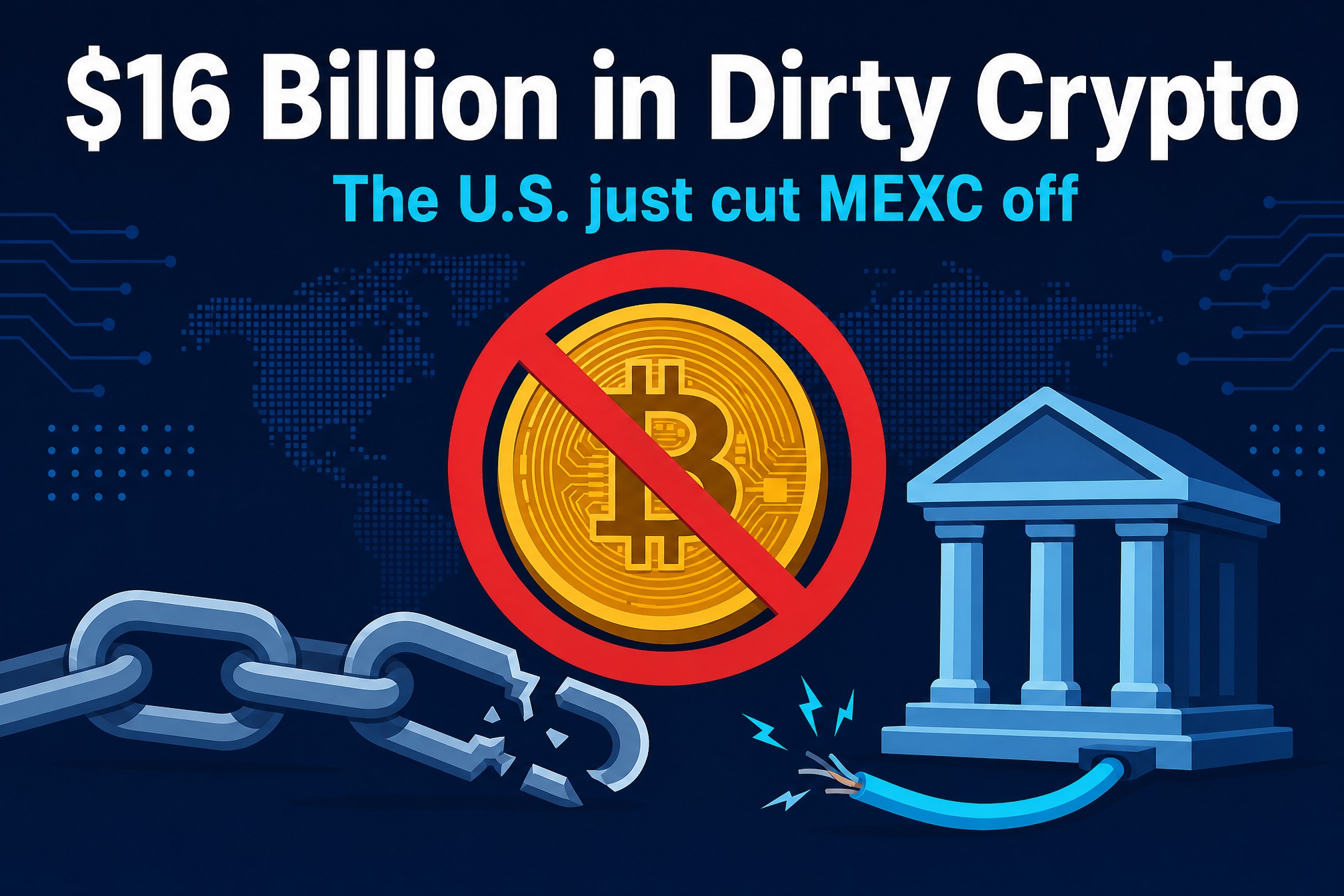









$16 Billion in Dirty Crypto. The U.S. Just Cut the Cord.
The United States just cut one of the world’s biggest crypto exchanges off from the American financial system. The Treasury Department’s Financial Crimes Enforcement Network (FinCEN) issued an order on November 6 barring U.S. financial institutions from doing business with MEXC Global, a Seychelles-based exchange with more than 40 million users in over 170 countries.
The reason, in FinCEN’s words, is that MEXC had become a hub for illicit finance. At least $16 billion in transactions tied to cybercrime and sanctions evasion flowed through the exchange between May 2021 and May 2026.
The numbers behind the ban
FinCEN’s order reads like a charge sheet, and the figures are blunt:
- $16 billion in illicit transactions linked to cybercrime operations and Iranian, North Korean, and Russian sanctions evasion, between May 2021 and May 2026.
- About $1 billion in direct transactions with more than 40 identified Iranian crypto exchangers, some of them already under U.S. and international sanctions.
- At least $226 million in transactions benefiting or connected to the A7 network, a Russia-based sanctions-evasion operation already on the U.S. Treasury’s OFAC sanctions list.
- Transactions with the sanctioned Russian entities Garantex and Grinex were still being processed as recently as June 2026 — five years into the period FinCEN examined.
FinCEN blamed the pattern on deficiencies in MEXC’s anti-money-laundering and customer identification policies — the basic checks that are supposed to stop a regulated exchange from becoming a laundromat. The Treasury Department put it plainly: MEXC “has not only facilitated Russian illicit finance but has also served as a hub for other types of illicit financial activity, including Iranian and DPRK sanctions evasion, ransomware and scam payments, and Russian and other darknet market activity.”
Why an exchange ban matters
Crypto crime needs an off-ramp. A ransomware gang can encrypt a hospital and demand payment in Bitcoin, but Bitcoin alone does not buy houses, pay salaries, or fund a weapons program. At some point the coins have to pass through an exchange, get swapped, and come out the other side as spendable money. That is the moment when the trail goes cold — and it is exactly the moment this order targets.

Cutting MEXC off from the U.S. financial system does not shut the exchange down. It makes it radioactive for anyone who touches dollars: U.S. banks, payment processors, and individuals now face secondary sanctions or enforcement action for transfers to or from MEXC. For a business that once treated crypto as just another payment rail, that turns a counterparty question into a legal one. The same laundering playbook showed up in the French bank heist we covered this week, where attackers converted stolen funds into stablecoins to move them — the bank’s own account was used to move $133 million, and the crypto leg of the escape is what made the money hard to claw back.
What MEXC said
MEXC said its legal and compliance teams have launched a review of its sanctions and anti-money-laundering controls, and that it intends to engage constructively with FinCEN and other regulators. The exchange says it is operating normally and that user assets remain secure, and that it has begun an independent review of its controls.
That is the standard response, and it is worth reading carefully. “Operating normally” is a claim about today, not a guarantee about tomorrow. An exchange cut off from the U.S. financial system can face frozen correspondent accounts, banking partners walking away, and withdrawal restrictions with little warning.
Four checks if you ever touched MEXC
Most readers will never have used MEXC. But crypto moves through supply chains, vendors, and clients, and exposure is not always obvious. Four things worth doing:
1. Stop and document any U.S.-linked transfers. If you are a U.S. person or business and you have moved funds to or from MEXC, pause. The ban exposes those transfers to secondary sanctions or enforcement, and the first thing a lawyer or compliance officer will ask for is a complete record. Pull your transaction history now, while the exchange is still operating.
2. Screen your counterparties. If a vendor, client, or partner pays or gets paid in crypto, ask where the money passes through. A payment routed through a sanctioned exchange can taint a transaction even if you had no idea — the same way stolen credentials can taint an account, as we saw when an AI agent broke into Chainalysis and every password walked out.
3. Move funds you need through compliant channels. If you hold assets on MEXC, do not leave money there that you cannot afford to have frozen. Withdraw through channels with real compliance programs, and keep records of every step. Treat “assets remain secure” as a statement to verify, not a promise to rely on.
4. Treat exchange choice as a security decision. The next MEXC is already operating somewhere, offering low fees and asking few questions. Before using any exchange, check whether it publishes real compliance policies, holds licenses in serious jurisdictions, and has survived a regulatory look. The cheapest on-ramp is often the one with the weakest checks — and weak checks are what criminals pay for.
FinCEN’s order does not end crypto crime, and it does not need to. It raises the cost of doing it through the biggest, most convenient doors — and every door that closes pushes the next scheme toward smaller, riskier, more visible channels.